
Virtual Team Productivity Checklist for Support Teams
Virtual Team Productivity Checklist for Support Teams ! Support manager reviewing productivity checklist Run async-first rules, a shared inbox operating standard (assign every thread, prevent collisions, publish SLAs), and three KPIs (first response time, resolution time, backlog

Run async-first rules, a shared inbox operating standard (assign every thread, prevent collisions, publish SLAs), and three KPIs (first response time, resolution time, backlog) in a focused 2–4 week rollout. Teams that apply structured remote frameworks report 35% higher engagement and 28% lower turnover versus ad hoc management. Sendsync connects to Gmail or Microsoft 365 in minutes, no DNS changes required, making it one of the fastest ways to get the inbox side of this checklist live.
The one-sentence version: Assign every thread, cap meetings at 4 hours per person per day, and track first response time, resolution time, and backlog from day one.
Table of Contents
- What does your virtual team productivity checklist look like in 30 days?
- How should you design async-first communication for a support team?
- What operating rules make a shared inbox actually work?
- How do you get a shared inbox live fast without DNS delays?
- Which KPIs actually tell you if your support inbox is healthy?
- Should you fix your systems or hire more agents?
- What does a 2–4 week rollout actually look like?
- How do you prioritize tickets inside a shared inbox workflow?
- How should you handle complex or escalated customer issues remotely?
- How do you keep a remote support team motivated and mentally healthy?
- How do you onboard new agents to a virtual support environment?
- Key Takeaways
- Why small systems beat more headcount when inboxes get noisy
- Sendsync gets the inbox side of this checklist live fast
- Research citations and further reading
What does your virtual team productivity checklist look like in 30 days?
Work through this in order. Each item has an owner and a clear “done” signal.
Day 0–3
- Create a single decision log (a shared doc or pinned channel post) where every policy call gets recorded with a date and owner.
- Pick one async channel for internal status updates; ban status questions from customer-facing threads.
- Publish response-time SLAs for every channel: urgent inbox tickets (2 hours), standard inbox (4 hours), internal async channel (end of business day).
- Enable assignment rules in your shared inbox so every incoming thread gets an owner before anyone replies.
Week 1
- Set a meeting-time cap of 4 hours per person per day and block protected deep-work windows (no meetings before noon works for most support teams).
- Identify your top 10 request types and deploy a template or snippet for each. These 10 types almost always account for the majority of volume.
- Map escalation rules: who handles VIPs, what triggers a tier-2 handoff, and where that handoff is documented.
Weeks 2–4
- Instrument the three primary KPIs: first response time, median resolution time, and open backlog by priority tier.
- Run a two-week meeting and channel audit to surface where time leaks.
- Train every agent on assignment workflows and collision-prevention patterns in the shared inbox.
Pro Tip: Start with the 20% of request types that create 80% of your volume. Build templates and routing rules there first. Everything else can wait.
Teams that apply this kind of structured framework report outcomes including 35% higher engagement and 28% lower turnover. The checklist is the mechanism; the framework is why it works.
How should you design async-first communication for a support team?
Async-first architecture is the core design principle of high-performing remote support teams. The common mistake is treating remote work like an in-office experience and defaulting to calls for everything. Reserve synchronous time for decisions, conflict resolution, and new-agent onboarding. Everything else goes async.
Channel roles:
- Decision log: Any policy or process call gets written here, dated, and owned.
- Async status channel: Ticket notes, shift handoffs, and progress updates. No customer threads here.
- Shared inbox: All customer-facing communication. One thread, one owner.
- Meetings: Decision-only, with a published agenda sent 24 hours in advance.
Target a synchrony ratio of 40% or less. That means roughly two-thirds of your team’s communication happens in writing, not on calls. Weekly 1-on-1s should focus on priorities and blockers, not status updates your manager could read in the ticket notes.
Pro Tip: Before changing any rituals, run a two-week calendar audit. Export everyone’s calendar and count actual meeting hours. Most teams are shocked by what they find.

Remote teams that document async reply expectations and target 80%+ of written replies within one business day avoid the slow drift back to direct messages and ad hoc calls. Publish that SLA alongside your inbox SLAs so the whole team sees the same standard.
What operating rules make a shared inbox actually work?
One rule above all: explicit assignment before reply. No thread gets a response without an owner on record.
Core operating rules:
- Status markers: Every thread sits in one of four states: open, working, pending (waiting on customer), or closed. Agents update status before they leave a thread.
- Collision prevention: Use your inbox tool’s soft-lock or reservation mechanism. If yours lacks one, a simple “I’m on this” note in the thread before typing prevents duplicate replies.
- Template library: Maintain a curated set of snippets for your top 10 request types. Require one edit for personalization before sending. A template sent verbatim reads like a template.
- Tag taxonomy: Keep tags flat and functional (billing, technical, VIP, escalation). Map each tag to a routing rule and an SLA tier.
| Rule | Why it matters | Acceptance test |
|---|---|---|
| Assign before reply | Prevents duplicate responses | Zero unassigned threads in “working” state |
| Status markers | Gives team visibility without a meeting | Every open thread has a current status |
| Collision prevention | Stops two agents typing at once | No duplicate replies in a 2-week audit |
| Template + one edit | Speeds response, keeps it human | Template use rate >60%, CSAT unchanged |
| Tag every thread | Enables routing and SLA tracking | <5% untagged threads per week |
Security and privacy: Limit mailbox access to agents who need it. Require multi-factor authentication on every account. Document your data-handling procedures in the team handbook, including what customer data can appear in internal notes and how long threads are retained. Least-privilege access is not optional when customer PII is in the inbox.
Pro Tip: For inbox delegation patterns that scale, assign a primary owner and a backup per thread type, not per agent. Backup coverage prevents SLA breaches during PTO without a full reassignment workflow.
How do you get a shared inbox live fast without DNS delays?
Sendsync connects to Gmail or Microsoft 365 via OAuth, not IMAP or DNS-level configuration. That means you can have a working shared inbox in under a business day.
- Connect your mailbox using OAuth (not IMAP). OAuth avoids the token-refresh and permission-scope issues that slow IMAP setups.
- Choose delegated mailbox access over alias-only access. Aliases route mail in; delegation lets agents act on threads.
- Run a permission audit before go-live. Service account permission gaps are the most common cause of delayed setups.
- Test the assignment flow with two agents before opening to the full team. Send a test thread, assign it, reply, and close it.
- Load your snippet library before training. Agents learn faster when real templates are already in the tool.
For Microsoft 365 integrations, confirm that the connecting account has “Send As” permissions on the shared mailbox, not just “Full Access.” Missing that one permission is the most common setup delay.
Pro Tip: Build a one-page onboarding doc: inbox URL, login method, assignment steps, top 5 templates, and escalation path. New agents should be handling live threads within 30 minutes of their first login.
Which KPIs actually tell you if your support inbox is healthy?
Three metrics do most of the work: first response time, median resolution time, and open backlog by priority. Track those first. Add the rest once the team has a baseline.
| Metric | Formula | Target | Owner |
|---|---|---|---|
| First response time | Time from thread creation to first agent reply | <2 hrs (urgent), <4 hrs (standard) | Team lead |
| Median resolution time | Median time from open to closed | Varies by tier; set at week 2 | Team lead |
| Open backlog | Count of open threads by priority | Flat or declining week-over-week | Manager |
| Agent workload distribution | Open threads per agent | Within 20% of team average | Manager |
| CSAT trend | Survey score over rolling 4 weeks | Stable or improving | Support manager |
| Async reply SLA | % of written replies within one business day | 80%+ | Team lead |
Outcome-based KPIs outperform activity signals like time online or app usage. Tracking whether work got done at the expected quality beats tracking whether agents were visibly active.
Reporting cadence:
- Daily: Backlog count and SLA breach alerts (automated dashboard).
- Weekly: Team review of trends, workload distribution, and CSAT.
- Monthly: Leadership review of system health, template coverage, and hiring signals.
Should you fix your systems or hire more agents?
Fix the system first. Adding people to a broken process multiplies the broken output; it does not dilute it.
Decision checklist:
- Backlog growing + template coverage below 60% + async reply SLA below 80%: fix the system. You have a process gap, not a capacity gap.
- Backlog growing + templates mature + routing optimized + SLA consistently above 80%: now consider hiring.
- Repeated SLA misses with no identifiable process gap: audit agent workload distribution before posting a job.
Pro Tip: Run a two-week experiment before committing to headcount. Apply one targeted system fix (a new routing rule, a template for your highest-volume request type) and measure backlog movement. If backlog drops, you had a system problem. If it holds flat, capacity is the constraint.
Visibility across email threads is often the hidden variable. Teams that can see who owns what, and what is sitting unresolved, make better hiring decisions because the data is real, not anecdotal.
What does a 2–4 week rollout actually look like?
A 90-day phased approach works for full operating system rollouts. For inbox-focused teams, a tighter 2–4 week sprint gets you to measurable results faster.
- Day 3 checkpoint: Decision log live, SLAs published, assignment rules enabled. Sign-off: team lead confirms zero unassigned threads in the first 48 hours.
- Day 14 checkpoint: Templates deployed for top 10 request types, meeting cap enforced, KPI dashboard live with baseline data. Sign-off: manager reviews first two weeks of first response time data.
- Day 30 checkpoint: Two-week audit complete, escalation rules tested, CSAT baseline established. Sign-off: leadership reviews system health against the three primary KPIs.
Launch day checklist:
- Shared inbox connected and tested
- All agents assigned and permissions verified
- Top 10 templates loaded
- SLAs published in team channel
- Escalation path documented
Day 30 retro template: Did first response time improve? Is backlog flat or declining? Are agents using templates? What broke? What gets fixed in week 5?
How do you prioritize tickets inside a shared inbox workflow?
Not all tickets are equal, and treating them as if they are is one of the fastest ways to miss SLAs on the issues that matter most.
A simple three-tier priority model works for most support teams. Tier 1 covers urgent issues: service outages, billing errors, and VIP accounts. These get a 1-hour first response target and skip the standard queue. Tier 2 covers standard requests with clear resolution paths. Tier 3 covers low-urgency items like feature requests or general inquiries.
Tag every incoming thread at assignment. Routing rules should automatically surface Tier 1 threads at the top of the queue, regardless of arrival time. Agents should never have to manually sort for urgency.
The Eisenhower matrix (urgent vs. important) translates cleanly to inbox work. A billing dispute is urgent and important. A product question is important but rarely urgent. A newsletter unsubscribe is neither. Build your SLA tiers around that logic, not around first-in, first-out.
How should you handle complex or escalated customer issues remotely?
Complex issues fail in virtual environments for one reason: context gets lost in handoffs. The fix is documentation before escalation, not after.
Before escalating any thread, the handing agent writes a two-sentence summary directly in the thread: what the customer reported, what was tried, and what is still unresolved. The receiving agent reads it before touching the thread. That single habit eliminates most of the “I already told the last agent” complaints.
For automating parts of the escalation path, routing rules can flag threads that have been open beyond a set threshold and auto-assign them to a senior agent or manager queue. That removes the dependency on an agent remembering to escalate.
VIP escalation deserves its own documented path. Define who qualifies as a VIP, what their SLA tier is, and which agent or team handles their threads. Publish that path in the team handbook so it is never a judgment call in the moment.
How do you keep a remote support team motivated and mentally healthy?
Burnout in remote support teams usually shows up in the metrics before it shows up in a conversation. Rising resolution times, declining CSAT, and increasing backlog are often early signals of a team running on empty, not a process failure.
Weekly 1-on-1s focused on priorities and blockers, not status updates, give managers an early read on how agents are actually doing. Keep them to 30 minutes. Ask what is in the way, not what got done.
Protected deep-work blocks matter more than most managers realize. An agent who spends the entire day in reactive mode, jumping between threads and messages, never gets the cognitive space to handle complex issues well. Block at least 90 minutes per day where no meetings are scheduled and async messages can wait.
Recognition does not require a ceremony. A specific, public callout in the team channel (“You handled that billing escalation cleanly and the customer noticed”) costs nothing and lands better than a generic “great job.” Specificity is what makes recognition feel real.
How do you onboard new agents to a virtual support environment?
The goal of onboarding is a new agent handling live threads independently within their first week, not their first month.
Start with the inbox before anything else. Walk new agents through the assignment workflow, the status markers, and the top 10 templates on day one. Everything else (product knowledge, escalation paths, edge cases) can layer in over the following days.
A 30-minute live walkthrough beats a 30-page handbook. Record it so agents hired later get the same start. Pair each new agent with a buddy who handles their first five threads alongside them, not instead of them.
The async inbox design should be part of the onboarding script. New agents who understand why threads are assigned before reply, and why status markers exist, follow the rules more consistently than agents who just see a checklist.
Document the escalation path on day one. New agents should never have to guess who handles a VIP complaint or a billing dispute. That information belongs in the onboarding doc, not in someone’s head.
Key Takeaways
A focused 2–4 week rollout with async-first rules, explicit thread assignment, and three tracked KPIs is the fastest path to measurable productivity gains for a virtual support team.
| Point | Details |
|---|---|
| Assign before reply | Every thread needs an owner before anyone types a response. |
| Publish SLAs on day one | Urgent inbox: 2 hours; standard: 4 hours; internal async: end of business day. |
| Cap meeting time | Limit meetings to 4 hours per person per day and protect deep-work blocks. |
| Track three KPIs | First response time, median resolution time, and open backlog drive all other decisions. |
| Sendsync fast setup | Sendsync connects Gmail or Microsoft 365 via OAuth with no DNS changes, getting teams live in under a business day. |
Why small systems beat more headcount when inboxes get noisy
The instinct when a support inbox gets overwhelming is to hire. It feels decisive. The problem is that a new agent dropped into a chaotic inbox learns the chaos, not the craft. They replicate the patterns already there, including the slow response times and the missed escalations.
The 35% engagement and 28% turnover improvements cited earlier do not come from adding people. They come from giving people a system that makes their work legible. When agents know what they own, what the SLA is, and where to escalate, they can actually do the job well. That clarity is what drives engagement.
Treating the remote team operating system as a product worth measuring changes how managers think about it. A product gets iterated. It gets a retro. It gets fixed when a metric moves the wrong way. Most teams treat their communication norms as a one-time setup and then wonder why they degrade.
The 90-day phased rollout idea is worth taking seriously even for smaller teams. Audit first, then layer in rituals, then turn on metrics. Skipping the audit phase is why most rollouts stall at week two.
Sendsync gets the inbox side of this checklist live fast
Most of the governance work in this checklist (SLAs, escalation paths, meeting caps) requires team decisions, not software. But the inbox setup piece, connecting a Gmail or Microsoft 365 mailbox, enabling assignment rules, loading templates, and giving every agent access without per-seat fees, is exactly where Sendsync removes friction.
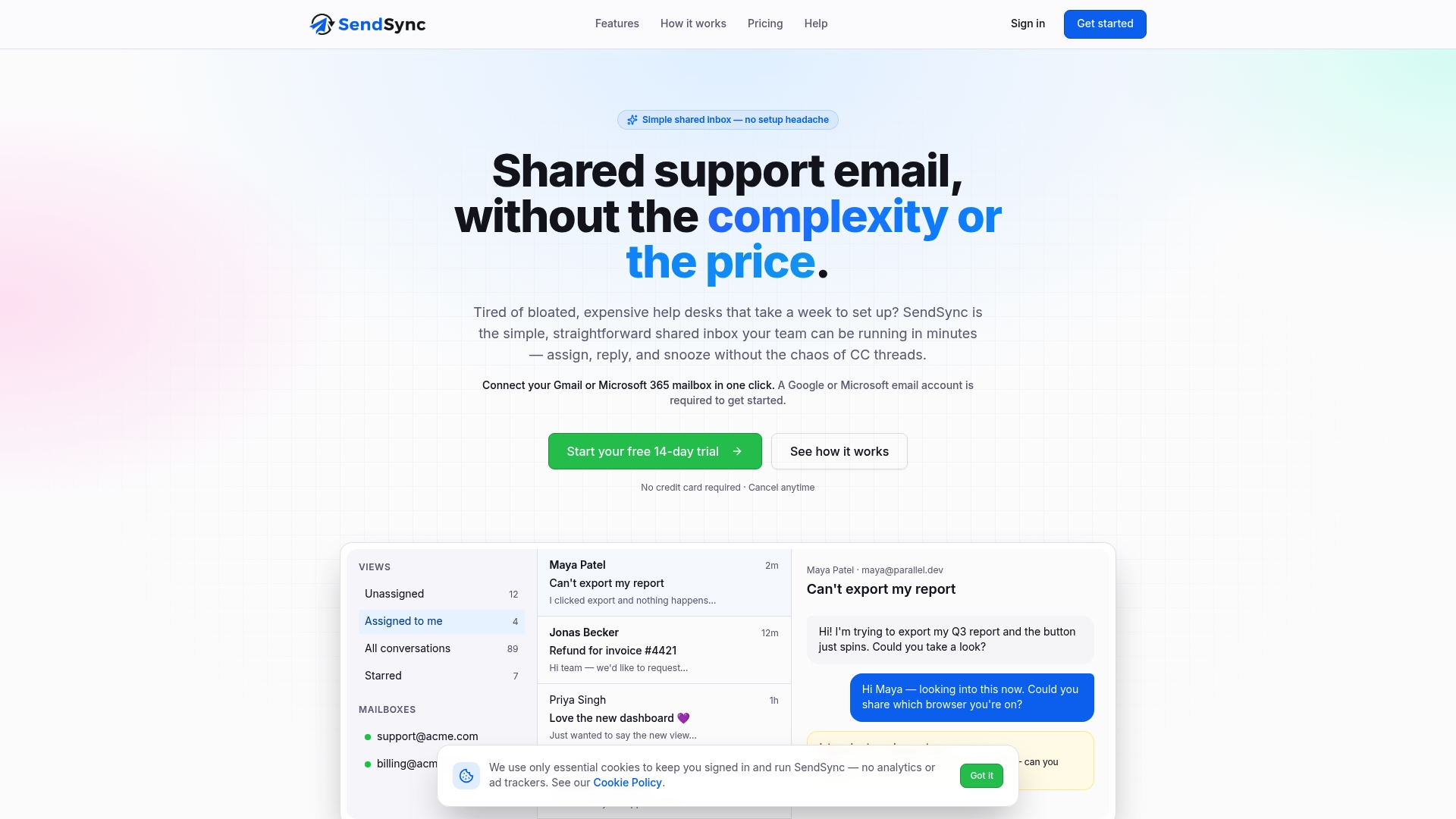
Sendsync connects via OAuth, skips DNS configuration entirely, and has teams assigning and replying in a shared inbox within a single business day. The unlimited-user pricing model means you are not penalized for onboarding the whole team at once. Assignment rules, collision prevention, and a template library are built in, which maps directly to the Day 0–3 and Week 1 items in the checklist above.
The governance work still belongs to your team. Sendsync handles the infrastructure so that work is not delayed by a two-week IT setup. Start with the shared inbox and build the rest of the operating system around it.
Research citations and further reading
- Remote Team Management Guide 2026
- Team Productivity Checklist
- How to Build a Remote Work Productivity System in 2026
- How to Build a Remote Team Operating System (2026 Playbook)
- Remote Team Management Checklist for Top Scaling Businesses
- Automate Customer Service Operations: 2026 Enterprise Guide