
Microsoft 365 Team Collaboration Benefits for Professionals
Microsoft 365 Team Collaboration Benefits for Professionals ! Professional woman collaborating with Microsoft 365 tools Microsoft 365 is defined as an integrated platform that unifies chat, file sharing, meetings, and task management into a single workspace for professional teams

Microsoft 365 is defined as an integrated platform that unifies chat, file sharing, meetings, and task management into a single workspace for professional teams. The microsoft 365 team collaboration benefits go well beyond convenience. Teams that consolidate communication inside one platform reduce the context-switching that kills focus and slows decisions. SharePoint, OneDrive, and Microsoft Teams work together as a connected system, not separate tools, and that integration is what separates real productivity gains from surface-level feature adoption.
1. How Microsoft 365 team collaboration benefits your communication structure
Persistent chat channels are the foundation of effective internal communication inside Microsoft Teams. Unlike email threads that fragment context across inboxes, channels keep every conversation, file, and decision in one searchable place. Teams can create dedicated channels for projects, departments, or recurring topics, so nothing gets buried.

The practical result is less noise. When your team routes internal questions to chat and reserves email for external audiences, information overload drops significantly. That separation alone changes how quickly teams respond and how clearly they think.
Key communication improvements you get from persistent channels:
Organized by purpose: Each channel maps to a specific project or function, so context is always clear.
Searchable history: Every message, file, and link stays findable, even months later.
Reduced CC chains: Internal updates stay in channels instead of cluttering inboxes.
Async-friendly: Team members in different time zones contribute without waiting for live meetings.
Pro Tip: Match message type to channel. Use chat for quick questions, channel posts for updates that need a record, and calls only when an async thread has stalled for more than 24 hours.
2. External collaboration through guest access and secure sharing
Microsoft 365 lets external partners join your workspace without requiring a Microsoft account. Guest users access chats and channels using just their email address. That removes the friction that typically slows down cross-organizational projects.
This matters most when you work with suppliers, clients, or contractors on a recurring basis. Instead of sending files back and forth over email, external guests can view, comment on, and co-edit documents directly inside Teams. SharePoint handles the permission layer, so you control exactly what each guest can see.
Benefits of guest access for external collaboration:
No account setup required: Guests join via email invitation, not IT provisioning.
Scoped permissions: You grant access at the channel level, not the entire organization.
Shared file history: All edits and comments stay in one place, visible to all parties.
Reduced email chains: Project updates happen inside the channel, not across scattered inboxes.
Teams that use guest access report faster feedback cycles on shared documents and fewer version-control problems. The alternative, sending attachments over email, creates duplicate files and breaks the audit trail.
3. Integrated file management with SharePoint and OneDrive
SharePoint provides team-level document governance; OneDrive is for personal file storage. That distinction matters more than most teams realize. When you store a file in a Teams channel, it automatically saves to the SharePoint library linked to that channel. When you work on a personal draft, OneDrive is the right location.
Mixing these up creates governance problems. A contract stored in someone’s OneDrive is invisible to the rest of the team. A draft stored in SharePoint before it’s ready creates confusion. Getting the structure right from day one prevents data silos and keeps compliance audits clean.
Tool | Best used for | Governance level |
|---|---|---|
SharePoint | Team-owned, shared content | High: permissions, versioning, audit logs |
OneDrive | Personal drafts and individual files | Low: owner-controlled |
Microsoft Teams | Active collaboration and channel files | Inherits SharePoint governance |
Pro Tip: When you create a new Teams channel, immediately check the linked SharePoint folder and set the correct permissions. Waiting until files accumulate makes cleanup far harder.
4. App integrations and automation that reduce manual work
Microsoft Teams integrates over 700 third-party apps, including Planner, Power BI, and Zendesk, directly into the workspace. That number is significant because it means most teams can consolidate their tool stack without switching platforms. Every app you remove from the daily rotation reduces the cognitive load on your team.
Bots add another layer of efficiency. WhoBot and similar automation tools handle routine queries like “Who owns this project?” or “What’s the status of this ticket?” without requiring a live person to respond. That frees up senior team members for work that actually requires judgment.
Practical apps worth adding to your Teams workspace:
Planner: Visual task boards linked directly to channel conversations.
Power BI: Live dashboards embedded in tabs so data is always current.
Approvals: Structured sign-off workflows without leaving Teams.
Forms: Collect structured input from team members or clients inside a channel.
Pro Tip: Follow a phased adoption approach: start with channels and meetings, then add file collaboration, then introduce third-party apps. Teams that try to adopt everything at once see lower usage across all features.
5. Async communication strategies that cut meeting overload
Async-first communication reduces time wasted in meetings and creates a searchable record that distributed teams can reference later. The principle is simple: default to written updates, and schedule live calls only when a thread has genuinely stalled. Most status updates, approvals, and decisions do not require a meeting.
Microsoft 365 supports this approach through several built-in features. Channel posts with threaded replies keep discussions organized. Topics let teams tag and surface key decisions without burying them in chat. Meeting recordings and transcripts mean that anyone who missed a call can catch up without a follow-up meeting.
Best practices for async communication inside Microsoft 365:
Write channel posts for any update that needs a record or a decision.
Use @mentions to notify specific people instead of broadcasting to the whole channel.
Set channel notifications to “only mentions and replies” to protect focus time.
Pin key decisions to the top of the channel so they stay visible.
Reserve video calls for brainstorming sessions or situations where tone matters.
The teams that get the most from Microsoft 365 collaboration tools are the ones that treat async as the default, not the fallback. Documenting decisions in Topics and maintaining thread discipline cuts meeting volume without losing alignment.
6. How Microsoft 365 unifies the full collaboration workflow
Microsoft 365 is a platform, not isolated apps. Productivity gains come from running conversations, edits, and tasks inside a single environment. When your team edits a Word document inside Teams, leaves comments in the margin, and resolves them in the linked channel thread, the entire workflow stays connected.
That integration removes the most common collaboration tax: switching between tools to find context. A team member who needs to review a decision no longer has to check email, a project board, a chat app, and a shared drive separately. Everything links back to the Teams channel where the work happened.
The collaboration tools for businesses that deliver the most value are the ones teams actually use consistently. Microsoft 365 succeeds here because the tools are connected by design, not bolted together after the fact. SharePoint, OneDrive, Teams, Planner, and the app marketplace all share the same identity and permission layer, which means access control is consistent across every tool.
Key Takeaways
Microsoft 365 delivers its strongest collaboration benefits when teams use SharePoint, OneDrive, and Teams for their intended purposes and adopt async communication as the default.
Point | Details |
|---|---|
Persistent channels beat email threads | Channel-based communication keeps context searchable and reduces inbox noise for internal teams. |
Guest access removes external friction | External partners join via email with no Microsoft account required, speeding up cross-org projects. |
SharePoint and OneDrive serve different roles | SharePoint governs shared team content; OneDrive holds personal drafts. Mixing them creates data silos. |
Async-first cuts meeting overload | Defaulting to written channel updates and using calls only when threads stall saves significant time. |
Phased app adoption improves uptake | Starting with channels and meetings before adding third-party apps prevents feature fatigue. |
What I’ve learned from watching teams misuse Microsoft 365
Most teams that struggle with Microsoft 365 are not missing features. They are using the wrong tool for the job. I have seen organizations store client contracts in personal OneDrive folders, run every update as a live meeting, and treat Teams channels as a dumping ground for files that belong in SharePoint. The platform works. The habits around it often do not.
The single biggest shift I advocate for is treating async communication as the professional default, not a workaround. When teams write channel posts instead of scheduling calls, they create a record that new hires can read, that managers can reference, and that auditors can trace. That record has real organizational value.
The second thing I push hard on is phased adoption. Teams that try to activate every Microsoft 365 feature in week one end up using none of them well. Start with channels. Get the communication norms right. Then layer in file governance, then app integrations. The platform rewards patience.
The teams I have seen get the most from Microsoft 365 are the ones that treat it as a single environment, not a collection of separate apps. When conversations, files, and tasks all live in the same place, the collaboration benefits compound over time.
— Nick
Sendsync and Microsoft 365: handling the inbox side of collaboration
Microsoft 365 handles internal collaboration well. The gap most teams hit is external email, where support requests, client messages, and vendor threads still pile up in shared inboxes with no clear ownership.
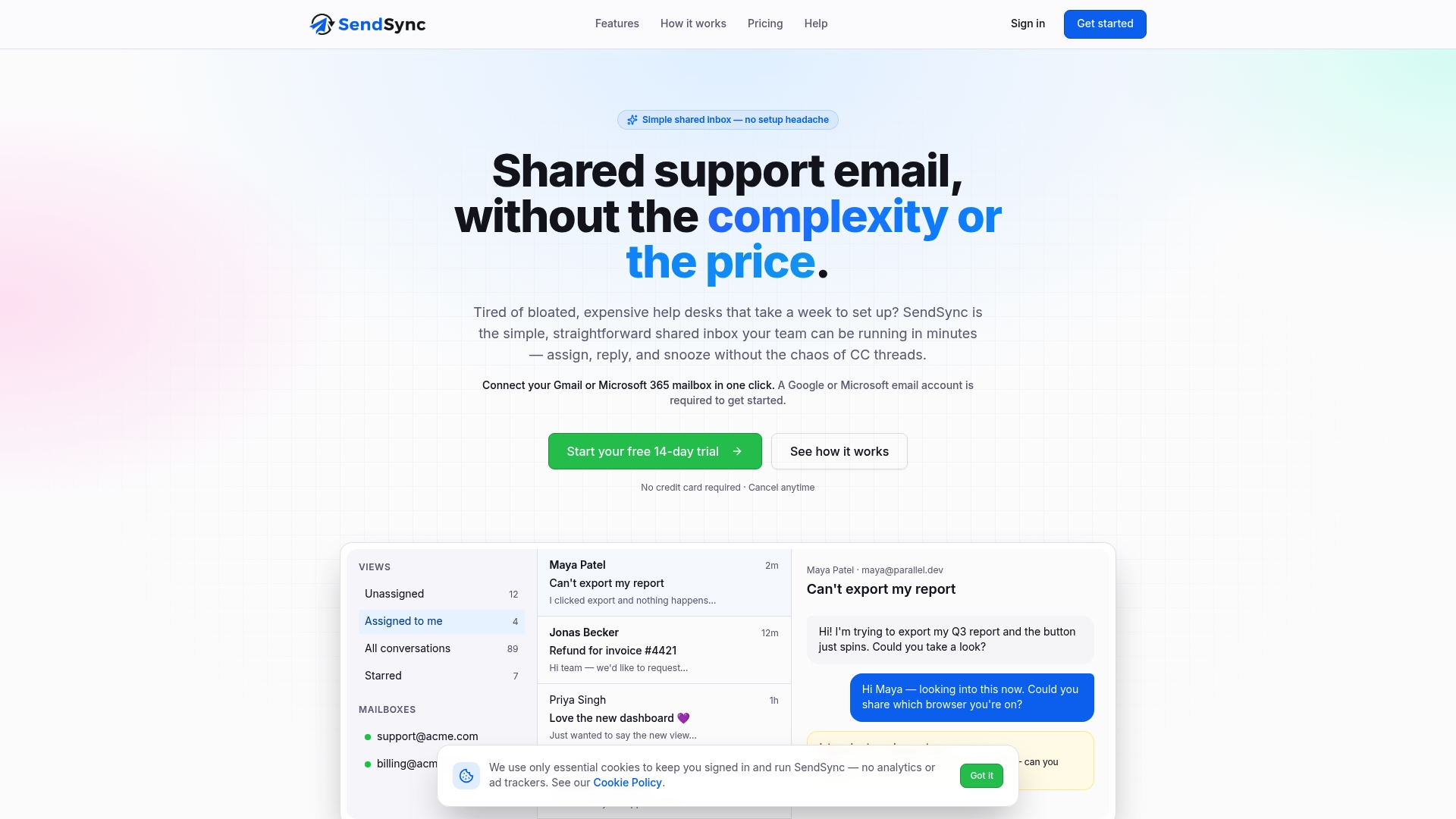
Sendsync fills that gap directly. It connects to your Microsoft 365 mailbox in minutes, with no DNS configuration or long setup process. Your team can assign conversations, reply together, and track every thread from a single shared inbox for teams without per-seat fees. If your team is already seeing the benefits of Microsoft 365 collaboration tools internally, Sendsync extends that same clarity to your external email. Teams that use both report faster response times and far less inbox chaos. You can also explore Microsoft 365 inbox setup guidance to get the full picture.
FAQ
What are the main Microsoft 365 team collaboration benefits?
Microsoft 365 unifies chat, file sharing, meetings, and task management into one platform. The core benefits include reduced email overload, persistent searchable communication, and integrated file governance through SharePoint and OneDrive.
How does Microsoft Teams reduce email overload?
Microsoft Teams replaces internal email threads with persistent chat channels, keeping conversations organized by topic and searchable over time. Teams that route internal updates to channels report significantly less inbox noise.
Can external partners collaborate inside Microsoft 365?
Yes. Guest users can join Teams chats and channels using just their email address, with no Microsoft account required. SharePoint manages the permission layer so you control exactly what each guest can access.
What is the difference between SharePoint and OneDrive in Microsoft 365?
SharePoint stores team-owned content with governance controls like versioning and audit logs. OneDrive is for personal drafts and individual files. Files shared in a Teams channel automatically save to the linked SharePoint library.
How many apps does Microsoft Teams support?
Microsoft Teams supports over 700 third-party app integrations, including Planner, Power BI, and Zendesk. That breadth lets most teams consolidate their tool stack without leaving the Teams environment.