
Benefits of a Unified Team Inbox for Business Teams
Benefits of a Unified Team Inbox for Business Teams ! Businesswoman using tablet in coworking space A unified team inbox is a single platform that consolidates all customer communications from email, chat, SMS, and social channels into one shared workspace.

A unified team inbox is a single platform that consolidates all customer communications from email, chat, SMS, and social channels into one shared workspace. Teams that adopt this model gain faster response times, clearer accountability, and measurably higher conversation capacity. The benefits of unified team inbox adoption go beyond convenience. They directly affect revenue, customer satisfaction, and how efficiently your team operates every day.
1. How a unified team inbox increases productivity
A unified team inbox removes the single biggest drain on agent time: switching between tools. When every message from every channel lives in one screen, agents stop losing minutes to tab switching, login prompts, and missed notifications.

The productivity numbers are concrete. Team members using a unified inbox handle 60–70 conversations daily, compared to 45 in multi-tool setups. That is a 44% increase in individual capacity without adding headcount. For a team of five agents, that difference equals the output of roughly two additional people.
Fewer tools also mean fewer errors. Agents who work from one interface are less likely to miss a message, reply twice, or lose a thread in a secondary app. The result is a tighter, faster workflow that scales without chaos.
All channels visible in one dashboard, no tab switching required
Conversation assignment prevents agents from working the same ticket twice
Workload balancing keeps no single agent buried while others sit idle
Faster context loading means agents spend time replying, not searching
Pro Tip: Set up automatic routing rules on day one. Routing by keyword or channel type cuts manual triage time and gets messages to the right agent without a supervisor in the loop.
2. Team collaboration advantages of a shared inbox
Shared visibility is the foundation of collaborative email management. When every agent sees the full conversation queue, no message hides in a personal inbox waiting for one person to return from vacation.
A shared inbox gives teams four specific collaboration tools that individual email accounts cannot replicate:
Collision detection. The system shows in real time which agent is already handling a conversation. This prevents two agents from sending conflicting replies to the same customer.
Internal notes. Agents leave private comments inside a thread visible only to the team. Customers never see these notes, but agents get full context before they reply.
Conversation assignment. A supervisor or the system itself assigns threads to specific agents, creating clear ownership and accountability.
Smooth handoffs. When an agent transfers a conversation, the receiving agent sees the full history. No customer has to repeat themselves.
Collision detection shows agents who is handling what in real time and eliminates duplicate responses. That feature alone prevents a common and embarrassing customer experience failure.
Pro Tip: Use internal notes to flag VIP customers or escalation risks before assigning a thread. The next agent opens the conversation already knowing what matters.
3. How unified inbox technology improves customer experience
Customer experience lives or dies on response speed. Responding within 5 minutes increases lead conversion likelihood by 100 times compared to a 30-minute response. A unified inbox makes that speed achievable at scale because agents see every message the moment it arrives, regardless of channel.
Complete conversation history is the second major customer experience driver. When a customer contacts support for the third time, the agent already knows the full story. There is no “Can you describe your issue again?” moment. That continuity builds trust and shortens resolution time.
Zero missed messages is the third pillar. Unified inbox platforms consolidate communication from Instagram, WhatsApp, email, and web chat into one interface. No channel goes dark because no one checked it.
Faster first response converts more leads before they contact a competitor
Full conversation history eliminates repetitive customer explanations
Multichannel visibility means no inquiry falls through the cracks
AI drafting features help agents reply faster without sacrificing quality
Teams that adopt unified inboxes report a 15% increase in conversion rates from inquiries to sales. That figure reflects the direct revenue impact of better service and faster responses working together.
4. Analytics and automation benefits of a unified inbox
Centralized data is one of the most underrated team inbox advantages. When all conversations flow through one platform, every metric becomes measurable from a single dashboard.
Unified inbox analytics provide insights on response times, conversation volumes, team performance, and customer satisfaction scores. Managers no longer need to pull reports from four separate tools and reconcile the numbers manually. One dashboard shows the full picture.
Metric | What it measures | Why it matters |
|---|---|---|
First response time | Minutes from message receipt to first reply | Directly tied to lead conversion and satisfaction |
Conversation volume | Total threads handled per agent per day | Reveals capacity gaps and overload risks |
Resolution time | Time from first contact to closed ticket | Measures efficiency of the full support cycle |
Customer satisfaction score | Post-conversation rating from customers | Tracks service quality over time |
Automation compounds these gains. AI-powered routing assigns incoming emails to the right agent based on skill or current workload. Cases are created automatically from emails, so agents never manually log a ticket. These automations remove administrative work and let agents focus on actual conversations.
5. Which teams benefit most from a unified inbox
Not every team feels the impact equally. The teams that gain the most are those handling high volumes of inbound communication across more than one channel.
Customer support teams managing email, chat, and social inquiries simultaneously see the clearest productivity gains. Multichannel volume is exactly the problem a unified inbox solves.
Sales teams handling inquiries across email, SMS, and chat benefit from faster response times and the conversion rate improvements that follow.
Professional services firms coordinating client communication across multiple accounts use unified inboxes to keep every client thread organized and assigned. Managing multiple clients in a single inbox prevents the confusion that comes with siloed personal accounts.
Remote and distributed teams gain the most from shared visibility. When agents work across time zones, a unified inbox ensures no conversation sits idle during a handoff between shifts.
Remote team collaboration is particularly difficult without a shared inbox. Distributed teams that rely on forwarded emails and personal accounts create gaps that customers notice immediately.
Setup is also simpler than most teams expect. Forwarding group email addresses like support@, sales@, and info@ to a unified inbox platform consolidates all departmental messages without rebuilding your email infrastructure.
6. How to use a unified inbox without disrupting your current workflow
Adoption fails most often not because the tool is wrong but because the rollout is abrupt. Teams that switch overnight from personal inboxes to a shared platform often revert to old habits within weeks.
The most effective approach is incremental. Start with one channel, typically email, and one team, typically customer support. Let agents build comfort with assignment, internal notes, and collision detection before adding SMS or social channels. Confidence in the core workflow makes adding channels feel like an upgrade, not an overhaul.
Clear ownership rules matter from day one. Every agent needs to know who handles what. Without assignment rules, a shared inbox can feel like a shared responsibility, which often means no one takes responsibility. Define routing logic, set response time targets, and review the analytics dashboard weekly to catch problems early.
Pro Tip: Run a two-week pilot with your highest-volume channel before full deployment. The data from that pilot will show exactly where routing rules need adjustment before the whole team is on the platform.
Key takeaways
A unified team inbox delivers measurable gains in productivity, collaboration, and customer satisfaction by consolidating all communication into one shared platform.
Point | Details |
|---|---|
Productivity jumps 44% | Agents handle 60–70 conversations daily versus 45 in multi-tool setups. |
Collision detection prevents errors | Real-time visibility stops two agents from sending conflicting replies to the same customer. |
Speed drives revenue | Responding within 5 minutes increases lead conversion likelihood by 100 times. |
Analytics become actionable | One dashboard tracks response times, volumes, and satisfaction scores across all channels. |
Incremental rollout works best | Starting with one channel and one team reduces resistance and builds lasting adoption. |
What I have learned after watching teams adopt unified inboxes
Most teams underestimate how much time they lose to tool switching before they see the data. When I have watched support teams move from scattered personal inboxes to a shared platform, the first reaction is almost always surprise at how many messages were being missed or delayed. Not because agents were careless, but because the system made it easy to miss things.
The cultural shift is real and worth addressing directly. Shared inboxes make individual performance visible in a way personal inboxes never do. Some agents find that motivating. Others find it uncomfortable. The teams that handle this best are the ones that frame the analytics as a workload management tool, not a surveillance system. When managers use the data to redistribute load rather than assign blame, adoption sticks.
The other thing I have seen trip teams up is over-automating too early. Routing rules are powerful, but they need to reflect how your team actually works, not how you think it works. Build the rules after two weeks of observation, not before. The inbox will show you patterns you did not know existed.
Unified inbox adoption is not a technology decision. It is a workflow decision. The technology is the easy part.
— Nick
Sendsync: a shared inbox built for support teams
Teams that want the productivity and collaboration gains described here without a lengthy setup process have a direct path forward with Sendsync.
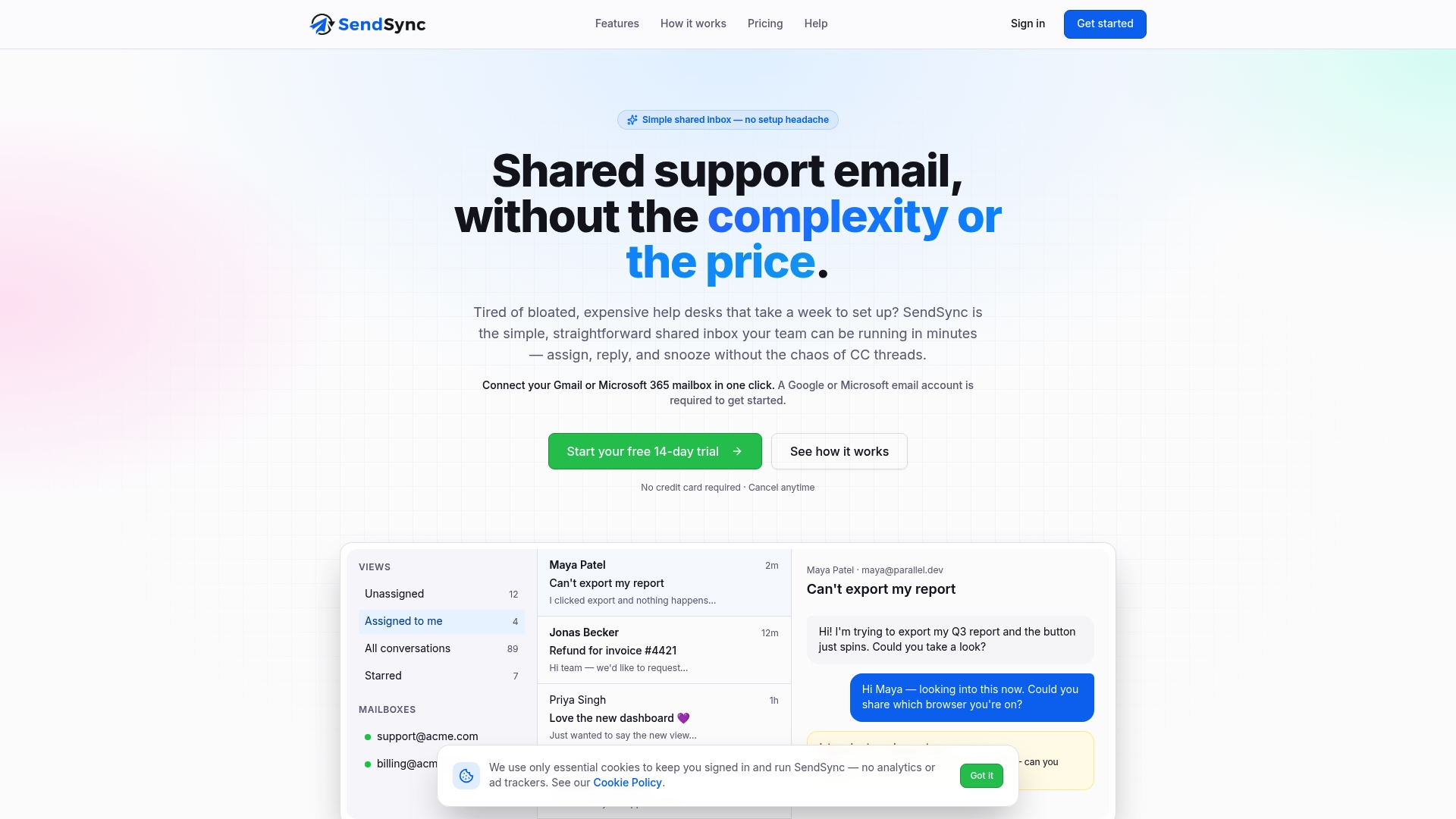
Sendsync connects to Gmail or Microsoft 365 in minutes, with no DNS configuration or complex onboarding required. Teams get conversation assignment, internal notes, collision detection, and AI drafting from day one. The platform runs on unlimited users with no per-seat fees, which means the cost stays flat as your team grows. If your team is ready to handle more conversations with the same headcount, try Sendsync and see the difference in your first week.
FAQ
What is a unified team inbox?
A unified team inbox is a single platform that consolidates messages from email, chat, SMS, and social channels into one shared workspace. Multiple agents can view, assign, and reply to conversations from the same interface.
How does a shared inbox improve response times?
A shared inbox puts every incoming message in front of the whole team instantly, so the first available agent can respond without waiting for a forward or reassignment. Responding within 5 minutes increases lead conversion likelihood by 100 times.
What is collision detection in a shared inbox?
Collision detection is a feature that shows agents in real time who is already handling a specific conversation. It prevents two agents from sending separate replies to the same customer at the same time.
Which businesses benefit most from a unified inbox?
Customer support teams, sales teams, professional services firms, and remote teams with high inbound message volumes gain the most. Any team managing communication across more than one channel will see immediate productivity gains.
How hard is it to set up a unified team inbox?
Setup depends on the platform. Sendsync connects to Gmail or Microsoft 365 in minutes with no DNS changes required. Group email addresses like support@ and sales@ forward directly into the shared inbox without rebuilding your existing email setup.