
Track Two Metrics This Week: Service Level Objectives for Small Teams
Track Two Metrics This Week: Service Level Objectives for Small Teams ! Support leads comparing response time targets Service level objectives support means tracking two numbers, first response time and resolution time, and holding your team accountable to them.

Service level objectives support means tracking two numbers, first response time and resolution time, and holding your team accountable to them. Start this week by picking those two metrics and building one simple dashboard. Everything else, tooling, automation, escalation, exists to protect those numbers once ownership is clear.
TL;DR:
- Small support teams should focus on establishing and tracking response time and resolution time metrics before considering public or contractual SLAs.
- Collecting two to four weeks of baseline data and segmenting tickets by priority are essential steps to set realistic and achievable SLO targets.
- Enforcing assign-before-reply and using shared inbox features like SLA timers and automations help ensure team accountability and SLO compliance.
- Regular daily triage, automations, and weekly reviews of SLA attainment and ticket age are critical practices to maintain and improve support performance.
- Implementing low-cost, quick-to-deploy tools like SendSync allows rapid testing of SLO improvements without complex setup or incremental costs.
Table of Contents
- What support SLOs are and how they differ from SLAs
- The core metrics to track first
- How to set achievable SLO targets for your team
- Shared inbox features that make SLOs enforceable
- Running the daily workflow that protects your SLOs
- Turning dashboards into weekly and monthly action
- Common failure modes and quick fixes
- What actually moves the needle for small teams
- Getting your team’s SLOs running with SendSync
- Where to go deeper
- FAQ
What support SLOs are and how they differ from SLAs
A support SLO is an internal target for how fast your team responds to and resolves customer messages, usually expressed as a time limit tied to priority. An SLA is the contractual or public version of that same promise, often written into a customer agreement with consequences attached.
Most small teams should start with SLOs, not SLAs. An internal target lets you test whether a response time is realistic before you promise it to customers in writing. Once you consistently hit a target for a few months, you can decide whether to make it public or contractual, especially for paid tiers or enterprise accounts where customers expect a written guarantee. Until then, treat the number as a working goal your team manages, not a legal commitment.

The core metrics to track first
Four metrics cover almost everything a small support team needs to know about SLO performance.
- First response time: the time between a customer’s message arriving and the first human reply, measured in business hours for most teams.
- Resolution time: how long a ticket stays open, though you should decide whether you mean time-to-close or time-to-final-resolution, since a reopened ticket changes the math.
- SLA attainment: the percentage of tickets that met your target, calculated as tickets resolved within target divided by total tickets resolved, times 100.
- Backlog and age distribution: how many open tickets you have right now and how old the oldest ones are, which tells you whether today’s numbers are about to get worse.
First response time typically gets the tightest target because it sets the tone for the whole interaction. Resolution time varies more by complexity, so many teams set separate targets by priority tier rather than one blanket number.
How to set achievable SLO targets for your team
Setting a target before you know your baseline is guesswork. Follow a short process instead.
- Collect two to four weeks of baseline data on first response and resolution time before setting any target.
- Segment tickets by priority or tier (urgent, standard, low) since a single target across all ticket types usually fails one segment.
- Run simple capacity math: divide average tickets per day by agents available, then check whether your proposed target is achievable at that ratio.
- Set an initial target slightly better than baseline, not an aspirational one, and give it a four to six week monitoring window before adjusting.
This sequence keeps targets grounded in what your team can actually deliver, which matters more for morale and customer trust than an ambitious number you miss every week.
Shared inbox features that make SLOs enforceable
A target without enforcement tools is a wish. A shared inbox needs a specific set of features to make SLOs stick.
- Assignment and ownership controls so every ticket has exactly one accountable person, not an implied “whoever gets to it.”
- SLA timers or status fields and saved views that surface tickets approaching or past their deadline without anyone hunting for them.
- Triage and escalation automations that flag priority tickets and notify a backup owner if the primary one goes quiet.
- Dashboards and exports for the weekly and monthly reviews your team needs to catch drift early.
SendSync builds these controls into a shared inbox that connects to Gmail or Microsoft 365 in minutes, without the DNS configuration that slows down traditional help desk rollouts. Because setup takes minutes rather than days, a team can test an SLO change this week instead of scheduling it for next quarter. The platform also charges no per-seat fees, so adding agents to cover a backlog does not increase your software cost.
Pro Tip: Turn on one automation at a time and watch its effect on attainment for a week before adding the next one, so you know which change actually moved the number.
Running the daily workflow that protects your SLOs
Tools only work if the team uses them the same way every day. A short set of habits keeps SLOs from slipping.
- Assign before you reply. No one answers a ticket that has not been claimed, which removes the ambiguity that causes duplicate replies and missed follow-ups.
- Define one owner and one priority rule per ticket so escalation decisions do not depend on memory.
- Run a daily triage pass using saved views for “due soon” and “overdue” tickets, ideally at the start and middle of the day.
- Set automations for auto-assign, auto-notify, and fallback ownership so a ticket never sits untouched because the primary owner is out.
This is the assign-before-reply pattern SendSync’s escalation workflow guide describes in more detail, and it is the single habit most responsible for keeping tickets from slipping past their owner.
Turning dashboards into weekly and monthly action
Measurement only matters if it changes behavior. A short reporting cadence does that without turning into busywork.
- Weekly: check the SLA attainment dashboard for trend direction, not just the current number, since a slow decline is easier to fix than a sudden spike.
- Monthly: run a root-cause review using a short template: a sample of missed tickets, the likely cause, the owner responsible, and the fix applied.
- Quarterly: connect repeated SLO breaches to workload data to decide whether the fix is process, tooling, or headcount.
SendSync’s workload reporting guide walks through turning that visibility into fixes faster than ad-hoc spreadsheet reviews allow.
Common failure modes and quick fixes
Most SLO failures trace back to one of four causes.
- No clear ownership: enforce assign-before-reply so every ticket has a named owner from the moment it arrives.
- Overload: use templates for repeat questions, reprioritize the queue, and treat sustained overload as a hiring or reassignment signal, not a permanent condition.
- Tooling gaps: add SLA timers and status fields if your team is currently tracking deadlines by memory or a spreadsheet.
- Poor tracking: build a baseline dashboard before changing any target, since you cannot fix what you have not measured.
Pro Tip: If more than one of these shows up at once, fix ownership first. Overload and tooling gaps are much easier to diagnose once every ticket has a clear owner.
What actually moves the needle for small teams
If you test one change, test assign-before-reply first. It costs nothing, takes a day to roll out, and exposes ownership gaps that no dashboard will show you on its own. A fast, low-friction inbox setup, the kind SendSync is built around, matters here because it lets you test that change this week rather than after a lengthy rollout.
— Nick
Getting your team’s SLOs running with SendSync
SendSync maps directly to the tooling needs above: assignment and ownership controls, saved views for tickets approaching deadline, triage automations, and dashboards for weekly review, all inside a shared inbox that connects to Gmail or Microsoft 365 without DNS setup.
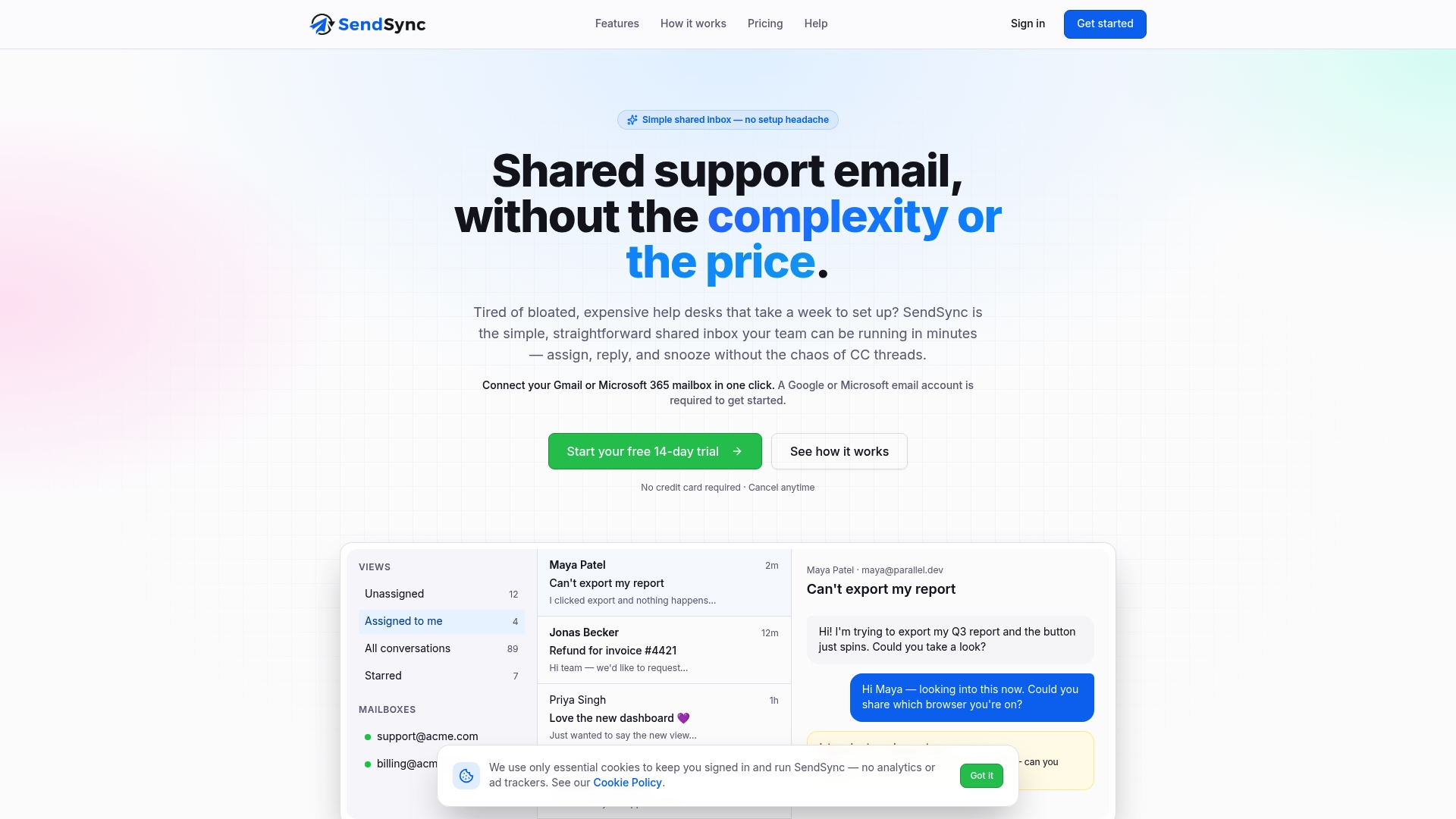
- Start free: try SendSync free for 14 days and connect your existing mailbox in minutes.
- Import your inbox: bring over open tickets so your baseline data starts accurate from day one.
- Use the dashboard templates: apply SendSync’s metrics dashboard templates to track attainment without building one from scratch.
SendSync offers multiple pricing tiers with unlimited users and no per-seat fees; current prices are available on the SendSync website. Visit the SendSync site to pick a plan and get your shared inbox live today.
Where to go deeper
Read SendSync’s guides on inbox organization and professional client inboxes. For the link between consistent delivery and reputation, see this SMB reputation guide.

FAQ
What is a good first response time SLO?
There is no universal number since it depends on your team’s capacity and priority tiers, but most small teams start by measuring their own baseline for two to four weeks before setting a target. Set the initial goal slightly better than that baseline rather than picking an aspirational figure.
How do I calculate SLA attainment?
Divide the number of tickets resolved within your target time by the total number of tickets resolved, then multiply by 100 to get a percentage. Track this weekly so you catch a downward trend before it becomes a pattern.
What’s the difference between an SLO and an SLA for support teams?
An SLO is an internal target your team uses to manage response and resolution times. An SLA is the contractual or public version of that promise, usually reserved for paid tiers once you have proven the target is achievable.
What causes most missed SLOs on a small team?
Unclear ticket ownership is the most common cause, followed by overload and tooling gaps like missing SLA timers or status fields. Enforcing an assign-before-reply rule, described in SendSync’s escalation workflow guide, fixes the ownership issue directly.
Does SendSync help with SLO tracking?
SendSync includes assignment controls, saved views, escalation automations, and dashboard templates that support SLO tracking inside a shared inbox, connecting to Gmail or Microsoft 365 without DNS setup. Pricing details are available on the SendSync website.