
Support Leaders: Pilot AI in a Customer Support Workflow This Week
Support Leaders: Pilot AI in a Customer Support Workflow This Week ! Support team reviews an AI ticket suggestion A customer support workflow is the defined sequence of steps, roles, and decision points that moves a customer inquiry from first contact to resolution.

A customer support workflow is the defined sequence of steps, roles, and decision points that moves a customer inquiry from first contact to resolution. The main outcome is consistency: every ticket gets handled the same reliable way regardless of who picks it up, with fewer handoffs and less manual digging. Done well, it also leaves room for human-in-the-loop automation to speed up resolution without sacrificing quality.
TL;DR:
- Classify every incoming ticket by category and urgency before routing, then assign an owner, deadlines, and context requirements for each handoff.
- Start automation with logging and replies drafted by AI for human review; automate only proven actions after setting abstention and rollback rules.
- Research reported 27% higher first contact resolution and 34% to 39% lower handling time with hybrid AI assistance, while production automation reached 45% coverage.
- Route distressed customers to a person early, require approval for refunds or account changes, and track accepted or rejected AI suggestions during the pilot.
Table of Contents
- What Is a Customer Support Workflow: Components and Terms
- Why Codified Workflows Matter: Measurable Benefits
- Common Workflow Types and Practical Examples You Can Adapt
- A Step-by-Step Process to Design or Redesign a Workflow
- Automation and AI in Workflows: Human-in-the-Loop Patterns
- Field Evidence and Practitioner Lessons for Safe Automation
- Metrics and KPIs to Track
- Tool and Integration Patterns: What to Connect and Why
- Implementation Checklist and Launch Playbook
- An Editor’s Take on Workflow Priorities
- Get a Workflow Running This Week, Not This Quarter
- FAQ
- Sources
What Is a Customer Support Workflow: Components and Terms
A workflow is built from a handful of recurring parts. A trigger starts the process (an inbound email, a chat message, a phone call). Triage sorts the ticket by urgency and category. Routing sends it to the right person or team. Handling is the actual work of answering or fixing the problem. Escalation kicks in when a ticket needs more authority, expertise, or urgency than the first responder can provide. Resolution closes the loop with the customer, and recording captures what happened for reporting and future reference.
A few terms come up constantly in workflow design:
- An SLA (service level agreement) sets the maximum time allowed for a first response or a full resolution.
- Triage is the initial sorting step that decides priority and category before any real work starts.
- An escalation gate is a checkpoint where a ticket either proceeds automatically or requires a human decision before moving forward.
- Urgency and priority are often confused: urgency measures how time-sensitive an issue is, while priority also factors in customer value or business impact.
Workflows rarely live in a single tool. They connect across channels (email, live chat, phone) and systems (a knowledge base for self-service answers, a CRM for customer history, a billing system for refunds). The handoffs between these channels and systems are usually where delays and errors creep in, which is why mapping them clearly matters more than picking any particular software.
Why Codified Workflows Matter: Measurable Benefits
Teams that document and enforce a workflow see fewer inconsistencies between agents, less back-and-forth with customers, and fewer unnecessary escalations. When every agent follows the same triage and routing logic, a customer gets the same quality of answer whether they reach a new hire or an experienced veteran.
The operational gains show up quickly:
- Response times drop because tickets route to the right person on the first try instead of bouncing between teams.
- Ownership becomes clear, so a ticket doesn’t sit untouched while two agents assume someone else has it.
- Rework falls, since agents aren’t re-gathering context that a clear triage step should have already captured.
A hybrid human-in-the-loop model can increase first-contact resolution by 27% and cut average handling time by 34 to 39%, according to published experiments on enterprise CRM support. That gain comes specifically from reducing the manual context gathering that eats up agent time on every ticket, which is exactly what a well-mapped workflow is designed to eliminate.
Common Workflow Types and Practical Examples You Can Adapt
Most support teams need some version of the following common workflows. Each one has a distinct trigger and a different risk profile, so they deserve separate treatment rather than one generic process.
- Triage and classification workflow. Every inbound email or chat gets tagged by category and urgency before anything else happens. This is the foundation everything else depends on, since misclassified tickets cascade into wrong routing and missed SLAs.
- Escalation workflow. High-urgency or high-risk issues (service outages, billing disputes, angry customers) pass through an approval gate where a senior agent or manager reviews before any irreversible action, such as a refund or account change.
- Onboarding and provisioning workflow. New customers trigger a sequence of welcome messages, account setup checks, and proactive check-ins, often on a fixed schedule rather than reactive to a ticket.
- Order, returns, and refunds workflow. Commerce teams need a workflow that verifies order details, checks return eligibility against policy, and routes refund approvals above a certain dollar threshold to a manager.
- Technical troubleshooting workflow. These typically start with a knowledge base search step before any human gets involved, then escalate to tiered technical support if self-service and first-line fixes don’t resolve the issue.
Teams running the triage workflow benefit from practical guidance on classifying and routing inbound email before building out the rest. A partner resource on ticket triage process and prioritization fields is also a useful reference for teams formalizing the fields and priority logic behind this first step.
A Step-by-Step Process to Design or Redesign a Workflow
Building a workflow from scratch, or fixing a broken one, follows a consistent sequence regardless of team size or industry.
- Map triggers and the customer journey. List every way a ticket can enter your system and what a fully resolved outcome looks like for each. Note the inputs an agent needs and the outputs a customer expects.
- Define roles, ownership, and SLAs. Assign a specific role to each step, not just “support team.” Attach a time target to each handoff so nothing sits in limbo.
- Decide routing and escalation gates. Determine which conditions trigger a handoff to a different team or a higher authority, and specify exactly what context must travel with that handoff so the next person isn’t starting from zero.
- Mark repeatable steps for automation. Identify the steps that are high-frequency and low-risk, like categorizing a ticket or drafting a standard reply, and set guardrails for what automation can and cannot do without a human check.
- Pilot with a staged rollout. Start small, log every outcome, and collect accept or reject feedback on any automated suggestion before expanding scope.
A practical guide to email triage automation walks through step four in more detail, including where automation tends to pay off fastest.
Pro Tip: Run your first pilot on a single ticket category before touching anything else. A narrow scope makes it easy to tell whether a change actually helped.
Automation and AI in Workflows: Human-in-the-Loop Patterns
Distinct levels of automation show up in modern support workflows, and confusing them is a common source of failed rollouts.
Copilot or assist mode has the AI draft a response or suggest a category while a human reviews and edits before anything goes out. Selective automation lets high-confidence steps run without review, such as auto-tagging a ticket that matches a known pattern, while lower-confidence cases still route to a person. Agentic AI goes further, autonomously taking multi-step actions like issuing a refund or closing a ticket without a human in the loop at all, which carries the highest risk and the highest reward.
The evidence favors starting conservative. A hybrid human-in-the-loop approach that pairs AI drafting with human review shows the strongest and most consistently reported gains:
- First-contact resolution rose 27% and handling time fell 34 to 39% in a published hybrid strategy study that used AI as a drafting collaborator rather than a decision-maker.
- A production system that automated 45% of sessions did so only after a staged pipeline: logging first, then copilot assistance, then selective automation gated by a calibrated confidence threshold, as described in research on learning selective autonomy from copilot feedback.
A workable staged deployment recipe follows that same order: log everything the human agent does first, introduce AI as a copilot that drafts but never sends, then gradually allow gated background execution for the narrow set of actions where a critic model and an abstention threshold keep error rates low.
Two practical rules follow from field research. Human intervention works well for algorithm-triggered technical escalations but tends to fail for emotionally charged ones, so routing angry or distressed customers to a person early matters more than routing technically complex ones. Recording every accept or reject decision an agent makes on an AI suggestion also builds the supervision signal that improves the system over time, rather than leaving automation to guess at what “good” looks like.
Field Evidence and Practitioner Lessons for Safe Automation
The strongest support for staged, human-supervised automation comes from production deployments rather than lab demonstrations. A system that learned directly from operator traces and copilot feedback reached 45% session automation coverage and a 39% reduction in average handling time without degrading support quality, according to research on selective LLM autonomy in enterprise support workflows.
AI failure is inevitable in any sufficiently complex workflow. The practical fix is a calibrated abstention threshold: the system defers when uncertain and hands the human full context plus a proposed draft, so the person acts as an editor rather than a data-gatherer.
That framing matters because it reframes the goal of automation. It isn’t to remove the human, it’s to remove the busywork that happens before the human can make a good decision.
The same hybrid model that improved first-contact resolution by 27% also cut handling time by up to 39% in controlled experiments on enterprise CRM, reinforcing that the biggest wins come from pairing AI speed with human judgment rather than choosing one over the other.
The harder lesson is organizational, not technical. BCG research on scaling AI in support operations found that 50% of executives cite change management, not technology, as the primary barrier to scaling AI in support. Redesigning the underlying processes and creating new roles, such as people who specialize in monitoring AI performance, matters as much as the automation itself.

Metrics and KPIs to Track
Defining a workflow is only half the job. Tracking whether it’s working requires a small set of metrics that teams can report on consistently rather than anecdotally.
| Metric | What it measures | Why it matters |
|---|---|---|
| First contact resolution (FCR) | Percentage of tickets resolved in the first interaction | Directly tied to customer satisfaction and repeat contact volume |
| Average handling time (AHT) | Time an agent actively spends per ticket | Flags where process friction or missing context slows resolution |
| Time to triage | Time between ticket creation and initial classification | Shows how fast tickets reach the right person |
| SLA compliance rate | Percentage of tickets resolved within agreed time targets | Direct measure of whether the workflow meets commitments |
| Reopen rate | Percentage of resolved tickets that come back | Signals whether “resolved” actually meant resolved |
| Automation coverage | Share of tickets or steps handled without a human | Tracks how much of the workflow automation is actually carrying |
| Accept/reject rate | How often agents approve versus override an AI suggestion | Health check on whether automation suggestions are trustworthy |
Beyond the core metrics, automation health metrics deserve their own attention once any AI assistance is in place. Tracking specific events, like a ticket being escalated or a ticket being auto-handled, feeds directly into dashboards and SLA reports instead of relying on agents to self-report how things went. That event-level data is what turns “I think automation is helping” into a number a team can actually defend in a planning meeting.
Tool and Integration Patterns: What to Connect and Why
Each tool category in a support stack plays a distinct role, and conflating them is a common reason workflows get tangled.
- A shared inbox gives a team one place to assign, reply to, and track conversations without each person working from a separate mailbox.
- A dedicated ticketing system adds structured fields, SLAs, and reporting on top of raw conversations, useful once ticket volume outgrows a simple shared view.
- A knowledge base holds the answers agents and customers both search before a human needs to get involved at all.
- A CRM supplies the customer history and account context a workflow needs to avoid asking the customer to repeat themselves.
Most teams connect these through mailbox integrations (linking Gmail or Microsoft 365 directly) rather than forwarding rules, since forwarding tends to lose thread context. API and webhook connections then let repeatable tasks, like creating a CRM record when a ticket closes, run in the background without manual steps.
A few integration habits separate workflows that scale from ones that break under load: log every automated action for later audit, build a safe fallback to a human when an integration fails rather than silently dropping the ticket, and keep the agent-facing experience simple even when the backend connects several systems. Guidance on organizing a shared inbox with tags and folders covers the agent-facing side of this balance in more depth.
Implementation Checklist and Launch Playbook
A pilot succeeds or fails based on a few concrete conditions set before launch, not on the sophistication of the tools involved.
- Assign a clear owner. One person is accountable for the pilot’s outcome, not a committee.
- Pick one metric to move. Choose FCR, AHT, or time to triage, and resist tracking five things at once in week one.
- Define the dataset. Decide which ticket category or channel the pilot covers, and keep it narrow.
- Set a rollback plan. Know in advance how to turn off any automated step if error rates climb.
- Set gating criteria for scale-up. Define the acceptance rate, error threshold, and SLA target that must be met before expanding beyond the pilot group.
- Train the team on the new roles. Agents need to understand what they’re reviewing and why, not just a new button in their inbox.
Pro Tip: Review accept and reject rates weekly during the pilot phase. A sudden drop in acceptance usually means the automation drifted outside its original scope, not that agents stopped trusting it.
A playbook for building an escalation workflow with approval gates is a useful companion once the pilot checklist above is in place and escalation handling becomes the next priority.
An Editor’s Take on Workflow Priorities
If you only fix one thing first, fix triage clarity and build a single, well-defined escalation gate. Everything downstream, routing, automation, reporting, depends on tickets being correctly classified from the start, and most of the breakdowns I see trace back to a vague or inconsistent triage step rather than a tool limitation.
Automate the boring, high-frequency steps before touching anything customer-facing or irreversible. Tagging and categorization are safe early automation targets. Refunds and account changes are not, at least not until the accept and reject data says otherwise.
Build logging and accept or reject tracking from day one, even before any automation exists. Without that data, you’re guessing at what to automate next instead of letting real agent behavior tell you. And treat AI adoption as a change to how the team operates, not a plugin bolted onto an existing process. The teams that struggle are usually the ones that skipped the role and process redesign and expected the software to do that work alone.
— Nick
Get a Workflow Running This Week, Not This Quarter
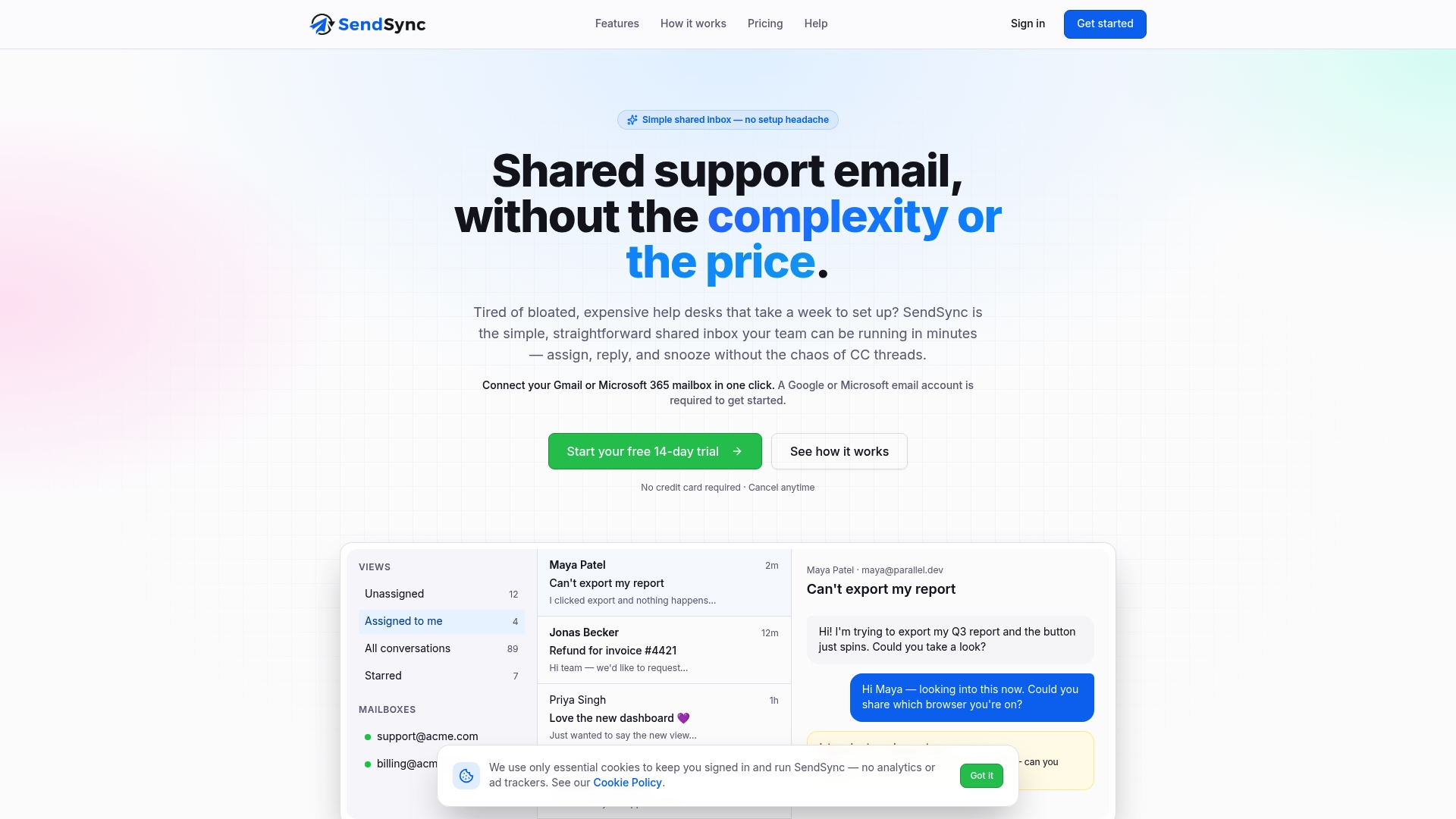
Most of the friction in building a support workflow isn’t the design work, it’s the setup time of the tools meant to run it. We built SendSync so a team can connect a Gmail or Microsoft 365 mailbox and be live, with no DNS configuration.
Once connected, the workflow pieces covered in this guide map directly onto what we offer:
- Assign conversations to the right person the moment a ticket lands, matching the triage and routing steps above.
- Add internal notes so context travels with a ticket through every handoff instead of getting lost.
- Tag and organize tickets by category or urgency to support the triage workflow without extra configuration.
- Automate the repetitive first steps, like sorting inbound email, so agents spend time on the judgment calls that actually need them.
Because pricing is flat per plan with unlimited users, a pilot doesn’t get more expensive as more of your team joins it. Plans start at $10 a month on the Founder tier, with Starter, Growth, and Scale tiers available as a team grows. Current prices are on the SendSync pricing page.
FAQ
What is a customer support workflow?
A customer support workflow is the defined set of steps, roles, and decision points that moves a customer inquiry from first contact through to resolution and closure. It typically includes triage, routing, handling, escalation, and recording steps so every ticket follows a consistent path regardless of which agent handles it.
How do I improve an existing customer support workflow?
Start by mapping every trigger and handoff in the current process to find where delays or inconsistencies happen, then assign clear ownership and SLAs to each step. A hybrid human-in-the-loop automation approach can improve first-contact resolution by 27% and cut handling time by 34 to 39% once the basic process is clearly defined.
What metrics should I track for a support ticket process?
The core metrics are first contact resolution, average handling time, time to triage, SLA compliance, and reopen rate. Once automation is involved, also track automation coverage and accept or reject rates to see whether AI suggestions are actually trustworthy.
How much does SendSync cost?
SendSync offers plans with unlimited users and no per-seat fees. Exact plan details are available on the SendSync pricing page.
Should I automate a support workflow fully or keep a human in the loop?
Field evidence favors staged automation that keeps a human in the loop rather than full autonomous handling, especially early on. A production system using a staged logging, copilot, and selective automation pipeline reached 45% automation coverage and a 39% reduction in handling time without degrading support quality, which suggests gradual rollout outperforms jumping straight to full automation.
Sources
- Researchgate
- Learning Selective LLM Autonomy from Copilot Feedback in Enterprise Customer Support Workflows
- Bcg