
Tags vs Folders for Teams: 4 Checks for a Lean Hybrid System
Tags vs Folders for Teams: 4 Checks for a Lean Hybrid System ! Support coordinator organizing customer email Use folders as the stable home for a file and tags as the flexible context around it.

Use folders as the stable home for a file and tags as the flexible context around it. Folders give every item one clear location, which makes them the right choice for projects, archives, and anything with a single owner. Tags layer status, topic, or people on top of that structure without forcing a second copy anywhere. The strongest system for most people and teams pairs a small set of folders with a short, well-kept list of tags.
TL;DR:
- Keep folder trees to two or three levels, and use specific names that let a teammate predict what each folder contains.
- A practical starting structure uses Projects, Areas, Resources, and Archive; file each item in one home, then add tags for status, topic, or people.
- Shared teams should agree on three to five tags, including status and priority, and restrict new tag creation to deliberate, occasional decisions.
- Review tag lists monthly for busy teams and quarterly for individuals, merging unused labels, spelling variants, and near synonyms before search becomes unreliable.
- Gmail labels act as tags rather than physical folders: archiving removes the Inbox label, but the message remains searchable under its other labels.
Table of Contents
- Folders vs tags: a quick comparison
- How folders and tags actually differ
- When folders are the right call
- When tags are the practical choice
- Building the hybrid workflow step by step
- Keeping tags consistent over time
- Making folders and tags work for a team
- Gmail labels vs folders in practice
- How shared inboxes put this into practice
- Why most advice oversimplifies this choice
- A faster way to handle this for shared inboxes
- FAQ
- Sources
Folders vs tags: a quick comparison
A folder is a location: one file, one home, one clear path to find it again. A tag is an attribute: a label you attach to a file so it can show up in several different views without being duplicated or moved.
Each works best for different signals. Folders fit anything with a single stable owner, like a client project, a finished deliverable, or a yearly archive. Tags fit anything that cuts across categories, like a status, a topic, or a person involved in several unrelated projects.
Before filing anything, run this quick check:
- Does it have one obvious home? If yes, put it in a folder.
- Does it belong in more than one context? If yes, add tags on top of its folder.
- Will you search for it by status or theme more often than by project? If yes, lean on tags for retrieval.
- Is it something you’ll hand off or back up as a unit? If yes, a folder keeps that unit intact.
Running through these four questions takes seconds and settles most filing decisions before they turn into a pile of “maybe later” files.
How folders and tags actually differ
The core difference is structural. A folder is a location: a file lives inside it, and moving the file to another folder means it no longer lives in the first one. A tag is metadata attached to the file itself, so the same file can carry several tags and surface in several different filtered views, all while the file itself stays in one place.
That single-copy-versus-multiple-views distinction matters more than it first appears. Folders provide a stable, hierarchical structure that answers “where does this live,” while tags answer “what is this about, and who cares about it.” You cannot usually put one file in two folders without duplicating it, but you can put ten tags on one file without touching its storage location at all.

Gmail’s label system is the clearest real-world example of this. In Gmail, labels function like tags applied to a single mail store rather than folders a message physically moves between. Archiving a message removes its Inbox label but the message stays in All Mail, and deleting a message removes that one copy from every label at once. That is a fundamentally different model from a classic folder tree, even though Gmail’s interface makes labels look a lot like folders in the sidebar.
The cognitive load differs too. Folders ask you to make one filing decision and move on. Tags ask you to think about every relevant dimension at the moment you file something, which takes more mental effort up front but pays off at retrieval time. Research on personal information management backs this up in an interesting way: behavioral studies show a gap between stated preference and actual habit, with people often saying they prefer tags in the abstract while defaulting to folders when they actually file and retrieve things. That gap is exactly why a hybrid system, rather than an all-tags or all-folders purist approach, tends to hold up better in daily use.
When folders are the right call
Folders earn their place whenever an item needs one clear, stable location rather than several overlapping contexts. A handful of situations call for a folder as the primary home:
- Active projects, where every file related to one client or initiative needs to live together.
- Client or case folders, especially when you will eventually hand the whole thing off to someone else.
- Archives and backups, where the goal is to preserve a complete unit exactly as it was.
- Finished deliverables, like a signed contract or a final invoice, where there is no ambiguity about ownership.
Practical guides recommend starting with a small set of top-level folders rather than a sprawling tree, then adding structure only when a folder genuinely needs subfolders. A shallow hierarchy, two or three levels deep at most, stays easy to scan. A ten-level-deep folder tree defeats the purpose of having folders at all, because nobody remembers where anything lives anymore.
Naming matters as much as depth. A folder called “Misc” or “Stuff” fails the one-obvious-home test before you even open it. Name folders after the thing they contain, not the mood you were in when you created them: “Acme Corp Website Redesign” beats “New Project 3” every time.
A simple checklist works well when you are setting up or cleaning up a folder structure:
- List the big, stable categories your work actually falls into.
- Keep that list to a handful of top-level folders, not dozens.
- Add subfolders only when a top-level folder has grown unmanageable.
- Give every folder a name specific enough that a teammate could guess its contents.
Pro Tip: If you can’t decide between two folder names, pick the one a new teammate would guess first, not the one that makes sense only to you.
When tags are the practical choice
Tags shine wherever a single folder would force an awkward either-or choice. Status, priority, topic, and person are the four categories that benefit most from tagging, because a file’s status can change without the file ever moving, and a person can show up across a dozen unrelated projects.
Useful tag categories look something like this:
- Status tags:
waiting,in-review,done. - Priority tags:
urgent,low-priority. - Topic tags:
billing,onboarding,design. - People tags: a client name or teammate initials for anything they are personally involved in.
The biggest mistake with tags is treating them like folders and creating one for every possible nuance. Practical recommendations favor a short tag list for status, topic, or client rather than an ever-growing vocabulary that nobody remembers how to use consistently. A tag set with 200 entries is really just a messier, harder-to-browse folder tree wearing a different name.
The fix is discipline, not more tags. Keep the list short enough that you could recite most of it from memory, and resist the urge to tag every file with every possible label. A file tagged urgent, billing, and the client’s name tells you everything you need to triage it at a glance. A file tagged with fifteen labels tells you nothing, because nothing stands out.
Think of tags as seasoning, not as the main structure. A small number of high-signal tags, applied consistently, outperforms a long list applied haphazardly every time someone actually tries to find something later.
Building the hybrid workflow step by step
A practical hybrid system starts with four folders at the top level: Projects, Areas, Resources, and Archive. Projects holds anything with a deadline and an end state. Areas holds ongoing responsibilities with no finish line, like “Finance” or “Client Relationships.” Resources holds reference material you’ll want again but that isn’t tied to one project. Archive holds anything finished or inactive that you’re not ready to delete.
On top of that folder floor, apply a short set of tags at the moment you file something, not days later:
- Capture the item wherever it lands, an inbox folder, an email, or a notes app.
- File it into one of the four top-level folders based on its single clearest home.
- Tag it with whatever status, topic, or person applies, using your short, pre-agreed tag list.
- Review tags periodically rather than letting them pile up untouched.
Four everyday examples show how this plays out:
A meeting note goes into the relevant project folder, then gets tagged with the meeting’s topic and an action-items tag if anything needs follow-up. An invoice goes into the client’s project folder under a “Billing” subfolder, then gets tagged paid or overdue so you can find every outstanding invoice across clients without opening a single folder. A research clip you saved for later goes into Resources, then gets tagged by topic so it resurfaces when you’re working on something related months from now. A photo from a project shoot goes into that project’s folder, then gets tagged with the subject or location so it’s findable later even if you forget which project it came from.
Pro Tip: Tag at the moment of filing, not during a weekend cleanup session, because tags applied in hindsight are almost always less accurate.
This same capture-file-tag sequence works whether you’re organizing personal notes, client files, or a shared team drive. The folder gives the item permanence. The tags give it reach.
Keeping tags consistent over time
A tag system only stays useful if it stays small and consistent, which means naming rules matter from day one. Use a simple namespace pattern where it helps, like status:done or client:acme, so related tags sort together and nobody invents three different spellings of the same idea.
A few rules keep the list manageable:
- Use one separator consistently, whether that’s a colon, a hyphen, or nothing at all.
- Keep the active tag list short enough to fit comfortably on a single screen so it stays manageable.
- Avoid near-duplicate tags like
urgentandhigh-priorityexisting side by side. - Review the full tag list on a set cadence, monthly for a busy team, quarterly for an individual.
Governance matters more for shared tag sets than for a personal ones. Controlled vocabularies and a small editing group prevent the tag list from fracturing into synonyms that nobody can search reliably. Treating new tag creation as a deliberate, occasional action rather than something anyone can do mid-task keeps the list from quietly doubling in size every quarter.
| Maintenance task | How often | What to check |
|---|---|---|
| Review full tag list | Monthly (teams) or quarterly (individuals) | Unused tags, near-duplicates |
| Merge duplicate tags | As discovered | Spelling variants, synonyms |
| Audit tag count | Quarterly | Total stays under the agreed limit |
| Confirm naming pattern | At tag creation | New tag matches the namespace rule |
A tag list that nobody prunes becomes a junk drawer with extra steps. Ten minutes a month keeps it a working tool instead.
Making folders and tags work for a team
Shared folders and shared tags need different levels of structure. Folders should be the adoption floor: every teammate needs to agree on where the big, stable buckets live, because without that agreement, people start creating their own parallel folder trees out of frustration.
Tags can stay optional on top of that floor, but they work best when the team commits to a short, shared list rather than letting everyone invent their own. A workable starting point:
- Agree on three to five shared tags before adding anything else, covering status and priority at minimum.
- Provide a template for new projects so the folder structure doesn’t drift from person to person.
- Run a short onboarding pass for new teammates covering the folder floor and the tag list in under ten minutes.
- Keep a one-page reference listing every active tag and what it means, so nobody has to guess.
Teams succeed when folder hierarchies stay shallow and tags remain optional, governed metadata rather than a second competing structure. For shared email specifically, mapping clear ownership onto assignment, the same way a folder gives a file one owner, removes most of the ambiguity about who is responsible for what.
Saved views built on top of the shared tags, like “everything tagged urgent across all projects,” give teams the cross-cutting visibility that folders alone can’t provide, without anyone needing to reorganize a single file.
Gmail labels vs folders in practice
Gmail’s label system looks like folders in the sidebar, but it behaves like tags underneath. Every message lives in one place, and labels are views on top of that single store rather than separate physical locations. Archiving a message removes its Inbox label without deleting anything, which is why an archived email still turns up under any other label you’d applied to it.
A few practical moves make Gmail behave more like a folder system when you want that:
- Archive plus a label gives you a folder-like “done” state while keeping the message searchable under its other labels.
- Filters apply labels automatically as mail arrives, so routine messages sort themselves.
- Saved searches act like a dynamic folder for anything matching a label or sender pattern.
For a deeper technical look at how labels map onto the IMAP folder model that most other mail clients still use, see this explanation of Gmail labels and IMAP folders. Folder-like behavior still matters for IMAP clients, backups, and handing off an account to a new teammate, which is one reason small support teams managing shared inboxes often reintroduce clearer ownership rules on top of Gmail’s label model rather than relying on labels alone.
How shared inboxes put this into practice
Shared inboxes face the folder-versus-tag question constantly, just with higher stakes: an unanswered message is a customer waiting, not a misplaced file. The pattern that works best mirrors the hybrid system directly. Assignment gives each conversation one clear owner, the same job a folder does for a file. Tags or labels on top of that handle triage, status, and topic without anyone needing to move the conversation anywhere.
Keeping ownership and triage as two separate layers, rather than forcing a single folder-like structure to carry both jobs, is the detail most teams get wrong until something slips through. A structured shared inbox built around that separation tends to produce clearer handoffs than an inbox where folders and status are mixed into one system.
Nick covers practical assignment and tagging patterns for small teams in the related guides linked throughout this piece, drawing on how freelance and small-team inbox systems typically get built from scratch.
Why most advice oversimplifies this choice
Most articles on this topic present folders and tags as competing philosophies, as if choosing one proves you understand organization better than the other camp. That framing wastes the reader’s time. The real skill is deciding, file by file, which dimension is stable enough to deserve a folder and which is fluid enough to deserve a tag, and most people never make that distinction explicit.
The conventional advice to “just pick a system and stick with it” undersells how much maintenance a tag system needs to stay useful. A tag list left ungoverned for a year is worse than no tags at all, because it creates false confidence that something is organized when it’s actually just labeled inconsistently.
If you take one thing from this, prioritize the folder floor first. Get your top-level buckets right before you touch tags at all, because a shaky folder structure makes every tag you add harder to trust. Tags are the refinement layer, not the foundation, and treating them as the foundation is the most common reason tagging systems collapse within a few months.
— Nick
A faster way to handle this for shared inboxes
Everything above gets harder to enforce once a team is sharing one inbox instead of one person managing their own files. We built a shared inbox that connects to your Gmail or Microsoft 365 mailbox in minutes, with no DNS setup standing between you and a working system.
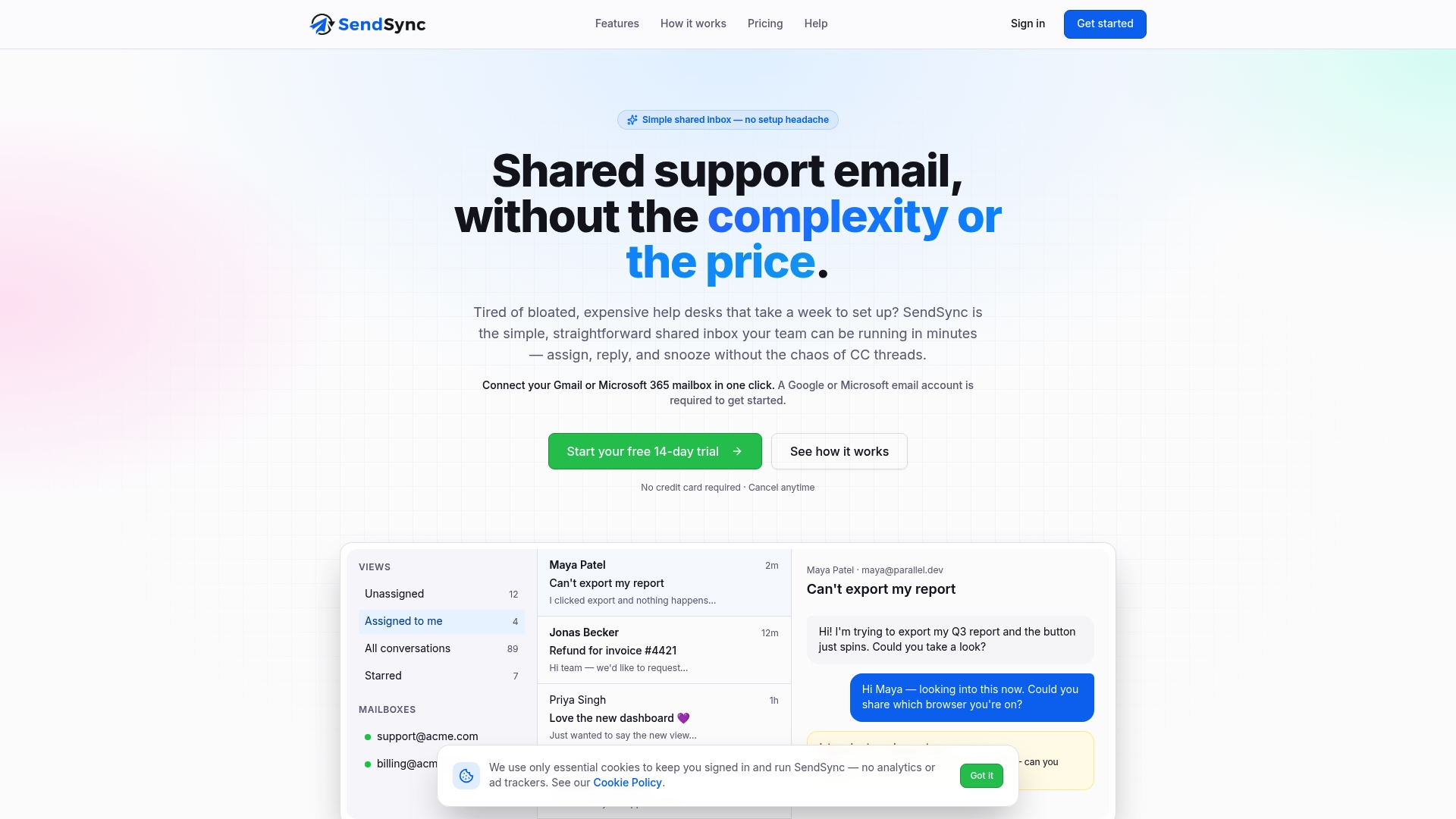
Inside SendSync, the hybrid model maps directly onto how support teams actually work. Assignment covers the folder half of the equation, giving every conversation one clear owner the moment it comes in. Tags and saved views cover the rest:
- Assignment gives each conversation a single, stable owner, the same job a folder does for a file.
- Tags handle status, topic, or urgency without anyone moving the conversation anywhere.
- Saved views surface everything matching a tag across the whole shared inbox at once.
Our plans include unlimited users with no per-seat fees, so adding a teammate never means renegotiating your bill. See current plans on SendSync and get a shared inbox running before your next support shift starts.
FAQ
What is the point of using tags?
Tags let one item show up in several different contexts, like status or topic, without duplicating the file or moving it anywhere. They solve the problem folders can’t: when something belongs to more than one category at once, a tag captures that without forcing a single either-or choice.
What are the four types of folders?
A common hybrid structure uses four top-level folders: Projects for anything with a deadline, Areas for ongoing responsibilities with no end date, Resources for reference material, and Archive for anything finished or inactive. Definitions vary across systems, but this grouping covers most personal and team setups well.
What do tags mean in files?
A tag is a piece of metadata attached to a file that describes an attribute like its status, topic, or priority, rather than where the file is stored. The same file can carry multiple tags at once, and changing a tag never moves the file or affects its folder location.
Is it better to tag or hashtag?
For file and note organization, structured tags inside a dedicated tagging system work better than hashtags buried in free text, because a real tag field is searchable and filterable on its own. Hashtags inside a note or caption can work for quick, informal labeling, but they lack the governance and consistency a proper tag list provides over time.
Sources
- Folders vs. Tags: The Best Way to Organize Digital Notes | reMarkable
- Support
- Tagging personal information: A contrast between attitudes and behavior
- Tags vs. Folders: File Organization Explained | Softorino blog