
Stop Using BCC: Better Alternatives for Team Email
Stop Using BCC: Better Alternatives for Team Email ! Hands sorting mail envelopes on desk Stop using BCC for routine workplace email.

Stop using BCC for routine workplace email. It hides your audience, invites reply-all disasters, and signals to your team that transparency is optional. The fix is simple: use CC when you want people to know who’s involved, forward emails with a short explanatory note when you need to loop someone in after the fact, set up a mailing list or distribution group for announcements, and move ongoing monitoring into a shared inbox instead of a hidden recipient line.
A few quick swaps cover almost every situation:
- Updating your manager on a client thread? Forward the email with one line of context instead of silently BCCing them from the start.
- Sending an announcement to fifty people? Use a distribution group or mail-merge tool built for that job, not a BCC field never designed for scale.
- Need your whole team to see incoming support requests? A shared inbox gives everyone visibility without anyone hiding in the header.
BCC still has a narrow, legitimate use: protecting the privacy of unrelated recipients on a one-time external announcement, where nobody needs to know who else received it. Outside that case, it’s a habit worth breaking.
Key Takeaways
Stopping BCC works because it replaces a hidden, untracked communication pattern with transparent, purpose-built alternatives that build trust and improve deliverability.
| Point | Details |
|---|---|
| Drop BCC as a default | Reserve it only for narrow, one-off privacy cases and use CC or forwarding everywhere else. |
| Update team policy in writing | Document the one or two acceptable BCC exceptions so the standard is clear to everyone. |
| Replace monitoring with a shared inbox | Give the team one visible view of conversations instead of quiet BCC-based oversight. |
| Use mail-merge for bulk outreach | Personalized, tracked sends outperform BCC blasts on both deliverability and engagement. |
| Model transparent CC as a manager | Leaders who ask to be CC’d, not BCC’d, set the tone the rest of the team follows; consider a tool like Sendsync for shared visibility. |
Table of Contents
- Why Stop Using BCC Hurts Trust and Workflow
- Common Reasons People Use BCC — and What Works Better
- What BCC Mistakes Actually Look Like in the Wild
- Real Alternatives to BCC and Their Trade-Offs
- How to Retire BCC as a Team Default
- Scripts to Replace BCC in Real Emails
- What the Data Says About BCC and Deliverability
- Why I Stopped Defaulting to BCC on Every Update
- A Shared Inbox Fixes What BCC Never Could
- Sources
Why Stop Using BCC Hurts Trust and Workflow
The core problem with BCC isn’t technical. It’s relational. When you hide a recipient, you’re making a judgment call about who deserves to know something, without telling the other people on the email that you made that call. If the hidden recipient ever surfaces, whether through a slip, a forward, or a reply-all, the sender’s credibility takes the hit.
BCC-ing a manager or colleague can quietly damage trust, because the practice signals that something is being tracked or reported without the other party’s knowledge.
Cambridge Judge Business School’s guidance on this is blunt: BCC-ing the boss can read as passive-aggressive, especially in tense exchanges, because it turns a private management update into a covert paper trail. Harvard Business Review makes the same point from a different angle, advising employees to stop BCC-ing their managers and instead forward relevant threads or write a separate summary. Either method keeps the manager informed without making the original recipient a subject of quiet surveillance.
The operational risk is more mundane but just as damaging: reply-all. A BCC recipient who forgets they’re hidden and hits reply-all exposes themselves to everyone on the thread instantly, which usually creates more confusion than the BCC was meant to prevent. Grammarly’s etiquette guidance is direct on this point: BCC should never be used when collaboration is the goal, because it fragments who knows what and who’s supposed to act on it.

Then there’s deliverability. Mass BCC sends mimic the structural pattern of spam, an email going to many addresses with none visible to each other, and email providers penalize that pattern. West Virginia University’s IT department warns that mass BCC-style sends trip spam filters and can quietly erode a sender’s reputation over time, making even legitimate future emails less likely to land in an inbox.
Pro Tip: If you manage a team, say out loud that you don’t want to be BCC’d on internal updates. That single sentence in a team meeting does more to end the habit than any written policy, because it removes the guesswork about whether copying you quietly is expected.
Common Reasons People Use BCC — and What Works Better
Most BCC habits trace back to a handful of recurring situations. Each one has a cleaner fix.
- Keeping your boss in the loop. Instead of BCC, forward the thread afterward with a one-line note: “Wanted you to see this exchange with the vendor.” It’s transparent, and it doesn’t turn your manager into a silent observer of every message you send.
- Sending one email to a large group. BCC was never built for scale. A mailing list, distribution group, or mail-merge tool personalizes each message and tracks opens, something a flat BCC blast can’t do.
- Quietly monitoring a conversation. If you need visibility into a thread without inserting yourself, a shared inbox with roles and permissions lets multiple people see and act on the same message without anyone being hidden.
- Keeping a private record for yourself. Forward the email to your own archive folder or CC yourself openly. There’s rarely a reason to hide that you’re keeping a copy.
- Looping in a specialist without cluttering the main thread. Start a new email that references the original, rather than BCCing them onto a conversation they weren’t part of.
The one case where BCC still earns its keep: a one-off external announcement to a list of recipients who don’t know each other and shouldn’t see each other’s email addresses, think a community newsletter sent manually. Even then, the moment that list grows past a handful of names, a proper mailing list tool becomes the better call, both for privacy and for deliverability.
Legal and regulated professions carry an extra layer of caution here. NC Bar’s guidance for lawyers notes that covert copying, particularly copying a client on correspondence with opposing counsel without disclosure, can raise real professional-conduct concerns. The safer route is a documented, transparent alternative: a separate summary email or an explicit CC that everyone on the thread can see.
What BCC Mistakes Actually Look Like in the Wild
The scenario plays out the same way in almost every office: someone BCCs a colleague on a sensitive email, the original recipient hits reply-all without realizing there’s a hidden name on the thread, and the BCC’d person’s email address shows up in everyone’s inbox. The fallout isn’t just awkward. It raises the question of what else has been quietly copied without disclosure, and that question tends to linger.
Mass outreach carries its own quiet failure mode. A sales rep BCCs forty prospects on one pitch email, thinking it saves time compared to individual sends. The message lands in spam for most of them, engagement is close to zero, and the sender has no way to tell who even opened it, because BCC gives you no tracking data at all.
Widespread BCC use inside a team is often less about efficiency and more about a lack of psychological safety, employees quietly copying managers because they don’t trust that direct, visible communication will be heard or protected.
That reading comes from Cambridge Judge Business School’s analysis of workplace BCC habits, and it’s worth sitting with. A team that leans on BCC to “cover their backs” isn’t solving a communication problem. It’s masking a trust problem that BCC only makes worse over time.
Real Alternatives to BCC and Their Trade-Offs
Every BCC use case maps to a category of tool built for that specific job, transparency, personalization, or shared visibility, rather than a single field trying to do all three badly.
Transparent CC works when you want everyone on a thread to know exactly who else is involved. It’s the simplest fix for the “keeping my manager informed” problem, and it costs nothing but a moment of honesty.
Forwarding with context fits situations where you need to loop someone in after the fact. A single sentence explaining why you’re forwarding keeps the gesture from feeling like a leak.
Mailing lists and distribution groups handle one-to-many communication at scale, department announcements, newsletters, policy updates, without exposing every recipient’s address or triggering spam filters the way a giant BCC field does.
Shared inboxes solve the ongoing monitoring problem. Instead of quietly BCCing three people on every customer email so they stay aware, a shared inbox gives the whole team the same view, with the ability to assign, tag, and track who’s handling what. SendSync’s guide to shared inbox best practices covers how this plays out for support teams specifically.

Mail-merge and bulk-sending tools replace BCC for anything resembling a campaign. Each recipient gets a personalized message and a real unsubscribe option, both of which matter for deliverability. BounceCheck’s analysis of BCC misuse points out that BCC lacks personalization and an unsubscribe mechanism entirely, two things that spam filters actively look for.
| Alternative | Transparency | Deliverability | Tracking / analytics | Scale |
|---|---|---|---|---|
| Transparent CC | High, everyone sees who’s included | Same as normal email | None | Small groups only |
| Forwarding with context | High, explained openly | Same as normal email | None | One-off situations |
| Mailing list / distribution group | Moderate, list membership may be visible | Strong when properly configured | Basic (opens, in some tools) | Medium to large |
| Shared inbox | High, full team visibility | Same as normal email | Strong (assignment, status, history) | Team-based, not mass send |
| Mail-merge / bulk-sending tool | Moderate, each recipient sees only their own copy | Strong, built for volume | Strong (opens, clicks, replies) | Large-scale outreach |
Pros and cons in short form:
- Transparent CC: builds trust fast, but gets unwieldy past a handful of people.
- Forwarding: low friction, but easy to forget the explanatory line that makes it transparent rather than sneaky.
- Mailing lists: handles volume cleanly, but takes a few minutes of setup most people skip.
- Shared inboxes: solves the monitoring problem completely, but requires the team to actually adopt the workflow.
- Mail-merge tools: best deliverability and tracking, but overkill for a one-off internal note.
How to Retire BCC as a Team Default
Breaking a habit that’s baked into muscle memory takes more than a memo. It takes a policy, a few template changes, and a manager willing to model the behavior publicly.
- Define the narrow exceptions first. Write down the one or two legitimate uses of BCC your team will keep (typically, external one-off announcements protecting recipient privacy), so nobody is left guessing where the line is.
- Update your email templates. Replace any template that defaults to BCC-ing a manager or teammate with a CC field or a forwarding instruction instead.
- Set a team-wide expectation in writing. A short paragraph in your communication guidelines saying “we CC, we don’t BCC, except for X” removes the ambiguity that lets the old habit creep back.
- Introduce the replacement tool before you ban the old habit. If monitoring was the reason for BCC, get a shared inbox running first so people have somewhere to redirect that impulse.
- Review email drafts during onboarding. New hires often copy whatever habits they see in the inbox they inherit; catch BCC use early before it becomes their default too.
Managers carry most of the weight here. A short checklist keeps it concrete:
- Stop BCC-ing your own reports on internal updates, and say so explicitly.
- Give feedback the moment you notice a hidden CC, rather than letting it slide because it’s a minor issue.
- When someone asks “should I BCC you on this?”, answer with “CC me instead” every time, until it becomes reflexive.
- Document the agreed exceptions somewhere visible, not just in someone’s memory.
Pro Tip: Most email clients let you audit send patterns or set warnings when BCC is used on internal domains. A quick mailbox rule that flags BCC to your own company’s addresses is a low-effort way to catch the habit in real time instead of relying on willpower alone.
Scripts to Replace BCC in Real Emails
Copy and adapt these for your own team’s tone. Each one replaces a common BCC impulse with a transparent alternative.
Looping in your manager: “Forwarding this so you have visibility into where things stand with [client/project]. No action needed unless something looks off.”
Escalating an issue: “Adding [name] here since this needs their input on [specific issue]. Wanted to be upfront that I’m bringing them in rather than handling it solo.”
Sending a team announcement: “Sending this to the whole team distribution list so everyone has the same information at the same time. Reply directly to me with questions.”
Keeping a record without hiding it: “CCing myself on this so I have a copy in my archive, just flagging that in case you notice the extra address.”
Bringing a specialist into an existing thread: “Starting a new email to loop in [name], who can speak to [topic] better than I can. I’ve included the relevant background below.”
Paste whichever fits into your draft, then adjust the tone to match how your team actually talks, formal for client-facing messages, casual for internal ones. The one rule that holds across all of them: when you CC someone new, add a single line explaining why. That sentence is what separates transparency from just moving the hiding spot from BCC to CC.
What the Data Says About BCC and Deliverability
The clearest signal against mass BCC use comes from deliverability research rather than etiquette guides. WVU’s IT department has documented how bulk BCC sends trigger the same spam-filter heuristics as unsolicited mail, because the pattern, one sender, many hidden recipients, no personalization, looks identical to a spam blast from the filter’s perspective.
An analysis of cold email campaigns found that BCC-style mass sends generally underperformed personalized, tracked outreach on engagement.
That figure comes from a practitioner case study on cold-email deliverability, and it’s worth reading as a directional signal rather than a scientific benchmark. A single case study of this size doesn’t prove BCC is always the wrong tool for outreach, but it lines up with the broader pattern communications researchers describe: BCC gives senders zero visibility into opens, clicks, or bounces, while mail-merge and shared-inbox tools track all three by default.
| Method | Personalization | Open/click tracking | Spam risk |
|---|---|---|---|
| BCC bulk send | None | None | Elevated |
| Mail-merge tool | Per-recipient | Yes | Low |
| Shared inbox (team monitoring) | N/A (not a bulk method) | Yes, at the conversation level | Low |

The practical takeaway isn’t that BCC is inherently broken as a protocol feature. It’s that using it as a stand-in for tools purpose-built for scale or shared visibility consistently underperforms those tools on every metric that matters: trust, deliverability, and the ability to know what actually happened after you hit send.
Why I Stopped Defaulting to BCC on Every Update
Early in managing support workflows, BCC felt like the fastest way to keep stakeholders informed without cluttering a thread. It wasn’t. It created a habit where nobody quite knew who else had seen a given email, and more than once a BCC recipient replied-all without realizing they’d been hidden, turning a routine update into an uncomfortable conversation about who was tracking what.
Working closely with customer support and email management workflows changes how you see this problem. The teams that struggle most with BCC aren’t the ones being deceptive on purpose, they’re the ones who never built a shared system for visibility, so BCC became the default patch. Once you replace that patch with an actual shared view of the inbox, the impulse to hide a recipient mostly disappears on its own, because the thing BCC was trying to solve, “does someone else know about this?”, is now answered by the tool itself rather than a hidden email address. That’s the real argument for shared inbox workflows over covert copying: they don’t just replace BCC, they remove the reason for it.
A Shared Inbox Fixes What BCC Never Could
Sendsync gives your team the visibility BCC was always a poor substitute for, without adding a single line of hidden email routing. When the goal is monitoring a thread or keeping the whole team aware of what’s happening in a client conversation, a shared inbox does the job openly instead of quietly.
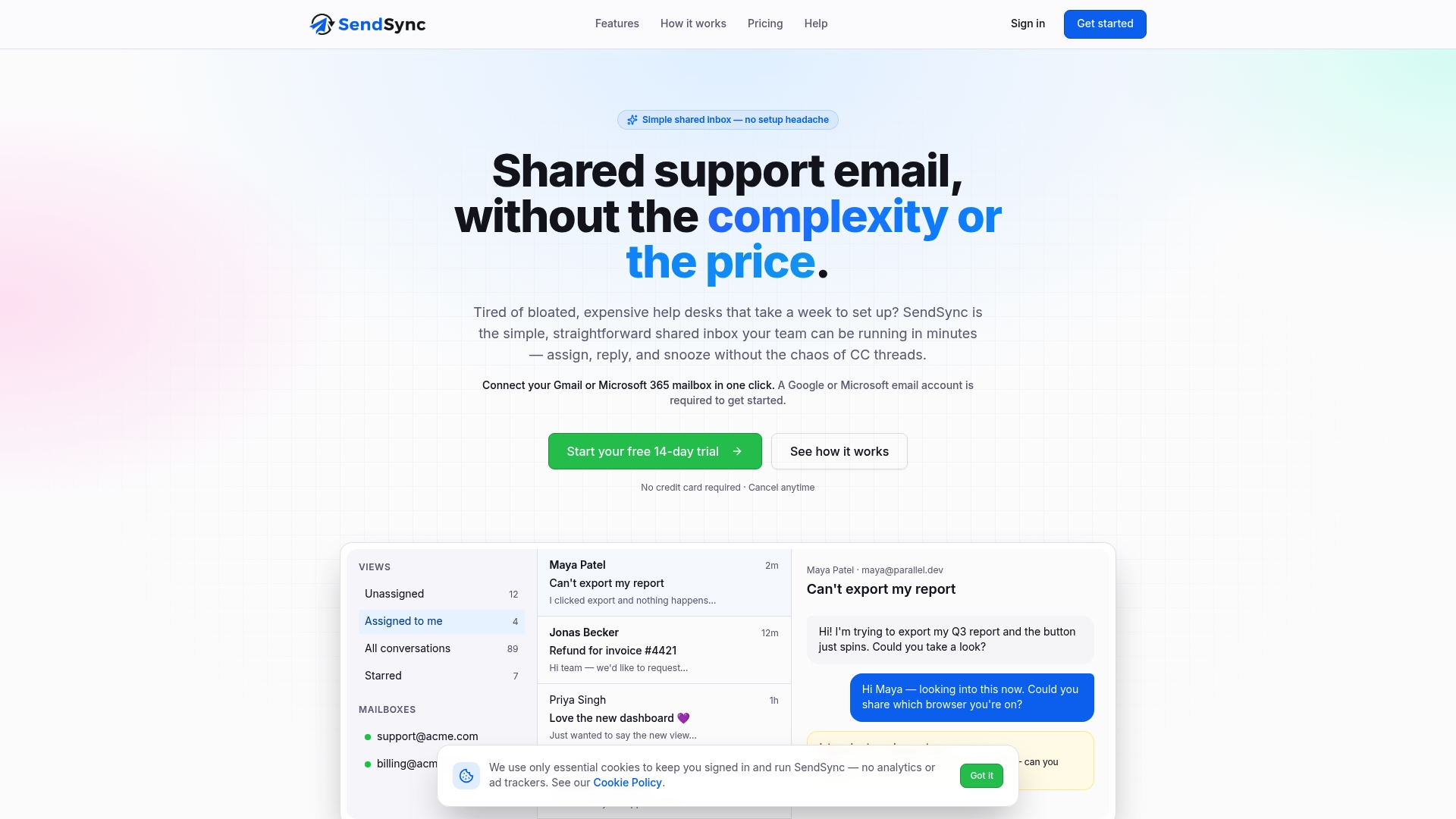
Three things a shared inbox handles that BCC never could:
- Full visibility without hiding anyone. Every teammate with access sees the same conversation, no covert recipients, no guessing who else is watching.
- Assignment instead of ambiguity. Conversations get assigned to a specific person, so “who’s handling this” stops being a question answered by who was quietly copied.
- A real audit trail. Every reply, note, and status change is logged in one place, which beats reconstructing a decision from scattered BCC’d forwards.
Sendsync connects directly to Gmail or Microsoft 365 in minutes, with no DNS setup and no per-seat fees eating into a growing team’s budget. If your team has been leaning on BCC to keep everyone in the loop, start a free trial at Sendsync and see what actual shared visibility looks like instead.
Sources
- Avoid bccing the boss (Cambridge Judge Business School)
- IT’s offers tips for dealing with spam filters when sending mass emails (WVU eNews)
- Three reasons lawyers use BCC and why to stop (NCBar)