
5 Step Inbox SLA Tracking for Support Teams, No Help Desk Migration
5 Step Inbox SLA Tracking for Support Teams, No Help Desk Migration ! Support lead configuring an inbox escalation reminder SLA tracking in a shared inbox means automatically measuring response and resolution time against defined targets for every conversation that lands in your

SLA tracking in a shared inbox means automatically measuring response and resolution time against defined targets for every conversation that lands in your team’s mailbox. The fastest way to get there is lightweight rules paired with automation that creates tracker records and sends alerts before anything slips. The rest of this guide walks through the setup, start to finish.
TL;DR:
- SLA tracking in a shared inbox requires capturing start, due, and closure times, along with ownership and status updates for each conversation.
- Building automation with triggers, delays, and deduplication ensures accurate and reliable tracker records without manual effort.
- Monitoring key metrics like on-time rate, overdue count, and response times helps teams identify issues early and improve service performance.
- Alerts before breaches and live dashboards support proactive management and reduce missed customer responses.
- Small to mid-sized teams benefit from inbox-based SLA tracking for quick setup, while larger or multi-channel operations may eventually need a dedicated ticketing system.
Table of Contents
- What SLA tracking means inside a shared inbox
- Why bother tracking SLAs in the inbox
- Setting up SLA tracking in your inbox: a step-by-step playbook
- Alerts, dashboards, and the metrics worth watching
- Automation recipes you can copy today
- How SendSync supports in-inbox SLA tracking
- When to keep SLA tracking in the inbox versus move to a ticketing system
- Try SendSync to start tracking SLAs in your inbox
- Sources
- FAQ
What SLA tracking means inside a shared inbox
A service level agreement sets the performance standard your team commits to: how fast you respond, how fast you resolve, and during which hours that clock runs. In customer support, an SLA typically spells out service descriptions, turnaround times, operating hours, and what happens when something breaches. Inside an inbox, that agreement becomes a live measurement: each thread gets a start event, a due time, and a status that updates as the conversation moves.
Start and stop events matter more than people expect. A new thread, a fresh customer reply, or a label applied by an agent can all trigger the SLA clock, and the clock stops when someone replies or closes the thread. To track this reliably, capture a few core fields for every conversation:
- Start time: when the SLA clock began (new message, reopened thread, or applied label).
- Due time: the calculated deadline based on your target and business hours.
- Status: on-time, at-risk, or overdue.
- Owner: the agent or queue responsible for the reply.
Why bother tracking SLAs in the inbox
Teams that track SLAs directly where they work catch problems before customers do. Missed commitments become visible the moment a thread crosses its due time instead of surfacing days later in a complaint. Ownership gets clearer too: when every conversation has an assigned owner and a visible deadline, there is no ambiguity about who drops the ball.
The operational payoff shows up in a few specific places:
- Fewer missed replies: overdue conversations get flagged instead of buried in a shared folder.
- Better triage: agents see what’s urgent versus what can wait, rather than working top to bottom.
- Balanced workload: managers can spot when one person is drowning in overdue threads while another has room.
- Trackable metrics: overdue rate and average response time become numbers you can actually report on, not guesses.
Shared inbox setups that build in ownership and escalation rules tend to see fewer conversations fall through the cracks in the first place.
Setting up SLA tracking in your inbox: a step-by-step playbook
Building this out does not require a full help desk migration. Follow these five steps in order.
- Define your SLA types, targets, and operating hours. Separate first-response targets from resolution targets, and decide whether your clock runs 24/7 or only during business hours.
- Choose your SLA start events. Pick the triggers that start the clock: a new inbound thread, a customer reply to an open conversation, or a specific label applied by an agent.
- Build the automation pattern. Capture the thread’s metadata, add a short delay to avoid creating duplicate records when a customer sends two quick follow-ups, check for an existing tracker tied to that thread, then create or update the record. This capture-delay-dedupe-create sequence is the backbone of reliable SLA tracker automation.
- Assign ownership and set escalation windows. Every tracker record needs an owner, plus a reminder window before the due time and an escalation path if that window passes with no action.
- Close and log the resolution. When the thread resolves, stop the clock, log the resolution time, and keep the record as part of your audit trail.
That audit trail is not optional busywork. Capturing timestamps for start, first response, assignment, and closure gives you the evidence to validate SLA performance and settle disputes when a customer questions your record, a practice TechTarget’s SLA breakdown flags as a baseline for any SLA program.
Pro Tip: Build your escalation rule before your first SLA breach happens, not after, so the reminder fires automatically instead of relying on someone remembering to check.
Alerts, dashboards, and the metrics worth watching
Tracking SLAs only pays off if the data reaches someone in time to act. A handful of metrics deserve a permanent spot on your dashboard:
- On-time rate: the share of conversations closed within target.
- Overdue count: how many threads have already breached their due time.
- Time-to-first-response: how long customers wait for the first reply.
- Average resolution time: how long it takes to close a conversation start to finish.
Near-breach alerts matter as much as overdue flags. Set a reminder to fire a set number of minutes before a thread’s due time so the owner has a chance to respond before it slips into overdue territory, rather than finding out after the fact.
Inbox-integrated SLA tracking keeps these numbers visible at the point of work, surfacing overdue and at-risk conversations with a live timeline that updates as each thread’s status changes, instead of requiring a separate reporting portal.

For cadence, a real-time inbox view handles the moment-to-moment work, a daily digest catches what slipped overnight, and a weekly trend report shows whether your overdue rate is improving or creeping up. Teams following shared inbox best practices tend to pair all three rather than relying on one view alone.
Automation recipes you can copy today
These recipes follow the same capture, delay, dedupe, create, assign, close pattern described above. Each one plugs into a different trigger.
- Partner email to tracker record: capture an incoming email, filter it by label, delay 7 minutes to let any quick follow-up arrive, search for an existing thread, then create or update the tracker record with start time, due time, and owner.
- Keyword tagging to queue assignment: auto-tag messages by keyword, route them to the right queue, and set the SLA due timestamp based on the rule tied to that tag.
- Reply closes the loop: when the customer or agent replies, update the tracker record and clear any pending escalation automatically.
A few integration details decide whether this works smoothly. Business hours and time zones need to be set once at the team level so due times calculate correctly across regions, and calendar sync keeps holidays and off-hours from skewing your targets. Teams building out scalable inbox workflows usually standardize these settings before rolling automation out to the whole team.
How SendSync supports in-inbox SLA tracking
A shared inbox can connect a Gmail or Microsoft 365 mailbox in minutes, simplifying setup without DNS configuration. That matters for SLA tracking because the playbook above depends on automation hooks sitting close to where your team already replies, not in a separate system you have to maintain.
Relevant features for the workflow described here include:
- Shared assignment so every thread has one clear owner.
- Tags and labels to trigger SLA start events and route conversations.
- Saved views to surface at-risk and overdue conversations at a glance.
- Automation hooks for the capture, delay, dedupe, and create pattern.
- Dashboards for the on-time rate, overdue count, and response time metrics covered above.
When to keep SLA tracking in the inbox versus move to a ticketing system
Inbox-first SLA tracking fits small-to-mid teams that want a fast rollout without a migration project. High-volume or multi-channel operations, especially ones juggling billing SLAs across email, chat, and phone, usually outgrow it. Watch for frequent breaches despite automation or growing channel sprawl as your signal to move. A hybrid approach, migrating one queue at a time, beats a single disruptive cutover.
— Nick
Try SendSync to start tracking SLAs in your inbox
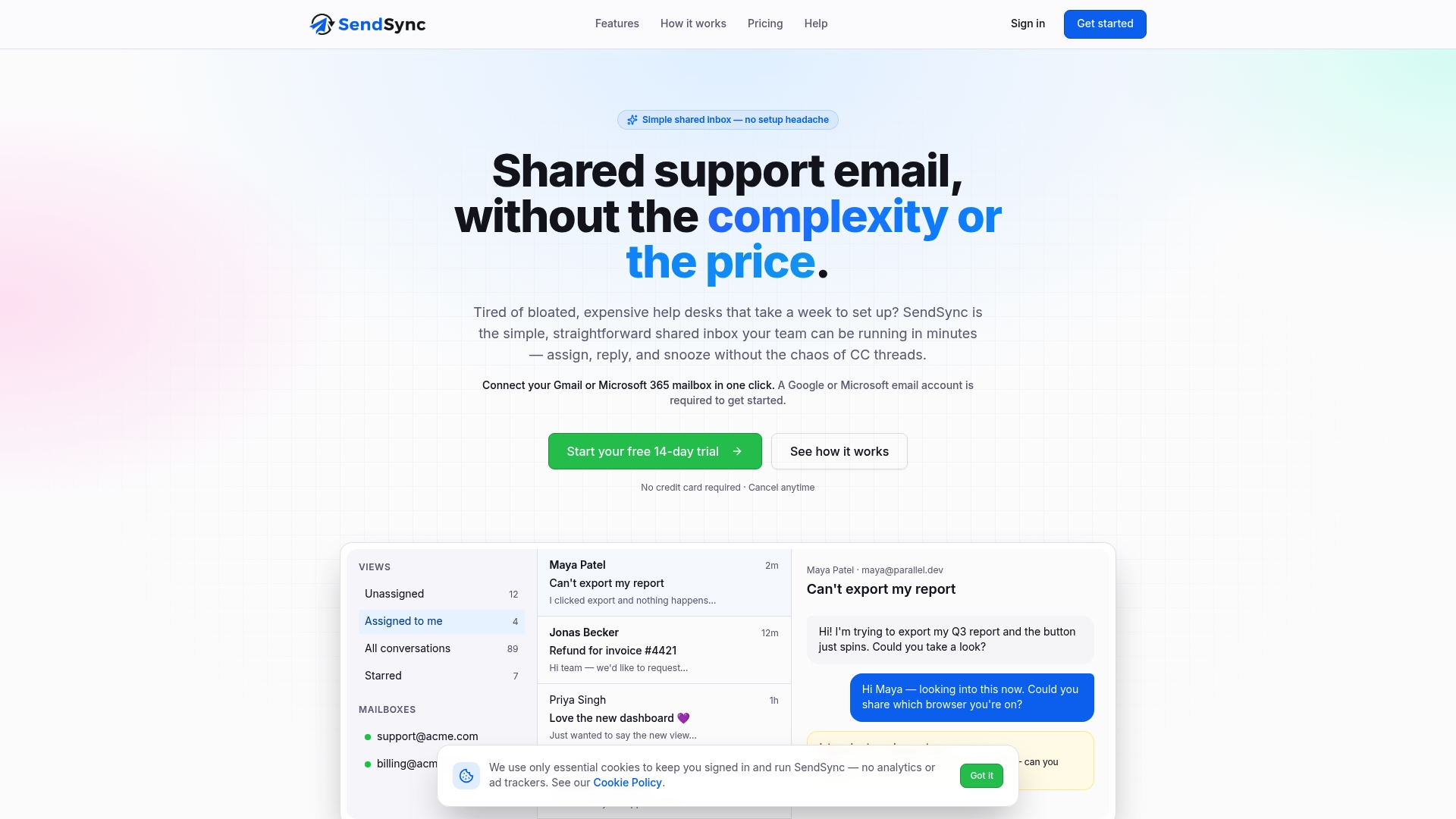
Setting up SLA tracking does not have to mean months of configuration. SendSync connects your existing Gmail or Microsoft 365 mailbox in minutes and supports unlimited users with no per-seat fees, so the whole team can own conversations and SLA targets without a licensing spreadsheet.
Next steps are simple:
- Start a 14-day free trial and connect your mailbox.
- Import the automation recipes from this guide as a starting point.
- Check the plans page to compare Founder, Starter, Growth, and Scale, or request a demo if you want a walkthrough first.
Sources
For more on SLA definitions and monitoring, see TechTarget’s SLA overview and the Wikipedia entry on service level agreements. For automation patterns, see Zapier’s SLA tracker guide and this practical SLA tracking guide.
- What is a service-level agreement (SLA)? | Definition from TechTarget
- Create SLA tracker records from partner service emails — Zapier
FAQ
What does SLA tracking mean?
SLA tracking means measuring whether your team meets agreed performance targets, like response and resolution time, for each customer interaction. In a shared inbox, it works by timestamping key events (thread start, reply, closure) and comparing them against your targets automatically.
What is an SLA in email?
An SLA in email is a defined commitment, such as replying within a set number of hours, applied to conversations in your inbox. It typically includes service descriptions, turnaround times, and business hours that determine when the clock runs.
How do you track SLA?
You track SLA by defining start and stop events for each conversation, setting targets and operating hours, then using automation to create a tracker record that updates as the thread moves. Capturing timestamps for start, first response, and closure gives you the data to report on-time rate and overdue conversations.
What does SLA mean in helpdesk?
In a helpdesk or shared inbox context, SLA refers to the response and resolution targets your team has committed to for incoming requests. Helpdesk and inbox tools apply these targets per conversation and flag items as on-time, at-risk, or overdue based on how close they are to the deadline.