
Support teams: Set up a shared inbox without forwarding in two weeks
Support teams: Set up a shared inbox without forwarding in two weeks ! Administrator setting up shared inbox access You can stop forwarding emails by choosing one of two routes: native mailbox delegation or shared mailboxes built into Gmail and Microsoft 365, or a dedicated share

You can stop forwarding emails by choosing one of two routes: native mailbox delegation or shared mailboxes built into Gmail and Microsoft 365, or a dedicated shared-inbox platform layered on top of either. Small, low-volume teams usually do fine with native delegation. Support teams that need assignment, internal notes, or response metrics outgrow it fast. The right pick depends on volume and workflow, and the setup steps and policies below will get you there.
TL;DR:
- Native delegation and shared mailboxes are suitable for small teams handling low email volume, but they lack assignment, internal notes, and performance metrics as volume grows.
- Shared-inbox platforms add features like message ownership, internal notes, automation, and reporting, which are essential for managing larger, more complex workflows.
- Setting up native tools involves simple configuration steps with Gmail delegation or Microsoft 365 shared mailboxes, but they can cause issues like reply collisions and limited tracking.
- Using a platform such as SendSync allows quick connection to existing mailboxes, offering advanced collaboration features without complex DNS changes or per-seat pricing.
- Establishing clear policies on ownership, naming conventions, and regular permission reviews prevents teams from reverting to old forwarding habits.
Table of Contents
- What a shared inbox without forwarding actually means
- How Gmail delegation and Microsoft 365 shared mailboxes work
- Why native delegation and shared mailboxes still frustrate support teams
- The feature checklist that actually replaces forwarding
- Step-by-step: moving your team off forwarding
- Policies that keep “no forwarding” from quietly reverting
- How SendSync sets up a shared inbox without forwarding
- A simple rule for choosing native versus a platform
- Try a shared inbox that skips the setup headaches
- FAQ
- Sources
What a shared inbox without forwarding actually means
Forwarding copies a message from one inbox to another, which multiplies copies, breaks reply threads, and leaves no record of who is handling what. A shared inbox without forwarding means several people work from one mailbox or one shared view of it, so there’s a single thread, a single source of truth, and no duplicate replies crossing in transit.
There are two practical ways to get there. The first is native: Gmail delegation or a Microsoft 365 shared mailbox, both built into the email platform you already pay for. The second is a shared-inbox platform, a layer of software that connects to your existing Gmail or Microsoft 365 account and adds collaboration features neither provider includes out of the box.
Native options work well when the volume is low and the team is small. A two-person team handling a few dozen emails a day can delegate access to a shared Gmail account or open a Microsoft 365 shared mailbox and call it done. There’s no extra subscription, no new login, and no learning curve beyond “right-click to add this account.”
The limits show up as volume grows. Native delegation has no concept of who owns a message, no way to leave a note for a teammate without it going to the customer, and no dashboard showing how long people take to reply. That’s where a shared-inbox platform earns its subscription fee: it keeps the same mailbox but adds assignment, internal notes, automated routing, and reporting.
A short pros-and-cons view makes the trade-off concrete:
- Native delegation or shared mailboxes: free with your existing plan, fast to set up, but no assignment, no internal notes, and no reporting.
- Shared-inbox platforms: add ownership, notes, automation, and metrics, but cost a monthly fee and require connecting your mailbox to a third party.
- Hybrid reality: many teams start native and migrate once ticket volume or team size makes coordination painful.
- Decision shortcut: if you’ve ever asked “did anyone reply to this yet?” in a team chat, you’ve already outgrown native-only.
Neither approach requires forwarding a single message, which is the point. The question isn’t whether to stop forwarding. It’s which tool replaces it.
How Gmail delegation and Microsoft 365 shared mailboxes work
Both platforms let multiple people act from one address without CC, BCC, or forwarding, but they work differently and have different ceilings.
Gmail delegation, as Google’s support documentation explains, lets an account owner grant another user the ability to read, send, and delete messages from their inbox. Delegates access the mailbox by switching accounts inside Gmail rather than logging in separately, and administrators can enable or restrict delegation at the organization level. Google also documents how admins can let users delegate access to a Gmail account across a domain, which is the setting you’ll need to turn on before anyone can delegate at all. Delegation only works within the same Google Workspace organization, and Google caps how many delegates a single mailbox can have, so it’s built for small teams, not large ones.
Microsoft 365 shared mailboxes work through Exchange Online and rely on three distinct permission types, according to Microsoft Learn’s documentation on shared mailboxes:
- Full Access lets a user open the shared mailbox and read, send, and delete messages as if it were their own.
- Send As lets a user send messages that appear to come directly from the shared mailbox address, with no “on behalf of” tag.
- Send on Behalf lets a user send messages that show both their name and the shared mailbox’s, and it requires a separate PowerShell command (
Set-Mailbox) rather than the same toggle used for the other two permissions.
Most teams grant Full Access and Send As together so replies look clean and consistent. Admins set this through the Microsoft 365 admin center or PowerShell, and Microsoft’s own guidance recommends testing from a non-admin account afterward, since permission changes can take time to propagate.
A few admin gotchas trip people up every time: delegation and shared mailbox access are typically restricted to users inside the same domain or tenant, so an external contractor usually needs a guest account first. Both platforms also have practical ceilings on concurrent access. Gmail delegation tends to get clunky once more than a handful of people are switching into the same account throughout the day, and heavy simultaneous use on either platform can cause sync delays or “who’s typing a reply right now” confusion.
Pro Tip: Before rolling access out to the whole team, test sending, replying, and deleting from a test account with the exact permission level you plan to assign, not an admin account, since admin accounts often have access that regular users don’t.
Why native delegation and shared mailboxes still frustrate support teams
Native delegation and shared mailboxes solve the forwarding problem but create a new one: everyone can see and send from the mailbox, but nobody can coordinate inside it.
The most common complaint is the absence of private internal notes. If someone needs to say “I already answered a near-identical ticket, see our macro” or “escalate this to billing,” there’s no way to attach that note to the thread without it accidentally going to the customer. Teams end up solving this with a parallel Slack channel or a spreadsheet, which defeats the purpose of having one shared mailbox in the first place.
There’s also no collision detection. Two people can open the same message, both start replying, and only find out they duplicated effort when the customer gets two answers. Native tools have no concept of “this message is assigned to Priya” or “this message is already being handled.”
Reporting is another gap. Neither Gmail delegation nor a Microsoft 365 shared mailbox tracks first-response time, reopen rate, or how evenly work is distributed across the team. If a manager wants to know whether the team is meeting a service-level target, there’s no dashboard to check, just a manual count.
- No internal notes: private context has to live outside the mailbox, usually in a separate chat tool.
- No collision detection: two agents can reply to the same message without knowing it.
- No native reporting: first-response time and workload balance require manual tracking.
- Shared-credential risk: when delegation isn’t available or is misconfigured, teams sometimes fall back on sharing a single login and password, which makes it impossible to audit who sent what.
Google Workspace’s own knowledge base notes that native delegation and shared mailboxes avoid forwarding and cost nothing beyond the existing subscription, but lack the private notes, automated triage, and metrics dashboards that specialized collaboration tools provide. That gap is exactly what pushes growing teams toward a dedicated platform rather than stretching native tools further.
The feature checklist that actually replaces forwarding
Once a team outgrows native delegation, the temptation is to shop by brand name. A more useful approach is to check any tool, native or third-party, against the specific gaps that caused the problem in the first place.
Ownership and status. Look for the ability to assign a message to a specific person, mark it open, pending, or closed, and see at a glance who is responsible. Without this, “who’s handling this” becomes a question asked out loud a dozen times a day.
Internal collaboration. Private notes attached to a thread, visible only to teammates, are the single feature that most directly replaces the old habit of forwarding a message with “can you take this?” typed above it.

Automation. Keyword-based routing (billing questions to one person, technical questions to another), round-robin assignment, and canned replies for repetitive questions all reduce the manual triage that forwarding used to half-solve.
Reporting. SLA tracking, first-response time, and per-agent workload numbers turn “I think we’re keeping up” into an actual answer. This is the feature most teams don’t know they’re missing until they have it.
Security. Role-based access (so a part-time contractor sees less than a full-time manager), audit logs showing who sent or deleted what, and multifactor authentication matter more once several people share access to one address. Teams handling sensitive client communication should also look at how a connector authenticates, since guidance on secure business email points out that compliance and audit requirements often get overlooked when inboxes are shared casually.
Integrations. A connector for Gmail or Microsoft 365 that doesn’t require new DNS records, plus hooks into a CRM and the ability to save a filtered view (all open billing questions, for instance), keeps the shared inbox from becoming an isolated tool the rest of the team ignores.
- Assignment and status markers replace “who’s got this.”
- Internal notes replace side-channel forwarding.
- Automation replaces manual sorting.
- Reporting replaces guesswork about response times.
- Security and integrations keep the whole setup auditable and connected to the rest of your stack.
Pro Tip: Score any option against this checklist before you look at pricing. A cheap tool missing internal notes will cost you more in confusion than a pricier one that has them.
Step-by-step: moving your team off forwarding
Whether you’re staying native or adding a platform, the rollout follows the same shape: decide, pilot, configure, test, train, measure.
1. Decide your approach. If your team is under five people and handles light volume, native delegation or a shared mailbox may be enough. If you need assignment, notes, or reporting, plan to add a platform on top of your existing mailbox.
2. Assign an owner. One person, usually whoever has admin rights to your email platform, should own the rollout from setup through the first month of use.
3. Configure the mailbox.
For Gmail, set up either a dedicated shared account or use delegation on an existing one:
- Create the shared address or confirm the mailbox you’ll use.
- Ask your Workspace admin to enable delegation for your organization if it isn’t already on.
- Add each team member as a delegate through Gmail settings under “Accounts.”
- Have one delegate send a test message to confirm it arrives correctly and that replies thread properly.
- Update any existing auto-forward rules pointing at this address so they’re turned off, not stacked on top of delegation.
For Microsoft 365, create a shared mailbox through the admin center:
- Create the shared mailbox and assign it an address.
- Grant Full Access and Send As to each team member who needs to work from it.
- Have each user add the shared mailbox in Outlook so it appears as a second inbox in their own account.
- Confirm that outgoing replies show the shared address, not an individual’s personal account, by sending a test message.
4. Connect a shared-inbox platform, if you’re using one. Link your Gmail or Microsoft 365 mailbox through an OAuth connection rather than new DNS records, which keeps setup to minutes instead of days. Map any routing rules you want (billing to one queue, technical questions to another), turn on internal notes and collision detection, and set your first-response and resolution SLA targets.
5. Test before rollout. Send a handful of real-world test messages covering your most common ticket types and confirm that assignment, notes, and automation all behave as expected.
6. Train the team. A fifteen-minute walkthrough covering how to claim a message, leave a note, and mark something resolved prevents most of the confusion that shows up in week one.
7. Measure after two weeks. Check first-response time and see whether anything is falling through the cracks that didn’t before.
- Pilot with a single address and a small group before rolling out to the whole team.
- Keep the old forwarding rule documented, not deleted, for the first week in case you need to fall back.
- Tell everyone outside the pilot team what’s changing and when, so customers and coworkers aren’t confused by a new reply address.
Pro Tip: Run the pilot for two to four weeks on one address before expanding. That’s long enough to hit a normal range of ticket types without dragging the decision out.
Policies that keep “no forwarding” from quietly reverting
Setting up a shared inbox without forwarding solves the technical problem. Without a few operating rules, teams tend to drift back into old habits within a month.
Ownership and escalation. Decide upfront who owns a message once it’s claimed, and write down a simple escalation path for anything that sits unanswered past your SLA. If nobody owns the exception, it becomes everyone’s problem and no one’s job.
Naming and routing conventions. Use consistent, descriptive names for shared addresses and any folders or tags (support@, billing@, not generic labels that require tribal knowledge to interpret). This matters more once you add automation, since routing rules depend on predictable naming.
Assignment etiquette. Set a simple norm: claim a message before replying, leave a note if you’re unsure rather than guessing, and transfer ownership explicitly rather than just going quiet on a thread. This single habit prevents most collision problems even in tools without built-in detection.
Access reviews. Review who has delegate or Full Access permissions on a regular cadence, especially after someone leaves the team or changes roles. Shared access that nobody revokes is a common source of security gaps.
Measurement cadence. Track first-response time and reopen rate (how often a closed message gets reopened) on a weekly or biweekly basis, not just when something goes wrong. These two numbers catch most coordination problems before they become customer complaints.
- Write down who owns escalations, not just who answers the first message.
- Standardize address and folder names before you add automation rules.
- Require a claim or note before replying to avoid duplicate responses.
- Review delegate and Full Access permissions on a set schedule, not only when prompted.
- Track first-response time and reopen rate every one to two weeks.
Pro Tip: Put these five rules on a single page and share it during onboarding. Teams that document the norm in writing revert to forwarding far less often than teams that rely on word of mouth.
How SendSync sets up a shared inbox without forwarding
We designed a shared inbox platform that fills the gap between native delegation and a full help desk: fast to connect, no DNS changes, and no per-seat pricing to negotiate. Connecting a Gmail or Microsoft 365 mailbox takes minutes through an OAuth link rather than a DNS migration, which is the step that usually stalls a pilot before it starts, as we cover in our guide to connecting a Gmail team inbox.
Once connected, a team can access features that native delegation lacks: assignment to see message ownership, private internal notes for side conversations that never reach the customer, automated routing rules, and metrics views for first-response time and workload distribution. We outline how this differs from basic delegation in our piece on what a collaborative email workspace actually is, and walk through the practical setup in Live in 20 Minutes for teams that want to avoid long configuration cycles.
- Assignment and status tracking help clarify responsibility.
- Internal notes keep context attached to the thread instead of scattered across chat apps.
- Automated routing and canned replies reduce repetitive manual sorting.
- Reporting on first-response time and workload provides managers with clear metrics.
For teams managing sensitive client correspondence, pairing a shared inbox with solid access hygiene is important, which is why role-based access and audit visibility are emphasized in setup guidance.
A simple rule for choosing native versus a platform
The honest answer is that most teams overthink this decision. If you’re under five people and handling a light, predictable volume of email, native delegation or a Microsoft 365 shared mailbox will carry you further than you’d expect, and adding a paid tool too early just adds a login nobody needed. The moment you can’t answer “who’s handling this” without asking out loud, or a manager wants a real number for response time, you’ve outgrown native tools regardless of your headcount. Don’t debate this in a meeting for a month. Pick one address, run a two-week pilot with whichever approach fits your current size, and let the actual friction (or lack of it) make the decision for you.
— Nick
Try a shared inbox that skips the setup headaches
If the checklist above sounds like more coordination than your current Gmail or Microsoft 365 setup can handle, a shared-inbox platform can help skip the painful parts of migration. Connecting your existing mailbox may take minutes, with no DNS changes required, and plans may offer unlimited users instead of per-seat charges.
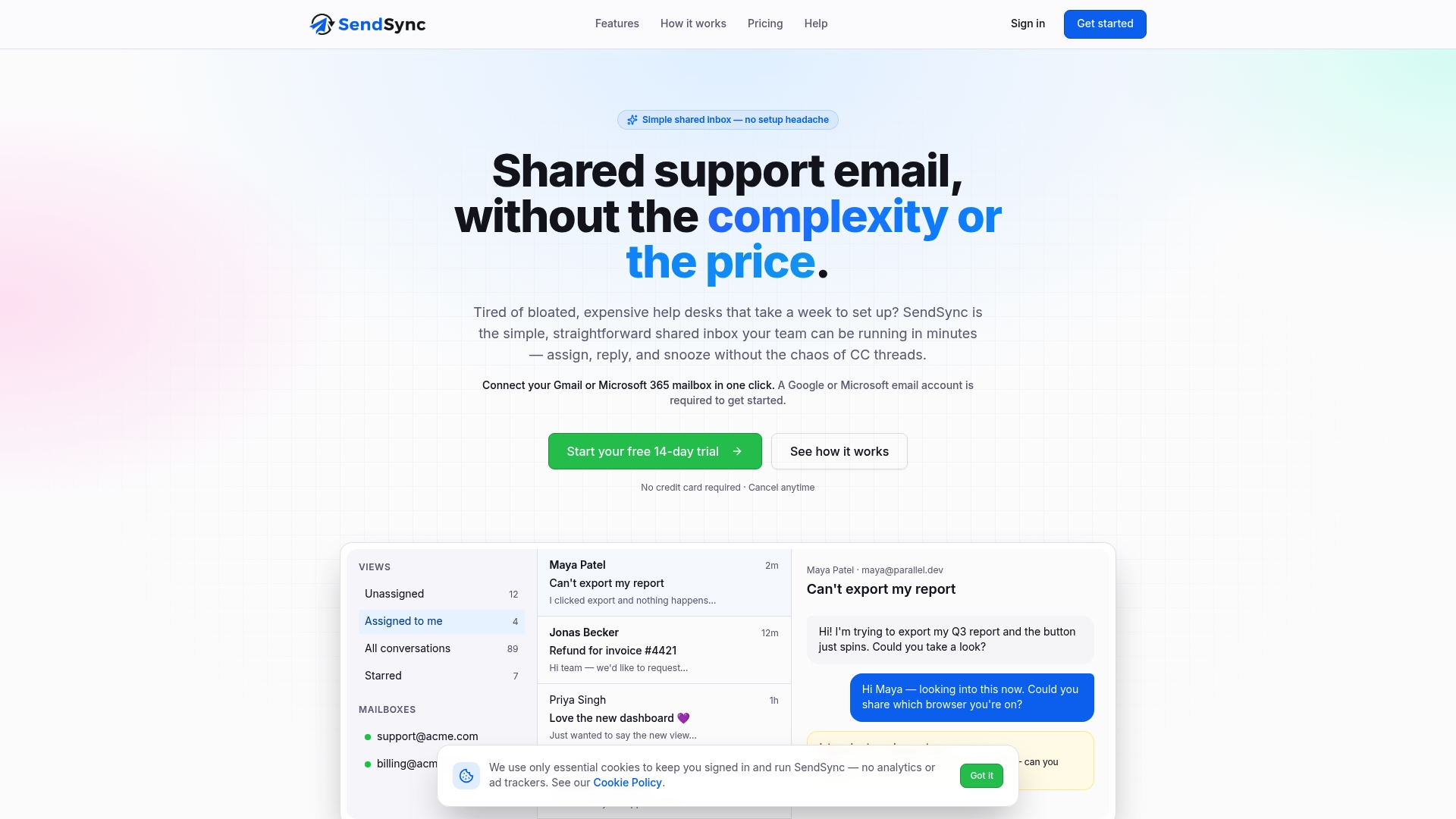
A short pilot is the fastest way to know if it’s worth switching. During a trial, test the parts that matter most:
- Connect your Gmail or Microsoft 365 mailbox and confirm messages flow through normally.
- Assign a handful of real messages and leave an internal note on one.
- Check whether your first-response time actually improves after a week.
Visit Sendsync to start a 14-day trial, or review our Gmail connection guide first if you want to see the exact steps before committing.
FAQ
How can I send the same email without forwarding it?
Instead of forwarding, use delegation (Gmail) or Full Access and Send As permissions (Microsoft 365 shared mailboxes) so a teammate can reply directly from the original address. This keeps the thread intact and avoids duplicate copies landing in separate inboxes, as described in Microsoft’s shared mailbox documentation.
What is the best way to manage a shared mailbox?
Native delegation or a Microsoft 365 shared mailbox works well for small teams with light volume, while a dedicated shared-inbox platform adds assignment, internal notes, and reporting once volume or team size grows. The right choice depends on whether you need to track who owns each message and how quickly your team responds.
What are the disadvantages of using a shared mailbox?
Shared mailboxes typically lack private internal notes, automated assignment, and collision detection, so two people can unknowingly reply to the same message. They also provide little to no built-in reporting on response times or workload, which Google’s own documentation acknowledges as a limitation compared to specialized collaboration tools.
Can you set up forwarding on a shared mailbox?
Yes, forwarding can technically be configured on a shared mailbox, but it defeats the purpose, since it creates duplicate copies and breaks the single-thread view that delegation or Full Access permissions are designed to preserve. Most teams disable any existing forwarding rules once they move to delegation or a shared mailbox setup.
Sources
- Delegate & collaborate on email - Computer - Gmail Help
- Shared mailboxes in Exchange Online | Microsoft Learn
- Let users delegate access to a Gmail account - Google Workspace Knowledge