
Stop Duplicate Replies: Six Step Email Assignment Workflow
Stop Duplicate Replies: Six Step Email Assignment Workflow ! Support lead assigning shared inbox email An email assignment workflow is the process that takes a message landing in a shared inbox and turns it into a task with one clear owner.

An email assignment workflow is the process that takes a message landing in a shared inbox and turns it into a task with one clear owner. The pattern that works best combines automated triage, rule-driven routing, and a single named owner per message, then closes the loop with a confirmed reply. Start today by building one auto-assign rule and a three-view queue: Waiting, Mine, and All Taken. Success looks like zero duplicate replies, visible ownership on every thread, and a faster time to first reply.
TL;DR:
- Effective email workflows should include a single owner assignment and clear ownership visibility to prevent duplicate replies and missed messages.
- Automating triage with rules based on sender, subject, and intent helps route messages accurately, but low-confidence cases must go to manual review to maintain quality.
- Using atomic claim mechanisms or unique constraints is essential to avoid race conditions where multiple team members reply to the same message simultaneously.
- Visual queue splits like Waiting, Mine, and All Taken improve individual focus and oversight, reducing ownership conflicts.
- Tracking key metrics such as time to first reply and resolution time guides workflow improvements and SLA compliance.
Table of Contents
- What an email assignment workflow is and why teams need it
- Step-by-step workflow: arrival, triage, routing, assignment, reply, and close
- Automation and routing rules: safe AI-assisted triage and rule examples to copy
- Preventing collisions and technical guardrails for reliable ownership
- Roles, SLAs, and KPIs to measure and improve your workflow
- Author perspective: a practical playbook and checklists
- Examples of email assignment workflows across industries
- How to integrate with common mail clients
- What most teams get wrong about assignment workflows
- Try SendSync for queue-based routing and assignment
- Primary sources and further reading
- Sources
- FAQ
What an email assignment workflow is and why teams need it
For a shared team inbox, an email assignment workflow is the set of steps that moves a message from “arrived” to “someone owns this” to “resolved.” It is not the same thing as a marketing sequence. Inbound workflows are built around routing, ownership, and closure rather than timed, scheduled sends, a distinction that Campaign Monitor draws clearly when separating outbound campaigns from operational email handling.
Teams without a real assignment workflow tend to run into the same problems: messages get missed because nobody claims them, two people reply to the same customer without knowing it, and ownership lives only in someone’s memory rather than in the system.
A few signals mean you need one now:
- Two teammates have replied to the same thread within the same day.
- Messages sit unassigned for hours before anyone notices them.
- Your team misses response-time targets even though total volume hasn’t grown.
Once you see these patterns, the fix is structural, not a reminder to “check the inbox more often.”
Step-by-step workflow: arrival, triage, routing, assignment, reply, and close
Every reliable workflow follows the same six-step shape, regardless of the tool running it.
- Capture: record the sender, subject, headers, and account context the moment a message arrives, and normalize it into a consistent record.
- Triage: classify automatically where confidence is high, and route anything ambiguous to a quick human screen.
- Route: apply rules based on sender domain, account ownership, or round-robin distribution.
- Assign: lock in a single named owner, never a team or a distribution list.
- Respond: the owner replies, then marks the thread read, closed, or pending for follow-up.
- Close: confirm resolution, log the handoff if one happened, and spin up a follow-up task when the thread isn’t fully done.
The step most teams skip is the close. A thread that gets a reply but never gets marked resolved quietly builds up until nobody trusts the “open” count anymore.
Pro Tip: Treat “assigned” and “replied” as two separate states. A message can be assigned and still waiting on the customer, and your queue view should show that difference.
Automation and routing rules: safe AI-assisted triage and rule examples to copy
Automated routing works best as a layer of rules, not a black box making final calls. Practitioner guidance on rule-engine design recommends combining sender, subject, and intent classification into routing decisions, then sending anything ambiguous to a manual review queue rather than letting a model guess.
A starter ruleset you can copy:
- sender-domain-to-owner: mail from a named enterprise account routes directly to that account’s owner.
- subject-tag-to-team: subject lines containing “[bug]” or “[billing]” route to product or finance.
- keyword-intent-to-queue: phrases like “cancel my plan” route to a retention queue before anything else.
- round-robin-fallback: anything left unmatched cycles evenly across available agents.
- low-confidence-to-review: classifications below your confidence threshold land in a manual review queue instead of auto-assigning.
Combining rule confidence with routing significantly changes reply quality. Rule-engine practitioners note that treating automation as a routing layer, with low-confidence output reserved for human review, keeps quality control intact rather than letting misclassified messages ship straight to the wrong owner.
Layer in account tier and SLA urgency alongside intent, so a message from a high-tier account with an urgent keyword jumps the queue instead of waiting its turn.
Preventing collisions and technical guardrails for reliable ownership
The most common failure in a shared inbox is two people replying to the same message at once. Developer documentation on shared team inboxes identifies this race condition as the most frequent production bug in these systems, and the fix is structural rather than a matter of team discipline.
- Avoid read-then-write claims: use a conditional update or a unique constraint so a claim either succeeds atomically or fails outright, never a check followed by a separate write.
- Treat zero-affected-rows as “already claimed”: if your claim attempt affects no rows, someone else got there first, and your interface should say so immediately.
- Use short-lived presence signals: a teammate who sees “Sam is viewing this” can back off before drafting a duplicate reply.
- Sync status and read state together: flip your internal status and the mailbox’s read or unread state inside a single handler, or the two will drift apart within days.
Queue design should default agents to narrow personal views, Waiting and Mine, while a team lead gets an All Taken view for oversight. That three-queue split is a pattern documented in shared-inbox best practices precisely because it keeps individual agents focused while still giving leads visibility across the whole inbox.
Roles, SLAs, and KPIs to measure and improve your workflow
You cannot improve what you don’t measure, and an email assignment workflow has a small set of numbers that matter more than the rest.
- Time to first reply: how long a message waits before any human response.
- Assignment latency: how long a message sits unassigned after arrival.
- Median resolution time: how long a thread stays open from first message to close.
- Reassign rate: how often a message changes owners, a proxy for routing accuracy.
- SLA adherence: the share of messages answered within your committed window.
Message content also affects your numbers in a predictable way. Short, direct messages get replies far more often than long ones. Research on email reply prediction found messages with an explicit request had roughly double the reply rate compared to those without, and reply rates peak around 40 words before declining sharply by 500 words. That’s worth remembering when you’re coaching agents on how to phrase a reply that needs a quick answer back.
Assign clear roles: a triage agent classifies and routes, an owner replies and closes, a reviewer catches low-confidence cases, and a team lead monitors SLA adherence across the All Taken view. Run a 14-day measurement window before changing rules again, so you’re comparing like against like.
Author perspective: a practical playbook and checklists
I’ve spent time building and refining assignment rules across shared inboxes, and the checklists here reflect what consistently holds up under real message volume rather than what sounds tidy on a whiteboard. Three quick wins get you most of the benefit fast: name your queues clearly, write one to three auto-assign rules instead of twenty, and turn on presence or claim signals before you scale headcount. For deeper walkthroughs, SendSync’s guide on assigning emails to teammates effectively and its email triage automation guide cover the mechanics in more detail.
Examples of email assignment workflows across industries
A support team at a small SaaS company typically routes by keyword intent: billing questions go to finance, bug reports go to product, and everything else lands in a general queue with round-robin assignment. A financial operations team handling high volumes of inbound requests needs stricter human review layered on top of automation. Guidance on high-volume teller workflows makes a similar point about automated routing at FX counters: automation speeds up the routine cases, but human review stays in place for anything unusual or high-stakes, which maps directly onto low-confidence email routing.
A mortgage or lending team often needs email assignment tied to a downstream task system, since a single inquiry can spawn document requests, underwriting handoffs, and follow-up calls. Guidance on mortgage workflow automation frames this as connecting email assignment to CRM activity tracking so nothing falls through between the inbox and the task list. A small agency, by contrast, might get by with just three rules: client-domain-to-account-manager, “urgent” keyword to lead partner, and everything else to a shared queue. The pattern scales down as easily as it scales up. What stays constant across all of these is the same shape: capture, route, assign one owner, close.

How to integrate with common mail clients
Most teams run their assignment workflow on top of Gmail or Microsoft 365 rather than replacing their mail client outright. In Gmail, shared inbox patterns usually rely on labels or a delegated shared account, with an assignment layer added on top to track who owns which thread, since Gmail itself has no native concept of “assigned to.” Outlook shared mailboxes work similarly: multiple people can access one mailbox, but nothing in Outlook natively prevents two people from replying to the same message at the same time.
That’s why the ownership layer has to live outside the raw mailbox state, in a system that tracks status separately and syncs it back. Developer documentation on shared inboxes recommends exactly this: keep an internal status column distinct from the provider’s read or unread flag, and update both inside one handler so the two never drift out of sync. Some teams bolt on email-to-task conversion for richer status tracking. Community examples of assigning tasks from email show teams converting inbound messages into task items so they get due dates and status fields beyond a simple open or closed flag. For teams that want this built in from the start rather than assembled from separate tools, SendSync’s guide on email ownership in Gmail and Outlook covers the setup directly.

What most teams get wrong about assignment workflows
Most advice on this topic focuses on picking the right automation tool, as if the software is the hard part. It isn’t. The hard part is deciding, in writing, who owns a message the instant it’s ambiguous, and building a queue that makes that ownership visible without anyone having to ask. Teams that skip the queue design and jump straight to “smart routing” end up with faster misrouting, not faster resolution.
The other overrated idea is that more rules mean better routing. In practice, three or four well-chosen rules with a solid fallback queue outperform twenty narrow rules that quietly conflict with each other and nobody remembers to update. If you take one thing from this, prioritize the atomic claim and the three-queue view before you touch automation at all. Automation on top of broken ownership just produces faster collisions.
— Nick
Try SendSync for queue-based routing and assignment
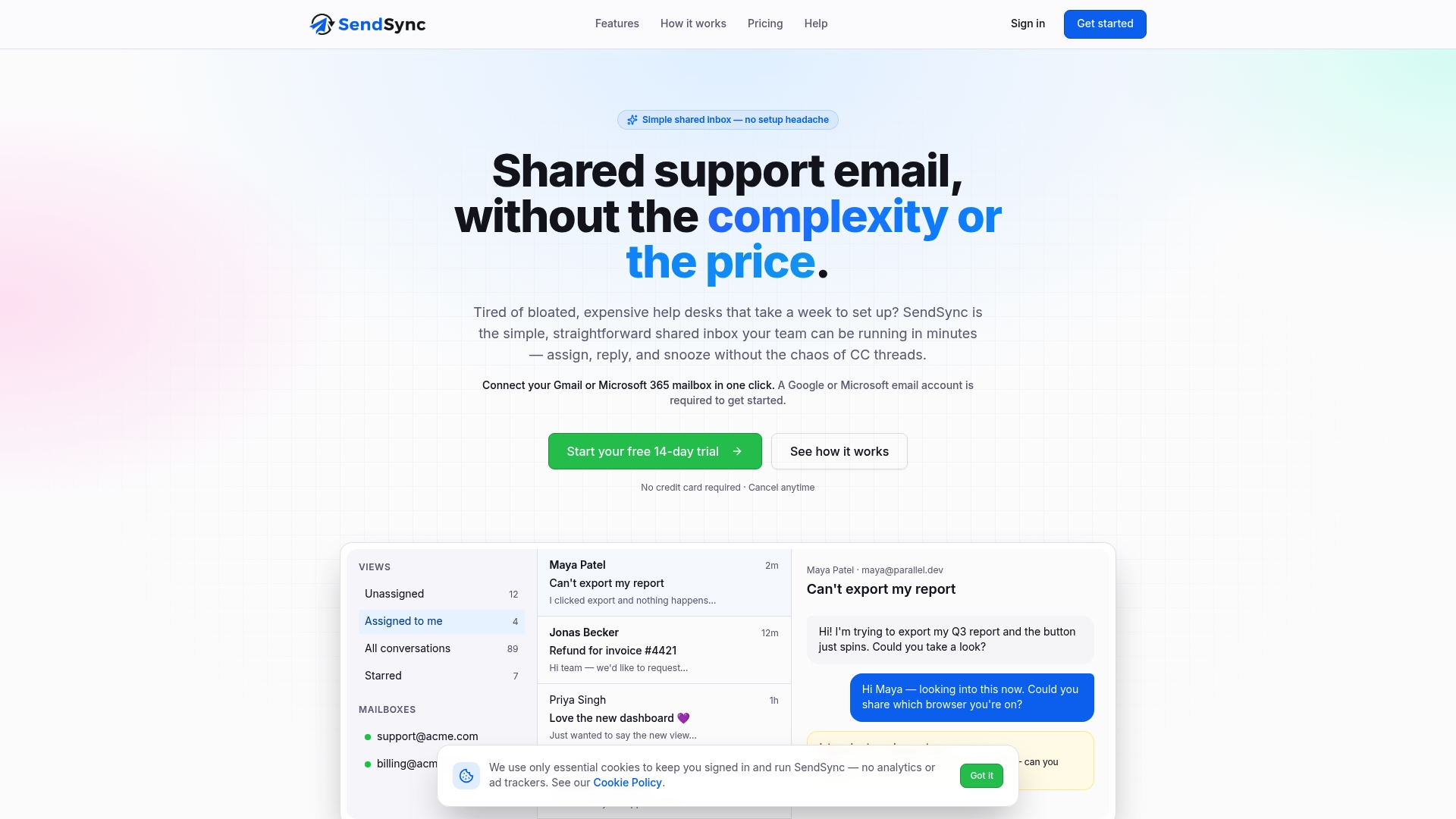
SendSync connects a Gmail or Microsoft 365 mailbox in minutes, without DNS setup, and gives you the queue-based routing and single-owner assignment this article describes, with unlimited users and no per-seat fees.
A practical way to test it:
- Connect your existing Gmail or Microsoft 365 mailbox.
- Add one auto-assign rule based on sender domain or keyword.
- Measure your baseline time to first reply for two weeks before adding more rules.
SendSync offers several pricing plans at different price points. You can see the full lineup and start a trial on the SendSync pricing page.
Primary sources and further reading
This article draws on developer documentation for shared inbox design, published research on email length and reply behavior, and practitioner guidance on rule-engine based routing, linked throughout the sections above.
Sources
- Build a shared team inbox (Nylas developer docs)
- Email Routing Automation Software | AI Rule Engine
- Queues & assignment - Calypso Docs
FAQ
What Are the 5 C’s of Email Writing?
Definitions vary across sources, but a common version covers being clear, concise, correct, courteous, and complete. In an assignment workflow context, clarity and conciseness matter most: shorter, direct messages get replies far more often, with an explicit ask nearly doubling reply rates according to research on email reply prediction.
What Is the Process of an Email Workflow?
An email workflow for a team inbox moves a message through capture, triage, routing, assignment to a single owner, a reply, and a confirmed close. This differs from a marketing email workflow, which Campaign Monitor describes as a timed sequence of outbound sends rather than an inbound routing process.
What Are the Steps of a Workflow?
For email assignment specifically, the steps are capture, triage, route, assign, respond, and close. Each step maps to an action a shared inbox tool should support directly: classifying a message, applying a rule, locking in one owner, and confirming resolution.
What Is the 12-Second Rule for Emails?
There is no established rule backed by research on email response behavior. What research does show is that shorter messages with a clear, explicit request get replies far more reliably than long or vague ones, which matters more for your reply rate than any fixed time limit.
How Do You Stop Two People From Replying to the Same Email?
Use an atomic claim, a conditional update or unique constraint, so only one person can successfully take ownership of a message, and treat a failed claim attempt as a signal that someone else already has it. Developer guidance on shared team inboxes identifies this exact race condition as the most common bug in shared inbox systems, alongside short-lived presence signals that let teammates see who’s already viewing a thread.