
Why Duplicate Replies Happen in Support Teams
Why Duplicate Replies Happen in Support Teams ! Team lead reviewing support tickets in office Duplicate replies in customer support are defined as two or more responses sent to the same customer message, caused by technical delivery guarantees, concurrent processing, or coordinat

Duplicate replies in customer support are defined as two or more responses sent to the same customer message, caused by technical delivery guarantees, concurrent processing, or coordination failures among agents. Support leaders often misattribute these errors to agent carelessness, but the root causes are structural. Understanding why duplicate replies happen in support teams requires looking at both the infrastructure layer and the human workflow layer. Fix only one, and the problem persists.
What are the main technical causes of duplicate replies?
Webhook providers guarantee at-least-once delivery, which means a message gets redelivered if your endpoint takes too long to acknowledge it. Acknowledgments delayed beyond 10–15 seconds trigger automatic redelivery. That redelivery lands in your queue as a fresh event, and your system processes it again.
Concurrency makes this worse. Two or more worker instances can pick up the same webhook event within milliseconds of each other. Both workers believe they are handling a new message. Both send a reply. The customer receives two identical responses before either worker knows the other acted.

Slow processing creates a third failure mode. Timeouts during long inference calls cause retries that are not idempotent. The retry does not check whether the first attempt succeeded. It simply repeats the side effect, posting the same message a second time.
A subtler cause involves API-level corruption. Identical message IDs reused under server load cause systems to execute the same logic repeatedly without triggering any error. No alert fires. No log entry flags the problem. The duplicate just appears.
Technical cause | Mechanism | Typical symptom |
|---|---|---|
At-least-once delivery | Webhook redelivery on delayed acknowledgment | Same event processed twice |
Concurrent workers | Two processes handle one event simultaneously | Two replies sent within milliseconds |
Non-idempotent retries | Retry repeats side effects without checking prior success | Identical message posted again |
API ID reuse under load | Duplicate message IDs trigger repeated logic | Silent re-execution, no error logged |
Self-reply loops | Outbound send triggers a new inbound event | Agent replies to its own message |
The self-reply loop deserves special attention. Outbound sends can generate new “message.created” events that the agent processes as inbound messages. The agent then replies to its own reply, and the loop continues until something breaks the cycle externally.
How do coordination gaps amplify duplicate response issues?
Technical failures explain many duplicate replies, but team coordination problems cause a different category of errors. These are harder to detect because they leave no error log.
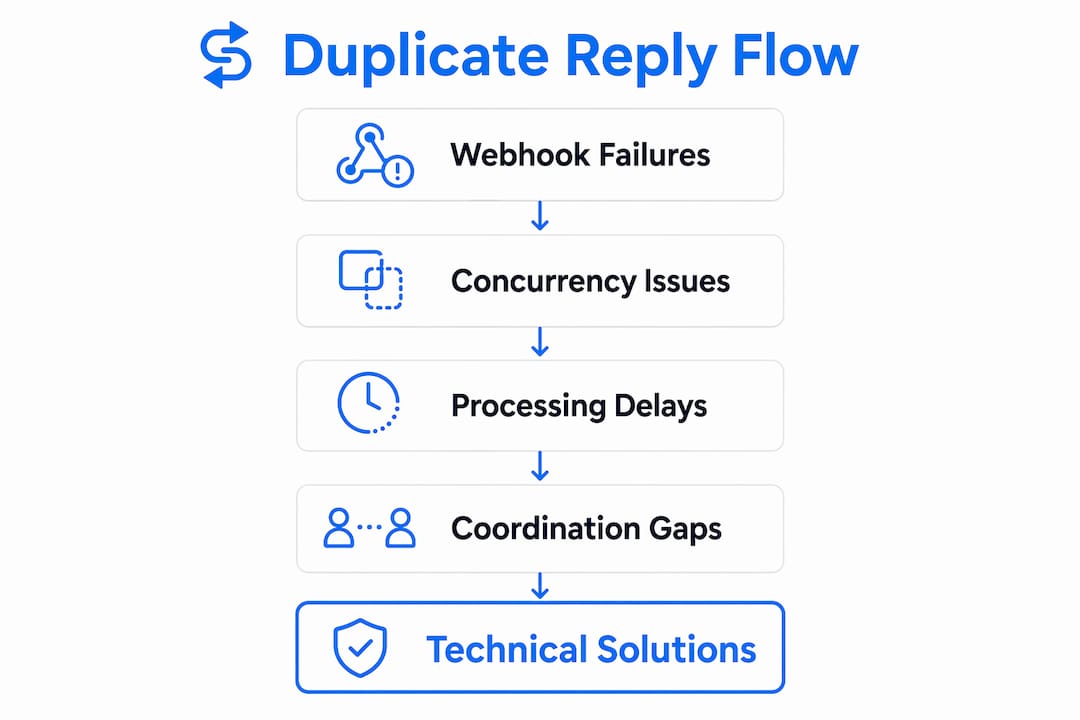
Shared inboxes without isolated agent streams let multiple agents work on the same conversation simultaneously. Two agents see an unanswered ticket. Both start typing. Both send. The customer gets two responses, often with slightly different information, which creates confusion on top of the duplication.
Common coordination pitfalls that amplify duplicate response issues include:
No clear ownership assignment before an agent begins replying
Automatic routing rules that assign a ticket to one agent while another is already drafting
Notification systems that alert multiple agents to the same unassigned message
Multiple active listeners on the same event source broadcasting messages more than once
Agents working across multiple browser tabs, each holding an active connection to the inbox
Multiple live listeners on one event source amplify duplicates exponentially. Each additional active connection multiplies the broadcast. A team with three agents each holding two open tabs can generate six simultaneous listeners on a single inbox thread.
Misaligned notifications compound the problem. When a ticket triggers alerts to a group channel and individual agents at the same time, two people may respond before either sees the other’s reply. The gap between sending and the inbox refreshing is wide enough for both replies to go out.
Pro Tip: Require agents to claim a ticket before drafting a reply. A simple “assigned” status change, visible to the whole team in real time, eliminates most human-layer duplicate responses without any technical changes.
What are effective technical solutions for preventing duplicate responses?
Solving duplicate replies at the application layer alone is often insufficient. Reliable prevention requires layered defenses built into the architecture itself.
The sequence below represents the standard prevention stack, applied in order:
Atomic dedup check-and-set. Before processing any event, check a shared store for the message ID. If it exists, skip processing. If it does not, write it atomically. This blocks duplicate event redeliveries.
Per-thread lock with TTL. Acquire a lock on the thread ID before sending a reply. Set a time-to-live so the lock expires if the process crashes. This blocks concurrent workers from racing to the same thread.
Idempotency keys on outbound calls. Retrying outbound side effects without idempotency keys creates duplicate tickets, emails, and replies. Attach a unique key to every outbound API call so the receiving system ignores repeated requests.
Self-send filter. Check whether the sender address matches the agent’s own address before processing. Discard any message the agent sent itself.
Single-owner architecture. Assign each agent a dedicated inbox and webhook stream so no two processes ever write to the same thread. This is the Agent Accounts pattern, and it removes multi-writer contention at the root.
Reliability requires both deduplication and locking mechanisms. Using only one layer leaves a gap. Dedup alone does not stop concurrent workers racing on a freshly seen ID. Locking alone does not stop a redelivered event arriving after the lock expires.
Deduplication pattern | Prevents | Limitation |
|---|---|---|
Message ID check-and-set | Redelivered events | Does not stop concurrent races |
Per-thread lock with TTL | Concurrent worker races | Lock expiry can allow redelivery gap |
Idempotency keys | Duplicate outbound side effects | Requires API support from downstream |
Single-owner inbox | Multi-writer contention | Requires architectural change |
Self-send filter | Agent reply loops | Does not address external duplicates |
No single pattern covers every failure mode. Teams that apply all five layers reduce duplicate reply incidents to near zero under normal operating conditions.
How can support team leaders reduce duplicate replies through better coordination?
Technical fixes address the infrastructure layer. Team leaders own the human layer, and that layer generates its own category of support team communication problems that no code change will fix.
The most effective coordination practices for reducing duplicate replies include:
Assign before replying. Make ticket assignment a required step before any agent drafts a response. Visible ownership prevents two agents from working the same ticket.
Limit inbox access. Not every agent needs write access to every queue. Narrowing access reduces the number of people who can accidentally duplicate a reply.
Audit reply logs weekly. Pull a report of conversations with more than one outbound reply within a short window. Review the cause. Pattern recognition over weeks reveals whether the problem is technical, behavioral, or both.
Train on notification hygiene. Agents who mute group alerts and rely on assigned-ticket notifications send fewer duplicate replies. Group alerts create a race condition among humans.
Monitor active listener counts. If your platform exposes connection data, track how many active sessions are open per inbox. More than one active session per agent is a warning sign.
Siloed inboxes hurt team efficiency by hiding what other agents are doing. A unified inbox with real-time status indicators gives every team member visibility into who is handling what. That visibility is the simplest coordination tool available, and most teams underuse it.
Regular audits matter more than most leaders expect. Duplicate replies often go unreported because customers do not always complain. They simply lose trust. Proactive monitoring catches the problem before it affects customer satisfaction scores.
Key Takeaways
Duplicate replies in support teams result from layered technical and coordination failures that require layered solutions addressing both infrastructure and human workflow.
Point | Details |
|---|---|
At-least-once delivery causes retriggers | Webhook redeliveries on delayed acknowledgments are the most common technical source of duplicates. |
Concurrency requires locking | Atomic per-thread locks with TTL prevent multiple workers from racing to reply to the same message. |
Idempotency keys protect outbound calls | Attaching unique keys to every outbound API call stops retries from posting duplicate replies. |
Ownership assignment prevents human duplicates | Requiring agents to claim a ticket before drafting eliminates most coordination-layer duplicate responses. |
Single-owner architecture removes root contention | Dedicated inboxes per agent or process eliminate multi-writer conflicts at the architectural level. |
The layer most teams skip
Most support teams I have seen fix the obvious technical issues and stop there. They add a message ID check, maybe a lock, and declare the problem solved. Then duplicates reappear under load, or during a deployment, or when a new agent joins and opens three tabs at once.
The layer teams consistently skip is the architectural one. Giving each agent or automated process a dedicated inbox and webhook stream is not glamorous work. It requires rethinking how conversations get routed and owned. But application-layer fixes alone are insufficient when the underlying design allows multiple writers to compete for the same thread.
I have also seen teams misdiagnose the problem repeatedly. They blame the AI model, the email provider, or the agent who sent the second reply. Duplicates are frequently misdiagnosed as AI model errors when the real cause sits in the event delivery and handling system. That misdiagnosis wastes weeks.
My practical advice: log every duplicate skip. When your dedup layer catches a duplicate and discards it, write that to a log with the message ID, timestamp, and worker ID. Review those logs monthly. The patterns tell you whether you have a delivery problem, a concurrency problem, or a human workflow problem. You cannot fix what you cannot see.
Test under load before you declare victory. A system that handles duplicates cleanly at 10 messages per minute may fail at 200. Concurrency bugs only appear when multiple workers are actually competing. Run load tests that simulate peak traffic, and watch your duplicate skip logs during the test.
— Nick
How Sendsync helps support teams avoid duplicate replies
Duplicate replies damage customer trust and waste agent time. Sendsync’s shared inbox for support teams is built around single-ownership conversation management, which removes the multi-writer contention that causes most coordination-layer duplicates. Each conversation gets assigned to one agent with full team visibility, so no two people reply to the same message without knowing it.
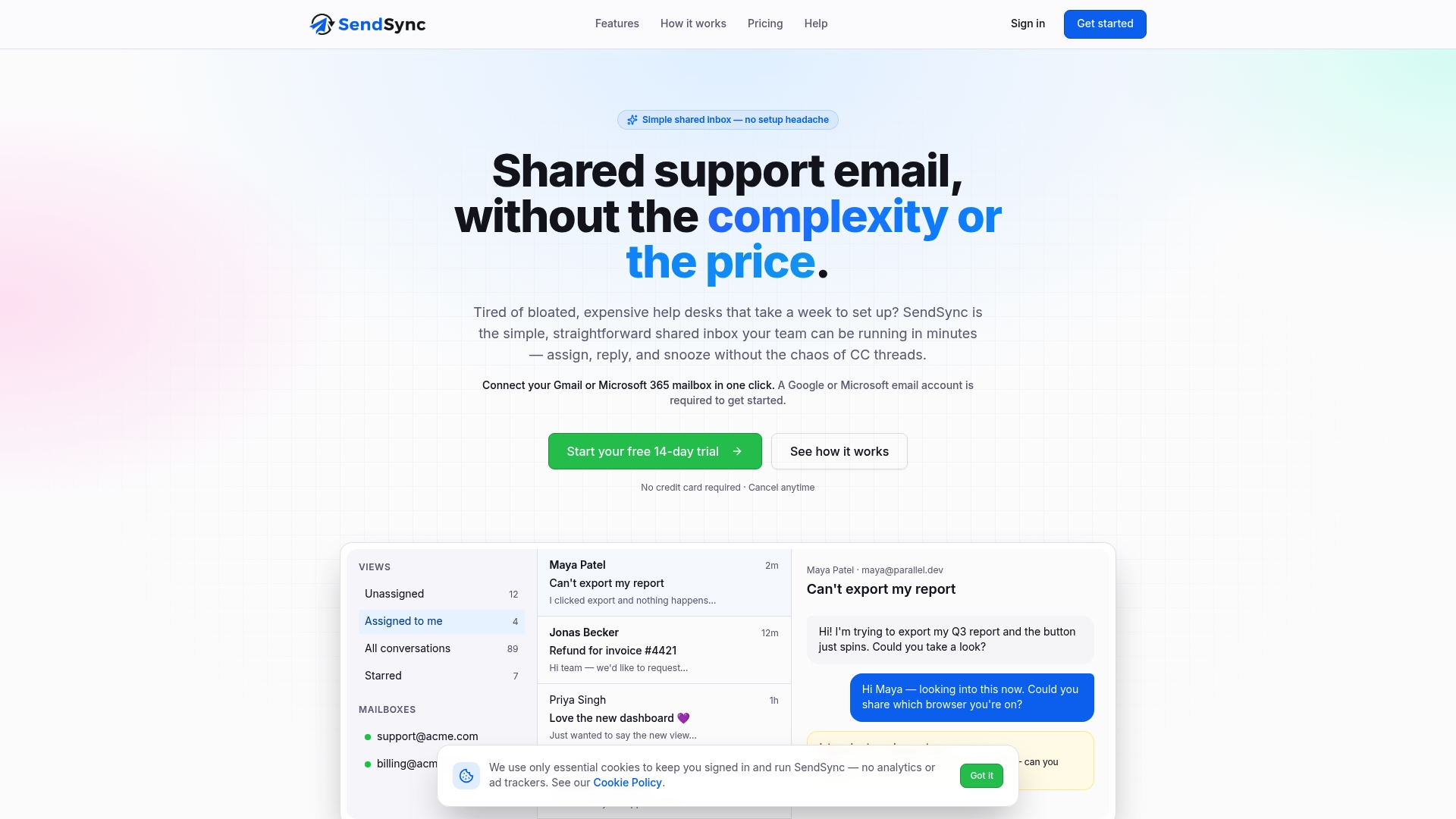
Sendsync connects directly to Gmail and Microsoft 365 mailboxes without DNS configuration or long setup times. Teams get real-time assignment status, conversation ownership indicators, and a clean workflow that makes duplicate replies structurally harder to produce. For teams looking to apply shared inbox best practices alongside technical deduplication strategies, Sendsync provides the coordination layer that code alone cannot replace.
FAQ
What causes duplicate replies in support teams?
Duplicate replies result from webhook at-least-once delivery guarantees, concurrent worker processes racing to handle the same event, and agents working the same ticket without clear ownership. Both technical and coordination failures contribute.
How do idempotency keys prevent duplicate responses?
Idempotency keys attach a unique identifier to every outbound API call. If the same call is retried, the receiving system recognizes the key and ignores the repeat, preventing duplicate tickets, emails, or replies.
Why do duplicate replies happen even with deduplication in place?
Deduplication alone blocks redelivered events but does not stop concurrent workers racing on a freshly seen message ID. Effective prevention requires both a dedup check-and-set and a per-thread lock with a time-to-live.
What is a self-reply loop in customer support systems?
A self-reply loop occurs when an agent’s outbound message triggers a new inbound event that the agent processes and replies to again. Filtering messages sent from the agent’s own address breaks the loop.
How can support team leaders detect duplicate reply problems?
Pull weekly reports of conversations with more than one outbound reply sent within a short time window. Log every duplicate skip at the system level and review patterns monthly to distinguish delivery, concurrency, and human workflow causes.