
Avoid AI Bill Shock: Zendesk vs Freshdesk, Procure Smart, Try $10 Plan
Avoid AI Bill Shock: Zendesk vs Freshdesk, Procure Smart, Try $10 Plan ! Small-business lead comparing help desk plans For most small and mid-sized support teams, Freshdesk remains the easier, better-value pick, while Zendesk suits larger or more process-heavy operations that nee

For most small and mid-sized support teams, Freshdesk remains the easier, better-value pick, while Zendesk suits larger or more process-heavy operations that need deeper routing and unified omnichannel reporting. The real difference in 2026 is how each vendor prices AI: predictable session packs versus metered resolution allowances that can swing your bill. If neither fits cleanly, the “how to choose” section below walks through a procurement checklist you can run before signing anything.
TL;DR:
- Model AI spend against ticket patterns; session packs are easier to forecast, while resolution allowances can trigger overage charges during seasonal or sudden volume spikes.
- Run a trial lasting 14 to 30 days with ticket history, and require vendors to define billable AI sessions, resolutions, and overage rates in writing.
- Choose Zendesk for native voice, skills based routing, multi brand separation, or cross team analytics; Freshdesk may require add ons for comparable channel coverage.
- Teams that only need shared email ownership and replies should test a shared inbox first; it will not replace voice, complex routing, or custom reporting.
Table of Contents
- Zendesk vs Freshdesk at a Glance
- Feature Differences That Affect Daily Agent Work
- How to Model the Real Cost of Zendesk and Freshdesk
- Which Platform Fits Your Team
- Migration Considerations and a Switching Checklist
- How to Choose: A Procurement Checklist
- Pros and Cons Summary
- Support Quality and Responsiveness Compared
- Interface and User Experience Differences
- Customization and Scalability Options
- Security and Compliance Features
- Mobile App Capabilities and Limitations
- When a Shared Inbox Beats a Full Help Desk
- Get Started With a Shared Inbox Built for Speed
- FAQ
Zendesk vs Freshdesk at a Glance
Both platforms handle the basics of ticketing, email, and chat competently, so the decision usually comes down to depth versus simplicity and how AI gets billed.
Freshdesk’s strength is accessibility: a shorter learning curve, a generous free tier for very small teams, and session-pack AI pricing that’s easier to forecast. Zendesk’s strength is depth: a more unified inbox across channels, stronger skills-based routing, and reporting that scales with complex organizational structures.
- Freshdesk fits: solo founders, lean support teams, and companies that want AI live within days without a dedicated admin.
- Zendesk fits: enterprise contact centers, multi-brand businesses, and teams running complex escalation paths across regions or product lines.
- Pricing signal: entry and mid-tier seat prices are close between the two, but they diverge sharply at upper tiers and, more importantly, in how AI usage gets metered and billed, according to 2026 platform comparisons.
- Integrations: Zendesk’s marketplace is larger, with thousands of apps compared with Freshdesk’s smaller but still substantial catalog, which matters if your stack includes niche CRM, ecommerce, or telephony tools.
If your team is under 20 agents and your workflows are straightforward, the at-a-glance comparison should already be enough to lean toward Freshdesk. If you’re running multiple brands, complex SLAs, or a large distributed team, keep reading through the feature and pricing sections before you decide.
Feature Differences That Affect Daily Agent Work
The marketing pages for both platforms look similar at a glance. The day-to-day experience for agents and admins is where the real gap shows up.
Ticketing and routing. Both platforms offer views, filters, and tagging, but Zendesk’s routing engine handles skills-based assignment and multi-brand ticket separation with more granularity out of the box. Freshdesk covers the same ground with simpler configuration, which is faster to set up but has less room to customize complex escalation rules. Side conversations (looping in a colleague without exposing the thread to the customer) exist on both, though Zendesk’s version integrates more tightly with its broader workflow builder.
Omnichannel and voice. This is one of the clearest differentiators. Zendesk markets a genuinely unified inbox across email, chat, voice, and social, with native voice support built into the core product. Freshdesk takes a more modular approach, often requiring separate apps or add-ons to reach the same channel coverage, according to 2026 comparison reviews. If your support operation is voice-heavy, that difference alone can decide the comparison.
AI and automation. Both vendors now sell AI as a core line item rather than a bonus feature, but the shape of the AI differs. Freshdesk leans toward agent-facing copilots and simpler automated triage, sold through predictable session packs. Zendesk pushes further into customer-facing autonomous agents that attempt full resolutions, billed against a resolution allowance. Either approach depends on a clean, well-maintained knowledge base. Reviews consistently note that AI agents produce weaker answers when the underlying help center articles are outdated or inconsistent, regardless of which platform is running them.
Statistic callout: AI billing is not standardized. One widely cited data point: session-pack pricing has been published at a known rate per 100 sessions for at least one major vendor, according to Eesel’s 2026 breakdown. That figure matters because it gives buyers a concrete unit to model against, rather than guessing at an “unlimited AI” marketing claim.
Integrations. Zendesk’s app marketplace is measured in the thousands, while Freshdesk’s is closer to a thousand native and marketplace integrations combined, per the same 2026 comparison. For most teams running Salesforce, Shopify, or a standard telephony stack, both marketplaces cover the basics. The gap shows up when you need a less common integration, a vertical-specific tool, or deep API access for a custom build.
Reporting and analytics. Freshdesk’s built-in dashboards cover standard support KPIs (first response time, resolution time, CSAT) without much setup. Zendesk’s reporting goes further into custom BI-style dashboards and cross-team analytics, but getting the most out of it usually means dedicating admin time or, for larger deployments, an analyst.
A few integration categories worth checking before you commit, regardless of which platform you choose:
- CRM sync: Salesforce, HubSpot, or your existing customer database.
- Ecommerce: Shopify, WooCommerce, or your order management system.
- Telephony: whether native voice covers your call volume or you’ll need a third-party add-on.
- Analytics: whether your BI tool can pull data out without custom engineering.
How to Model the Real Cost of Zendesk and Freshdesk
Sticker price is the easiest number to compare and the least useful one. The gap between quoted seat price and actual monthly bill comes almost entirely from how AI usage, add-ons, and upper-tier features get metered.
Base seat pricing between Zendesk and Freshdesk is close at entry and mid tiers, which is why vendor comparison charts often look like a tie. The divergence happens at upper tiers, where Zendesk’s enterprise plans add cost for advanced routing and analytics, and in AI billing, where the two vendors use fundamentally different models.
- Session-pack AI pricing (more common on the easier-to-start platform) charges a flat fee per bundle of AI sessions, such as the $49 per 100 sessions figure noted above. This is easier to forecast because you can estimate monthly session volume and multiply.
- Resolution-allowance AI pricing includes a baseline number of automated resolutions in your plan, then charges overage per resolution beyond that. This rewards teams with predictable ticket volume and penalizes teams with spiky or seasonal demand.
- Per-agent copilot pricing bundles AI assistance into the seat price itself, which simplifies the invoice but can mean paying for AI capacity agents don’t use.
The practical risk: if your support volume is highly variable, a resolution-allowance model can produce bill shock in a high-volume month. Session packs are easier to budget against but can mean paying for capacity you don’t use in quiet months.
Here’s how the math might play out across three illustrative scenarios (these are worked examples to show the mechanics, not published vendor quotes):
| Scenario | Agents | Estimated seat cost/month | AI usage assumption | Estimated AI cost/month |
|---|---|---|---|---|
| Small help desk | 10 | Base tier, moderate per-seat pricing | Light AI use, a few hundred sessions | One to two session packs |
| Mid-market team | 50 | Mid-to-upper tier pricing | Moderate automated resolutions | Allowance likely exceeded, moderate overage |
| High-volume AI-first queue | 50 | Upper tier, AI-heavy configuration | Heavy automated resolution volume | Significant overage risk if usage spikes |
The point of this table isn’t to hand you exact dollar figures, since both vendors frequently adjust tier pricing. It’s to show that the AI line item, not the seat price, is usually what makes one platform cheaper or more expensive in practice.
Hidden costs worth budgeting for before you sign: voice add-ons if your core plan doesn’t include native telephony, quality assurance or conversation review tools sold as separate modules, sandbox or test environments for larger teams running staged rollouts, and dedicated support or a named customer success manager at higher tiers.
Which Platform Fits Your Team
The right choice depends less on brand reputation and more on four concrete factors: team size, channel mix, how far you want to push AI automation, and whether compliance or procurement rules constrain your options.
- Lean SMB teams (under 15 agents): prioritize fast setup and predictable billing. A simpler platform with session-pack AI pricing reduces the risk of surprise invoices.
- Growing ecommerce support teams: need solid native integrations with Shopify or similar platforms, plus the ability to scale channels (chat, email, social) without re-platforming in a year.
- Enterprise contact centers: need unified omnichannel routing, native voice, and reporting that can serve multiple departments or brands under one roof.
- IT service desks: often better served by ITSM-specific tooling with asset management and change workflows rather than a customer-facing help desk at all.
Pro Tip: Before you shortlist a platform based on brand reputation, map your actual ticket volume and channel mix for the last three months. Most buyers overestimate how “enterprise” their needs really are.
A lean SMB team choosing Zendesk often ends up paying for routing complexity and reporting depth it never uses. A fast-scaling enterprise choosing Freshdesk often hits a ceiling on multi-brand separation and advanced analytics within a year or two. Matching platform depth to actual operational complexity, not aspirational complexity, avoids both mistakes.
Migration Considerations and a Switching Checklist
Moving help desk platforms, or moving away from one entirely, is manageable with the right sequence, but it’s rarely a weekend project once you factor in integrations and historical data.
- Export core data first: tickets, contacts, customer records, and knowledge base articles. Expect some fields to need reformatting since field names and custom attributes rarely map one-to-one between systems.
- Rewire integrations deliberately: CRM sync, ecommerce platforms, and telephony connections usually need to be reconnected and tested individually rather than migrated in bulk.
- Run a staged cutover: freeze inbound channels briefly during the final switch, run parallel routing to the new system for about a week to catch gaps, and validate that knowledge base links and macros survived the move before fully retiring the old system.
- Plan your timeline by team size: a small team (under 15 agents) can often complete a full migration in one to two weeks; a mid-market team should budget three to four weeks including integration testing; a large or multi-brand organization should plan six to eight weeks with a formal rollback plan at each stage.
For a full breakdown of this process, our migration checklist for switching from Zendesk covers the step-by-step timeline in more detail.
Not every team needs to migrate between two full help desks. If your actual requirements are “a shared place for the team to see and reply to support email without stepping on each other,” a full help desk migration may be solving a problem you don’t have. Our guide on shared inbox versus help desk software walks through when that simpler category fits better, especially for teams where cost and setup speed matter more than advanced routing logic.

How to Choose: A Procurement Checklist
Running a structured trial beats comparing feature lists, because most of the real differences only show up once your own tickets, agents, and integrations are in the system.
Score each vendor demo against the same criteria so you’re comparing apples to apples:
- Setup time: how long until a working inbox with routing rules, not just a login screen.
- Admin surface: how many clicks and how much training it takes for a non-technical manager to adjust a routing rule.
- AI pricing transparency: can the vendor tell you, in writing, exactly what counts as a “session” or a “resolution” and what happens on overage.
- Exportability: can you get your tickets, contacts, and KB articles out in a usable format if you leave.
When you get on a call with a vendor, ask directly: what’s included in the base AI allowance, what’s the overage rate, and how do they define a resolved conversation for billing purposes. Vague answers to that last question are a warning sign.
Structure your trial around a 14 to 30 day window with a real dataset, not a demo sandbox: import a slice of your actual ticket history, set your real KPIs (first response time, resolution time, CSAT), and define acceptance criteria before you start rather than after.
| Checklist item | What to look for | Red flag |
|---|---|---|
| Pricing transparency | Written definition of AI session/resolution unit | Vendor won’t put billing definitions in writing |
| Data exportability | Full export of tickets, contacts, KB in standard formats | Export locked behind a support ticket or extra fee |
| Integration footholds | Native connector for your CRM and ecommerce platform | Only available via generic webhook or third-party middleware |
| Admin complexity | Non-technical manager can edit a routing rule in minutes | Requires vendor professional services for basic changes |
A practical, vetted business software selection checklist can help you formalize this scoring process if you need something to circulate internally before a purchase decision.
Pros and Cons Summary
Freshdesk pros: faster setup, simpler admin experience, predictable session-pack AI pricing, strong fit for small and mid-sized teams.
Freshdesk cons: shallower omnichannel depth, smaller integration marketplace, less room for complex multi-brand routing.
Zendesk pros: unified omnichannel inbox, native voice, deeper skills-based routing, larger integration marketplace, stronger reporting for complex organizations.
Zendesk cons: steeper setup and admin learning curve, resolution-allowance AI billing can create cost unpredictability at scale, upper-tier pricing climbs faster.
Neither platform is objectively “better.” The right pick depends on whether your team values speed and predictability or depth and scale. Teams that outgrow their first choice usually do so because they picked based on brand recognition rather than actual channel mix and ticket volume.
Support Quality and Responsiveness Compared
Vendor support quality is worth evaluating with the same rigor you’d apply to the product itself, since you’ll be relying on it during your own migration and any future incident. Both vendors offer tiered support, where response time and channel access (chat, email, phone) improve as you move up plan tiers. Lower-tier plans on both platforms typically mean slower response windows and email-only support, while higher tiers unlock faster guaranteed response times and more direct access to technical staff.
The practical difference shows up in complexity of issues, not just speed. Zendesk’s support teams more often deal with complex, multi-system configuration questions given the platform’s depth, which can mean longer resolution times for nuanced routing or reporting issues. Freshdesk’s simpler configuration surface tends to produce shorter, more straightforward support interactions. Neither difference is dramatic enough to be a deciding factor on its own, but it’s worth testing directly during your trial period by filing a real support ticket with each vendor and timing the response.
Interface and User Experience Differences
Freshdesk’s interface leans toward simplicity: fewer menus, a more guided setup flow, and a dashboard that surfaces the essentials without much configuration. New agents typically get comfortable within a day or two.
Zendesk’s interface reflects its depth: more menus, more configuration options, and a steeper initial learning curve for both agents and admins. That complexity pays off for teams that need the granular control, but it means budgeting real onboarding time, not just a login and a quick tour. Admins setting up Zendesk for the first time often need several days to configure routing, views, and automation rules properly, compared with a few hours on a simpler platform.
Neither interface is objectively worse. The question is whether your team benefits more from fewer decisions (Freshdesk) or more control (Zendesk).
Customization and Scalability Options
Both platforms support custom fields, macros, and automation rules, but the ceiling differs. Freshdesk’s customization is deep enough for most SMB and mid-market workflows without requiring developer involvement. Zendesk’s customization extends further into custom apps, more granular permission structures, and multi-brand configuration that can separate ticket queues, branding, and SLAs across business units.
Scalability follows the same pattern. Freshdesk scales comfortably from a handful of agents to a few hundred without major friction. Zendesk is built to scale further, into thousands of agents and complex organizational hierarchies, which is also why its upper-tier pricing and configuration complexity climb faster. If you’re confident your team will stay under 50 agents for the foreseeable future, that extra scalability ceiling on Zendesk may never get used.
Security and Compliance Features
Both platforms offer standard enterprise security features: data encryption in transit and at rest, role-based access controls, and audit logging at higher tiers. Compliance certifications and specific data residency options vary by plan tier on both platforms, so if your business operates under specific regulatory requirements (healthcare, finance, or government contracts), confirm the exact certifications available at your intended plan tier directly with the vendor rather than assuming parity across tiers.
Single sign-on (SSO) and more granular permission controls are typically reserved for higher-tier plans on both platforms. If compliance and access control are non-negotiable for your organization, factor that into your tier selection early, since moving up a tier later just to unlock SSO is a common and avoidable cost surprise.
Mobile App Capabilities and Limitations
Both Zendesk and Freshdesk offer mobile apps for iOS and Android that let agents view, respond to, and assign tickets on the go. Core functions (replying, tagging, basic routing) work reasonably well on mobile for both platforms.
The limitations show up in complex tasks. Advanced reporting, detailed automation setup, and multi-brand configuration are difficult or impossible from a mobile app on either platform. They’re built for agents to stay responsive while away from a desk, not for admins to manage the system. If your team leans heavily on mobile for actual admin work rather than quick replies, test this directly during your trial rather than assuming feature parity with the desktop version.
When a Shared Inbox Beats a Full Help Desk
Full help desks like Zendesk and Freshdesk make sense when you need routing rules, SLA tracking, and reporting layered on top of your support channels. A meaningful share of small teams don’t actually need that layer. What they need is a way for several people to see, claim, and reply to the same support inbox without duplicating effort or losing track of who answered what.
That’s the specific problem we built software to solve. It can connect to existing Gmail or Microsoft 365 mailboxes without DNS changes or long setup, enabling teams to collaborate in a shared inbox quickly. Some plans include unlimited users and flat pricing, which removes the per-seat math that complicates budgeting on Zendesk and Freshdesk as your team grows.
This approach tends to win for teams where the main pain point is coordination, not complexity: founders fielding support email alongside other work, small customer success teams without a dedicated admin, or companies that tried a full help desk and found themselves paying for routing and reporting depth they never configured. If that sounds like your situation, our guide to the simple help desk approach for small teams walks through what moving to a shared inbox looks like in practice, and our piece on shared inbox versus help desk software breaks down the cost and speed trade-offs in more detail.
It’s worth being direct about the limits here too: if you need native voice support, skills-based routing across dozens of queues, or deep custom reporting, a shared inbox won’t replace that, and Zendesk or Freshdesk remain the better fit. The honest dividing line is whether your team’s problem is collaboration or configuration.
Get Started With a Shared Inbox Built for Speed
If your team’s actual problem is “too many people replying to the same inbox without visibility,” not “we need enterprise routing,” switching to a shared inbox can save both setup time and ongoing cost.
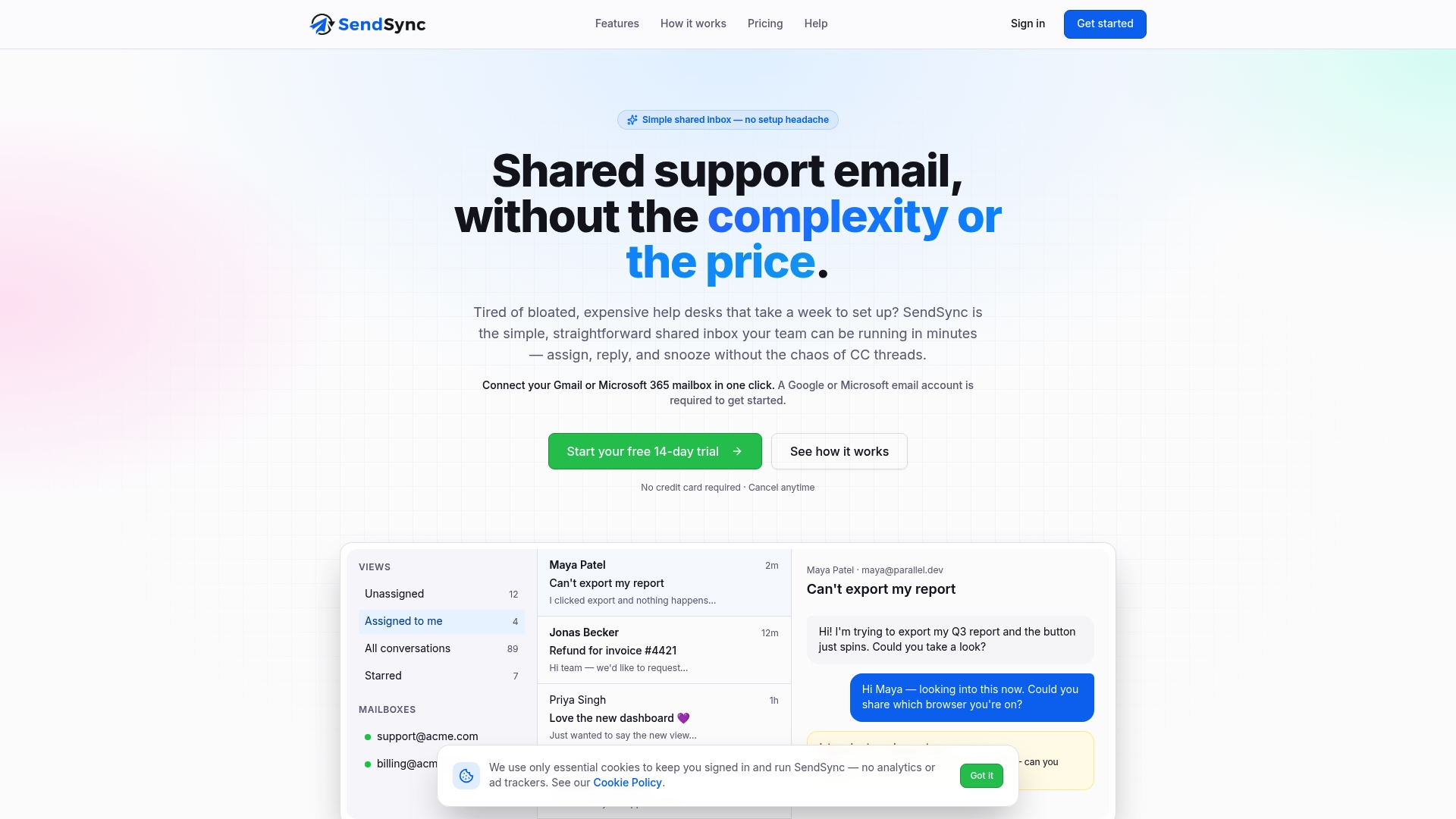
- Connect your existing Gmail or Microsoft 365 mailbox in minutes, no DNS changes required.
- Get unlimited users on every plan, so your bill doesn’t grow every time you hire.
- Choose from Founder at $10 per month, Starter at $30 per month, Growth at $80 per month, or Scale at $200 per month, all on our pricing page.
Start a free trial today and see whether a shared inbox covers what your team actually needs before you commit to a heavier platform.
FAQ
Which is better, Freshdesk or Zendesk?
Neither is universally better: Freshdesk tends to suit smaller, faster-moving teams that want quick setup and predictable AI pricing, while Zendesk suits larger teams that need unified omnichannel routing and deeper reporting. The right answer depends on your team size, channel mix, and how much AI automation you plan to rely on.
What is Zendesk’s biggest competitor?
Freshdesk is widely considered Zendesk’s closest direct competitor in the help desk category, given the overlap in features and target customers. Depending on the buyer’s actual need, lighter-weight tools like a shared inbox can also serve as an alternative for teams that don’t need full help desk complexity.
Is Zendesk a CRM or CMS?
Zendesk is a customer support and service platform, not a traditional CRM or content management system, though it includes some customer data and relationship features. It’s built around ticketing, omnichannel support, and service workflows rather than sales pipeline management or website content publishing.
Is Freshdesk a CRM tool?
Freshdesk is a help desk and customer support platform, not a dedicated CRM tool, though its parent company offers a separate CRM product. Freshdesk focuses on ticket management, automation, and support reporting rather than sales pipeline or lead management.