
Hit Policies and Shared Inbox: Support Routing Rules for Support Teams
Hit Policies and Shared Inbox: Support Routing Rules for Support Teams ! Support lead reviewing inbox routing rules Routing rules automatically send incoming support work to the right queue or agent based on conditions you define.

Routing rules automatically send incoming support work to the right queue or agent based on conditions you define. For reliable service levels, pair intent classification with route-to-queue rules and a skills-aware assignment stage, and always add overflow safeguards so nothing sits unanswered when volume spikes.
TL;DR:
- Effective routing requires pairing intent classification with layered route-to-queue rules and overflow safeguards to handle volume spikes without delays.
- Conditions for rules can match on any ticket attribute, evaluated in either hit-first or hit-all order, with percentage-based splits enabling balanced load distribution.
- Building a ruleset involves mapping workstreams, creating classification tags, and ordering specific rules before deployment, with continuous monitoring and rollback plans.
- Agent assignment strategies vary from exact skill matching for complex work to capacity and fairness-based methods like round-robin, adjusted dynamically with proficiency scores.
- Smaller teams or initial setups can rely on shared inboxes with simple rule-based routing, which is easier to set up and scales up to advanced skills-based engines later.
Table of Contents
- What are support routing rules and where do they run?
- Condition types and how rule evaluation order works
- How to author a routing ruleset step by step
- Assignment strategies: matching agents to the right work
- Overflow, escalation, and keeping SLAs intact
- Testing, diagnostics, and troubleshooting common issues
- A practical, low-friction option for email-based routing
- What actually matters when you roll this out
- Try SendSync for fast, rule-based email routing
- FAQ
- Sources
What are support routing rules and where do they run?
A routing rule is a condition paired with an action: when a ticket matches the condition, the system performs the action. Most rules route a conversation to a queue, a specific person, or a team, but the pipeline behind that single step usually has three distinct stages.
- Classification enriches the incoming item with intent, tags, or metadata before any routing decision happens.
- Route-to-queue rules use that enriched data, along with channel, subject, and header conditions, to pick a destination queue.
- Assignment then selects the agent inside that queue based on skills, capacity, or availability.
Small teams with one or two workstreams can often skip the full pipeline and rely on simple rulesets. Teams juggling multiple channels, languages, or SLA tiers tend to need the layered version, since a single flat rule list gets unmanageable fast.
Condition types and how rule evaluation order works
Routing rules can match on almost any attribute attached to a ticket: subject lines and keywords, headers or metadata, tags, channel (email, chat, voice), language, customer tier, or an intent field assigned during classification.
How those conditions get evaluated matters as much as what they check. Route-to-queue rules support two hit policies: hit-first stops evaluating as soon as one rule matches and applies its action, while hit-all evaluates every matching rule and applies selection logic across the results. Hit-first is predictable and easy to audit. Hit-all suits setups where you want multiple rules to contribute to a decision, such as applying a tag from one rule and a priority flag from another on the same ticket.
Percentage-based allocation adds a third dimension: instead of sending every matching ticket to one queue, you split the flow.
- Load-testing a new team by sending it a small slice of real traffic.
- Dividing overflow volume between two queues with similar skill sets.
- Running an A/B comparison between two response workflows.
How to author a routing ruleset step by step
Building a ruleset works best as a sequence rather than a single pass. Start by listing your actual workstreams (billing, technical, sales, VIP), then build classification rules that tag or score each incoming item, then create the route-to-queue ruleset that acts on those tags, and only then worry about ordering and activation.
- Map workstreams. Write down every category of request your team handles today, even the informal ones.
- Build classification rules that detect intent, tag the ticket, or score the customer tier.
- Create route-to-queue rules that act on those tags and select a queue.
- Order the rules so the most specific conditions sit above general catch-alls.
- Activate in a test queue first, then monitor before rolling out to the full team.
Two examples make this concrete. A rule matching “refund” or “chargeback” in the subject, combined with a billing intent tag, routes to Billing Tier 2. A rule matching an account flagged as VIP in your CRM sets priority to high and routes to a queue staffed by your most experienced agents, bypassing the general queue entirely.
Pro Tip: Keep one rule per intent where possible. Combining three conditions into one rule makes it harder to debug later when traffic patterns shift.
Document the intent behind each rule as you write it, roll out changes to one queue before touching the rest, and keep a fallback queue active in case a rule misfires. Treat rule changes like code: version them, note who changed what, and keep a rollback path.

Assignment strategies: matching agents to the right work
Once a ticket lands in a queue, the assignment engine decides which agent gets it. The matching mode you pick changes both speed and quality.
- Exact match requires an agent to have every skill the ticket calls for, which protects quality on complex or regulated work but can leave tickets waiting if no one qualifies.
- Closest match allows partial skill overlap as a fallback, trading a little precision for faster response when exact matches are scarce.
- Highest-capacity assignment sends work to whichever available agent has the most room, which fits asynchronous channels like email well.
- Round-robin distributes tickets evenly regardless of current load, which works better for voice queues where call length is unpredictable and fairness matters more than optimization.
A production-grade skills-based setup evaluates skills, capacity, and presence together at the moment of assignment rather than relying on static agent lists. Proficiency scores (how well an agent handles a given skill, not just whether they have it) and team-level capacity profiles let you fine-tune who gets the hardest tickets versus the high-volume, lower-complexity ones.
Overflow, escalation, and keeping SLAs intact
Even a well-tuned ruleset needs a plan for when a queue gets overwhelmed. Overflow rules typically fire on a timer or a threshold: if a ticket sits unassigned for a set number of minutes, move it to an overflow queue; if a queue’s open count exceeds a defined size, redirect new arrivals elsewhere.
- Set a time-based overflow trigger, often in the 8 to 10 minute range for SLA-sensitive queues, then adjust based on what you observe.
- Add a size-based trigger so a sudden spike doesn’t sit entirely on one queue’s shoulders.
- Use incremental priority bumps for tickets that age past a threshold rather than leaving them static.
- Route anything that breaches both thresholds to a supervisor queue or external handoff.
Pick starting thresholds, run a pilot, measure actual wait times and agent load, and adjust. Guessing the right number up front rarely works as well as watching real traffic for a week.
Testing, diagnostics, and troubleshooting common issues
Before activating any rule in production, replay it through a diagnostics or test panel that shows exactly which rule matched and what action it applied. Skipping this step is how teams end up with tickets silently landing in the wrong queue for weeks.
- Check agent presence first: an assignment engine can’t hand off work to someone marked unavailable, even if they’re technically at their desk.
- Look for unsupported operators or malformed conditions, which often fail silently instead of throwing a visible error.
- Review rule ordering, since a broad catch-all placed too high in a hit-first list can swallow tickets meant for a more specific rule below it.
- Confirm the import and activation lifecycle completed, since a rule saved but not activated won’t run at all.
Ongoing monitoring matters just as much as the initial test. Watch agent status dashboards, rule-hit reports, and alerts tied to overflow or SLA breaches so a quiet failure doesn’t surface only after customers complain.
A practical, low-friction option for email-based routing
Not every team needs a full routing engine on day one. Smaller teams or anyone piloting a new workflow often get more done with a shared inbox that supports rule-based triage without heavy setup.
- A shared inbox lets you write simple condition-based rules (keyword, sender domain, tag) without configuring a multi-stage classification pipeline first.
- A shared inbox solution can connect Gmail or Microsoft 365 mailboxes directly, skip DNS configuration, and offer unlimited-user pricing, which suits teams that want rule-based routing live quickly.
- Start with a shared inbox for intake and auto-assignment, then move to a dedicated routing engine once you need skills-based matching across multiple channels.
What actually matters when you roll this out
Most routing failures trace back to agent presence, not the rules themselves. Enforce accurate status updates before you trust any assignment engine to find available agents.
Pilot with one or two queues, watch SLA and agent load for a week, then expand. Document every rule’s intent and train agents on what the fallback and escalation paths actually do before they need them under pressure.
— Nick
Try SendSync for fast, rule-based email routing
If your routing needs start and end with email, a shared inbox gets you there without the multi-stage setup a full routing engine demands. SendSync connects a Gmail or Microsoft 365 mailbox in minutes, no DNS changes required, and lets you write rule-based triage and auto-assignment from day one.
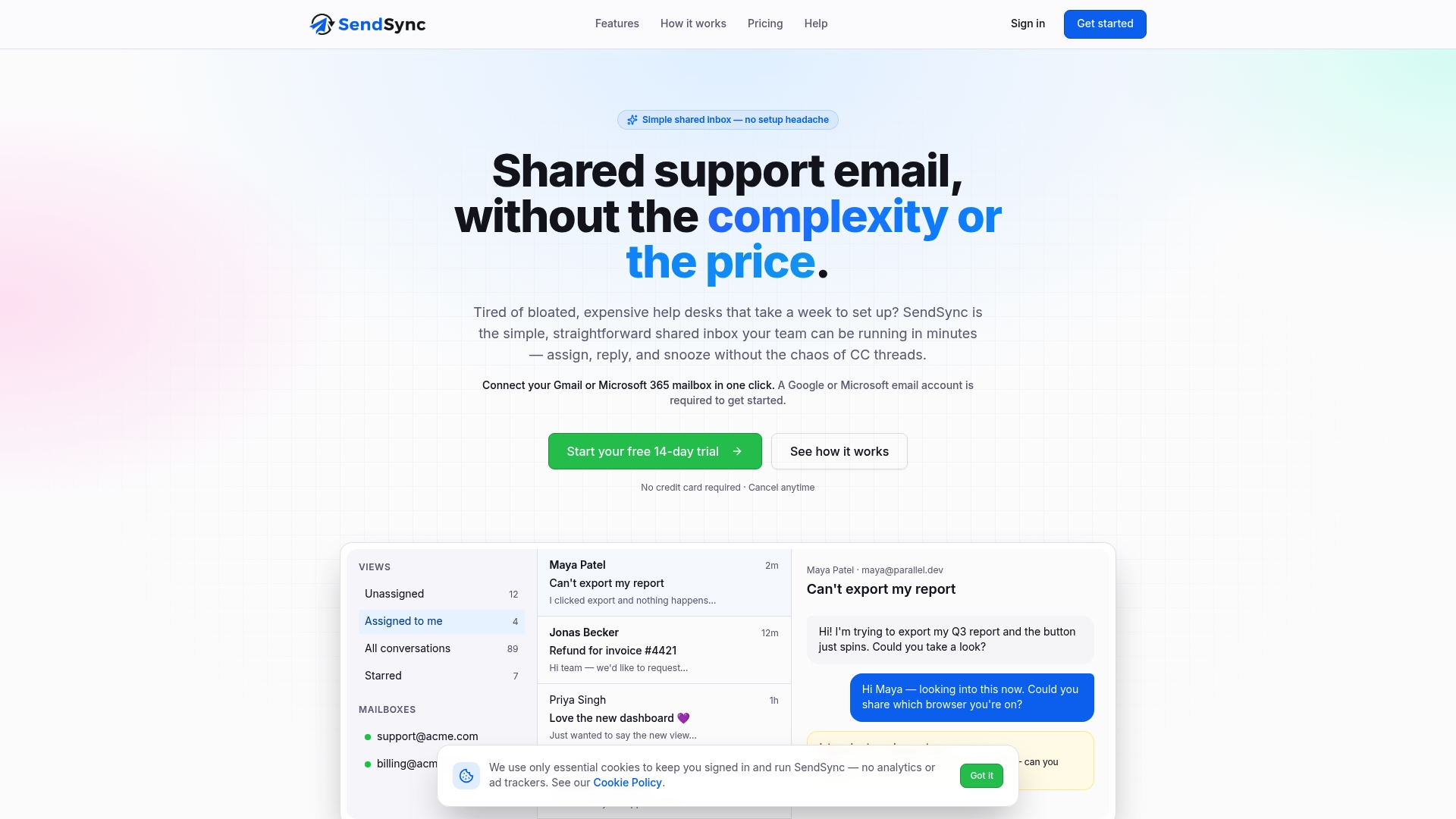
- Connect your existing mailbox and start routing by sender, subject, or tag immediately.
- Plans may allow adding agents without changing the billing structure.
- Plans run from Founder at $10 per month to Scale at $200 per month, each with a 14-day trial to test real traffic before committing.
For teams managing growing ticket volume without a dedicated routing engine, this queue-based approach covers the setup in more depth. Check plan details and start a trial at Sendsync.
FAQ
What are routing rules?
Routing rules are condition-to-action statements that automatically direct an incoming ticket, email, or call to a specific queue, team, or agent. They typically evaluate attributes like subject, channel, tags, or customer data, then apply an action such as routing to a queue.
What are routing instructions?
Routing instructions are the specific conditions and actions written inside a rule, such as “if subject contains ‘refund,’ route to Billing.” They’re the configured logic that tells the system exactly how to handle a matching item.
What are routing policies?
Routing policies govern how multiple rules interact, most commonly through hit-first (stop at the first match) or hit-all (evaluate every match) logic. Microsoft’s route-to-queue documentation describes both policies alongside percentage-based allocation for splitting work across queues.
Should you enable dynamic routing?
Dynamic, intent-driven routing is worth enabling once your volume and workstream variety outgrow simple static rules. Intent-driven routing lets classification attach intent fields that both route-to-queue rules and the assignment engine can use together with skills, which simplifies logic that would otherwise need many manual mappings.
How do you prevent support tickets from piling up in one queue?
Overflow rules that redirect tickets after a time or volume threshold, combined with monitoring agent presence and capacity, keep one queue from absorbing all the load. A best practices guide on reducing ticket volume covers additional approaches to easing pressure on any single queue.
Sources
- Configure route-to-queue rules | Microsoft Learn
- D365 Unified Routing: Skills-Based Assignment That Works | The Augmented Dev