
Support Email Templates for Small Teams: 8 Scenarios and Subject Lines
Support Email Templates for Small Teams: 8 Scenarios and Subject Lines ! Support agent drafting a customer email reply Here are support email templates for the eight situations you handle most, each one ready to copy, adjust, and send right now.

Here are support email templates for the eight situations you handle most, each one ready to copy, adjust, and send right now. They cover first responses, apologies, follow-ups, feedback requests, escalations, refunds, technical updates, and proactive outreach. They work for solo agents, support managers building a team playbook, and small teams who need consistency without writing every reply from scratch. Jump to the templates below or read the customization tips first if you want your replies to sound less like a script.
TL;DR:
- Replace every placeholder with case specific details, name the cause and fix in apologies, and give customers a clear path to reopen resolved cases.
- Acknowledge requests within a few hours, then resolve or send a substantive update within 24 to 48 hours, adjusting expectations for case complexity.
- Escalate cases requiring specialist access or after two templated replies fail, and include what has been tried plus the next step.
- Refund confirmations should state the exact amount, payment method, and expected arrival time, and invite customers to reply if the money does not appear.
- Assign one owner to the template library, review it quarterly, and track reply time, resolution time, and reopened case rates to spot stale templates.
Table of Contents
- Eight essential templates and when to use them
- Full, copy-paste templates grouped by scenario
- How to personalize templates quickly and pick the right tone
- High-performing subject-line formulas and first-sentence openers
- Rules for response timing, follow-up cadence, and template governance
- Practical evidence and use cases
- A practical perspective on using templates responsibly
- A faster way to put these templates to work
- FAQ
- Sources
Eight essential templates and when to use them
Every support inbox runs into the same handful of moments. Having a template ready for each one saves time and keeps your tone consistent across agents.
- Acknowledgement or first response: confirms you received the request. Subject: “We’ve got your request, [Customer name].”
- Apology and resolution: addresses a mistake and states the fix. Subject: “Here’s what happened, and how we’re fixing it.”
- Follow-up or case closed: confirms the issue is resolved and invites a reply if not. Subject: “Following up on your [Order #] case.”
- Feedback or review request: asks for a quick rating or review after resolution. Subject: “Got 30 seconds? We’d love your feedback.”
- Escalation or transfer notice: tells the customer their case is moving to a specialist. Subject: “Your case is now with our [Team name] team.”
- Refund or return confirmation: confirms the amount, method, and timeline. Subject: “Your refund for [Order #] is on its way.”
- Technical holding-pattern update: keeps a customer informed during a longer fix. Subject: “Update on [Issue]: here’s where things stand.”
- Proactive check-in or outreach: reaches out before a problem is reported. Subject: “Quick check-in on your [Product/Service].”
Full, copy-paste templates grouped by scenario
Each template below includes a subject line, a short opener, a body, and a closing. Swap the bracketed placeholders for the specific details of each case.
-
Acknowledgement. Subject: “We’ve got your request, [Customer name].” Opener: “Thanks for reaching out, [Customer name].” Body: “We’ve logged your request about [Issue] and [Agent name] is already looking into it. You can expect an update within [Timeframe].” Closing: “We’ll be in touch soon.” Note: swap the timeframe to match your actual response window, not a generic promise.
-
Apology and resolution. Subject: “Here’s what happened, and how we’re fixing it.” Opener: “I’m sorry about the trouble with [Issue], [Customer name].” Body: “Here’s what caused it: [Brief explanation]. We’ve [Action taken], and as a result, [Outcome/compensation if applicable].” Closing: “Let us know if anything still feels off.” Note: name the cause and the fix in the same sentence; vague apologies read as hollow.
-
Follow-up or case closed. Subject: “Following up on your [Order #] case.” Opener: “Just checking in on the [Issue] we resolved on [Date].” Body: “Everything should be working as expected now. If you’re still running into trouble, reply here and we’ll jump back in.” Closing: “Otherwise, consider this one closed on our end.” Note: give a clear path back in instead of assuming silence means satisfaction.
-
Feedback request. Subject: “Got 30 seconds? We’d love your feedback.” Opener: “Now that your [Issue] is resolved, we’d love to hear how it went.” Body: “Could you rate your experience in [Timeframe]? It takes less than a minute and helps us improve how we support you.” Closing: “Thanks for your time, [Customer name].” Note: state the purpose and time commitment upfront.
-
Escalation or transfer. Subject: “Your case is now with our [Team name] team.” Opener: “I want to make sure your [Issue] gets the right attention.” Body: “I’ve shared a summary of what we’ve tried so far with [Specialist name], along with the exact next step: [Next step]. They’ll follow up by [Timeframe].” Closing: “You won’t need to repeat anything you’ve already told us.” Note: include a compact incident summary so the customer doesn’t have to re-explain the problem.
-
Refund or return confirmation. Subject: “Your refund for [Order #] is on its way.” Opener: “Your refund of [Amount] has been processed.” Body: “It should appear in your account via [Method] within [Timeframe]. If it doesn’t show up by then, reply here.” Closing: “Thanks for your patience.” Note: always confirm the exact amount and method, not just that a refund was issued.
-
Technical holding-pattern update. Subject: “Update on [Issue]: here’s where things stand.” Opener: “Wanted to give you a status update on [Issue].” Body: “Our team has identified [Finding] and is working on [Next step]. We expect a resolution by [ETA].” Closing: “We’ll update you again by [Date], even if there’s no change.” Note: committing to a next update date matters more than the update itself.
-
Proactive check-in. Subject: “Quick check-in on your [Product/Service].” Opener: “Wanted to reach out before you had to.” Body: “We noticed [Observation, e.g., usage pattern or recent change] and wanted to check if everything’s working the way you expect.” Closing: “Reply anytime, we’re here.” Note: proactive outreach works best when it references something specific to that customer’s account.
How to personalize templates quickly and pick the right tone
Always replace the customer’s name, the specific issue, and any dates or amounts. Never send a template with a placeholder still visible. For apology templates, use one sincere acknowledgment followed by a concrete fix rather than several repeated “sorry” phrases, which AHRQ’s service recovery guidance frames as acknowledging the mistake, explaining the cause, and offering a real repair. Proactive outreach should sound curious, not apologetic.
Before: “Per our policy, your request cannot be processed at this time.” After: “I checked on this myself, and here’s what I found: your request needs one more detail, your shipping zip code, before we can process it.”
- Replace name, issue, date, and amount placeholders every time.
- Read the template out loud before sending; if it sounds stiff, cut a sentence.
- Match urgency in your opener to the customer’s actual tone.
Pro Tip: Keep a running list of phrases customers react well to, and retire ones that consistently get “that doesn’t answer my question” replies.
High-performing subject-line formulas and first-sentence openers
Subject lines that name an action and a timeframe tend to get opened faster than vague ones; for more examples of subject lines and CTAs, see Email Templates That Actually Get Responses. Try formulas like “Your [Issue] update,” “Fix confirmed for [Order #],” or “Quick question about your [Request].” For escalations, “Your case is now with [Team]” sets expectations immediately.
- “We’ve got your request” signals acknowledgment without over-promising.
- “Here’s what happened, and how we’re fixing it” works for apologies.
- “Update on [Issue]: here’s where things stand” suits ongoing technical cases.
- “Quick check-in on your [Product]” fits proactive outreach.
Openers that state what you’re doing right now, rather than what happened in the past, tend to reduce follow-up questions. According to HubSpot’s template research, teams that treat templates as starting points to customize, rather than final copy, respond roughly 40% faster while keeping replies consistent.
Rules for response timing, follow-up cadence, and template governance
- Acknowledge new requests within a few hours, and resolve or update within 24 to 48 hours depending on complexity.
- Escalate when a fix requires specialist access, or offer compensation when the AHRQ-style repair step applies.
- Assign one template owner per team and review the library quarterly for stale phrasing.
- Track reply time, resolution time, and reopened-case rate after rolling out new templates.
Practical evidence and use cases
Teams that document tone fixes with before-and-after examples, as in our support email tone guide, tend to cut reply times once agents see the contrast directly. Pairing templates with a shared inbox keeps routing and canned responses in one place instead of scattered across personal drafts.

A practical perspective on using templates responsibly
Templates save time, but they aren’t meant to be copied blind. Test variations, track which ones actually reduce back-and-forth, and retire the ones that don’t. The goal is consistency, not autopilot.
— Nick
A faster way to put these templates to work
We built our platform as a shared inbox that connects to Gmail or Microsoft 365 mailboxes quickly and without DNS setup, so templates live where your whole team already replies instead of in scattered personal drafts. Every plan includes unlimited users with flat pricing, so adding agents doesn’t add per-seat fees like some help desks.
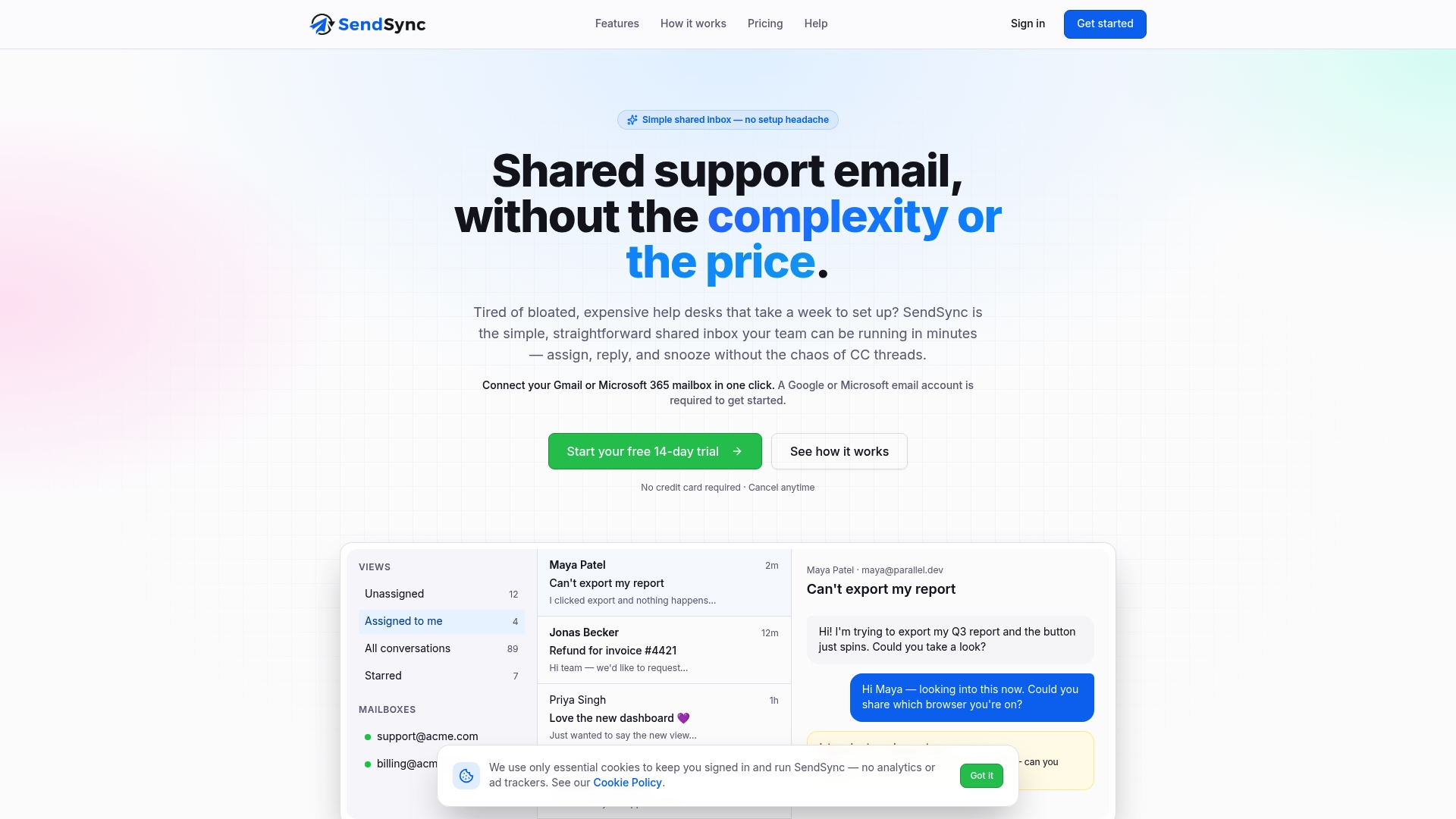
If you’re ready to centralize your templates and cut time-to-first-reply, check out SendSync’s plans starting with Founder at $10 per month.
FAQ
How do I make a template sound less robotic?
Replace every placeholder with a specific detail from the actual case, and read the message out loud before sending. A single sincere acknowledgment followed by a concrete next step works better than generic phrasing or repeated apologies.
How quickly should I respond using a template?
Acknowledge new requests within a few hours and aim to resolve or send a substantive update within 24 to 48 hours. For escalations, include a short summary of what’s been tried and the exact next step so the specialist doesn’t need to start over.
Should every agent have their own templates?
It’s better to maintain one shared library with a single owner who reviews it quarterly. Tools like a shared inbox make it easier to keep everyone using the same up-to-date versions instead of personal copies that drift out of sync.
When should I escalate instead of using a standard reply?
Escalate when the fix needs specialist access, when a customer has already received two templated replies without resolution, or when compensation is warranted under your service recovery policy. Include a compact incident summary and the next expected step to avoid repeating questions.
How do I know if my templates are actually working?
Track reply time, resolution time, and how often cases get reopened after a templated response. If a specific template consistently leads to follow-up complaints, revise its wording or retire it.
Sources
- AHRQ — Service recovery: components of an effective apology
- HubSpot — 35 customer service email templates to support, renew, & refund customers