
Support Email Retention: Copy Ready Policy for Shared Inboxes
Support Email Retention: Copy Ready Policy for Shared Inboxes ! Support lead reviewing an email retention policy The right approach is a banded policy: keep routine support threads for about 3 years, hold finance, contract, and litigation-relevant messages for about 7 years, and

The right approach is a banded policy: keep routine support threads for about 3 years, hold finance, contract, and litigation-relevant messages for about 7 years, and preserve messages indefinitely only under a legal hold or a specific regulatory mandate. This balances data minimization against the real risk of needing old records for audits or disputes, and it only works once you pair the policy with platform retention rules and secure disposal.
TL;DR:
- Keeping routine support emails for three years covers typical business cycles but may risk loss of relevant data if issues arise beyond that period.
- Financial, contractual, and dispute-related messages should be retained for about seven years to align with statutes of limitations and legal standards.
- Legal holds and regulatory correspondence must be preserved indefinitely until the specific obligation or case is closed or lifted.
- Tagging messages at triage time, such as marking billing or dispute emails for longer retention, helps enforce consistent categorization and compliance.
- Backup retention policies should be coordinated with live inbox rules to prevent discrepancies that could undermine the retention strategy.
Table of Contents
- Retention bands and when to use each
- What the FTC and NARA actually recommend
- A copy-ready retention policy and rollout checklist
- Setting retention rules in Google Vault and Microsoft 365
- Secure disposal and handling sensitive data
- A rollout plan for your shared support inbox
- Archiving and indexing support emails for retrieval
- Customer privacy and transparency obligations
- Backup and disaster recovery alongside retention
- Common pitfalls in support email retention
- Why minimal retention and a slim inbox reduce risk
- How SendSync supports a retention-friendly workflow
- FAQ
- Sources
Retention bands and when to use each
Not every support email carries the same risk, so a single retention period for the whole inbox almost always either over-retains low-value chatter or deletes something you needed. A banded system solves this by sorting messages into three groups based on what they contain, not how old they are.
- Routine support threads (password resets, shipping questions, general how-to replies): retain for a moderate period consistent with normal business cycles, since these rarely have legal relevance past typical retention needs.
- Financial, contractual, or dispute-related threads (billing disputes, refund negotiations, contract amendments, complaints that mention legal action): retain roughly 7 years, aligning with the baseline the National Archives applies to temporary email records and with typical statutes of limitation for contract claims.
- Legal hold or regulated correspondence (active litigation, subpoenas, sector-specific mandates): retain indefinitely until the hold is lifted or the regulation no longer applies.
A short policy line can do the classifying for your team: “Support threads tagged ‘billing’ or ‘dispute’ move to the 7-year band automatically; everything else defaults to 3 years unless flagged for legal hold.” Tagging at triage time, rather than sorting years later, is what makes this band usable in practice.
What the FTC and NARA actually recommend
Two government sources carry the weight in this space, and both point toward the same conclusion: write it down, keep it lean, and destroy it properly.
The Federal Trade Commission’s guidance for businesses states that any business retaining customer information for legal or operational reasons needs a written retention policy identifying what is kept, why it is kept, how it is secured, and how it gets disposed of once the retention window closes. That policy doesn’t need to be long, but it needs to exist and be followed consistently.
The National Archives’ General Records Schedule sets a 7-year baseline for temporary email records, with a 3-year band permitted for specific roles when justified. This NARA guidance was built for federal agencies, but the underlying logic (the 7-year window covers most statute-of-limitation and tax-related exposure) applies just as well to a small business support inbox.
- Treat 7 years as your default for anything touching money, contracts, or complaints.
- Reserve the 3-year band for roles or categories you can document as low-risk, such as a general “help@” alias that never handles payment details.
- Build exceptions (legal hold, active dispute, regulatory request) as named overrides, not silent extensions of the default.
Translating agency language into a small business rule is mostly a matter of naming your own categories and mapping them to these two bands, then writing the mapping down so a new hire can apply it without guessing.
A copy-ready retention policy and rollout checklist
A written policy doesn’t need legal drafting to be effective. It needs to cover seven things clearly enough that any team member can apply it the same way.
- Purpose and scope: what mailboxes and message types the policy covers.
- Record categories: routine support, financial/contractual, legal/regulated.
- Retention bands with sample language: “Routine support threads are retained for 3 years from last activity; billing and contract threads for 7 years; legal hold items until the hold is released.”
- Roles and responsibilities: who owns the policy, who can place or release a hold.
- Holds and exceptions: how a hold is requested, documented, and tracked.
- Disposal methods: how messages are purged once retention expires.
- Review cadence: how often the policy itself gets revisited.
For the rollout itself:
- Assign one owner for the policy, even in a two-person team.
- Map every shared mailbox and alias to a record category.
- Set platform-level retention rules matching your bands.
- Train staff on tagging conventions during onboarding.
- Log every disposal event and audit the log quarterly.
Sample phrasing you can adapt directly: “Messages in the support@ mailbox default to the 3-year routine band unless tagged ‘billing,’ ‘contract,’ or ‘legal,’ in which case they move to the 7-year band or an indefinite hold.”
Setting retention rules in Google Vault and Microsoft 365
Writing the policy is half the job. Enforcing it inside whichever platform hosts your shared inbox is the other half, and each major platform has its own quirks.
In Google Vault, administrators set retention rules and holds that determine when Gmail messages become eligible for purge. Holds override retention expirations entirely, so a message under hold stays even after its retention window closes. Vault’s rules can also operate at the thread level, which means a single retained message can keep an entire conversation thread intact, not just that one reply. After a message is purged from user view, Vault generally preserves it for about 30 days before it’s gone for good.
Microsoft 365 handles this through Exchange retention policies and labels in Purview. Retention features typically require a mailbox to hold a minimum amount of data, around 10 MB, before settings fully apply, and items subject to a retention label often display an expiry date to the user before moving into a recoverable or deleted items container ahead of permanent purge.
- Custom rules take precedence over default retention settings in both platforms.
- Holds always override expiration, regardless of what the retention band says.
- Permanent purge is rarely instant: expect a preservation window, not same-day deletion.
Pro Tip: Run a test message through your retention rule before rolling it out team-wide so you can watch exactly when it disappears from view and when it’s actually gone.
Secure disposal and handling sensitive data
Deleting a message from your inbox view does not securely erase it; following best practices for data security and encryption helps ensure proper disposal and protection of sensitive information. It can remain recoverable on mail servers, in backups, or in disk images until a system-level purge or certified wipe actually removes it, which is why the FTC’s guidance on protecting personal information calls for destruction methods like electronic wiping or certified shredding rather than a simple delete command.
The FTC’s Disposal Rule for consumer report information sets the standard other sensitive data should follow: shred paper records, erase electronic media, and vet any destruction vendor before handing off disposal work.
- Never ask customers to send Social Security numbers, card numbers, or similar data over email; direct them to an encrypted form or portal instead.
- If sensitive data does arrive in a support thread by mistake, redact or purge it promptly rather than letting it sit in the routine retention band.
- Vet disposal vendors the same way you would any data processor, with documented audits or certifications.
A rollout plan for your shared support inbox
Turning the policy into practice works best as a short, ordered sequence rather than a single big-bang change.
- Name a records owner and, for anything touching regulated data, a legal reviewer.
- Map each message category (routine, financial/contractual, legal) to its retention band and build the corresponding platform rule.
- Create a test hold, run a dry run of expiry behavior, and confirm disposal logs capture what actually happened.
- Train every team member on the tagging convention and fold it into onboarding.
- Schedule a quarterly review of the policy, the logs, and any open holds.
This sequence matters because skipping the dry run is where most teams get burned: a retention rule that looks right on paper can behave differently once thread-level or recoverable-items behavior kicks in.
Archiving and indexing support emails for retrieval
Retention only pays off if you can actually find a message again when an audit, a dispute, or an e-discovery request requires it. Archiving without indexing is close to useless: a 7-year-old thread you can’t search is functionally the same as one you deleted.
Index by the fields you’ll actually search on later: customer identifier, ticket category, date range, and any tag applied at triage (billing, contract, legal). A shared inbox that already tags conversations by category at the point of reply gives you this indexing for free, rather than requiring a separate archiving pass.

For e-discovery specifically, preserve the full thread rather than individual messages, since context (what was asked, what was promised, what was resolved) is often what a legal reviewer actually needs. Both Google Vault and Exchange retention tools default to preserving threads or conversation history rather than isolated messages, which works in your favor here as long as your retention rule is configured to match.
Keep a simple log of what’s been archived, when, and under which retention band. That log becomes your evidence that the policy was followed consistently, which matters more than the archive itself if a regulator or auditor ever asks.
Customer privacy and transparency obligations
Retaining support emails means retaining customer data, and that carries its own set of obligations separate from the retention schedule itself. Customers generally have a reasonable expectation that a routine support exchange won’t sit in your systems indefinitely without purpose.
Transparency here means two things in practice: your retention policy should be available if a customer or regulator asks about it, and your actual practice should match what the policy says. A policy that claims 3-year retention while backups quietly keep everything for a decade is a liability, not a technicality.
Where a support thread includes personal data (a shipping address, a phone number, account details), minimizing how long you keep it isn’t just good practice, it’s the principle behind most privacy frameworks: keep what you need for the stated purpose, and no longer. This is also the practical case for banding in the first place. Most routine support exchanges simply don’t need 7-year retention, and keeping them that long increases your exposure without adding any defensive value.
If your support flow touches regulated categories (health information, payment data), the retention and disposal rules for that specific data type take precedence over your general support policy, and that exception should be written into the policy itself rather than handled case by case.

Backup and disaster recovery alongside retention
A retention policy that only governs your live inbox and ignores backups isn’t really enforced. If your 3-year routine band purges messages from the shared inbox but a nightly backup quietly retains everything for years longer, your actual retention period is whatever the backup system keeps, not what the policy states.
Coordinate backup retention with your support email policy directly: either align backup retention windows to the same bands, or document the discrepancy and the business reason for it. A common approach is keeping disaster recovery backups on a short rolling window (a number of weeks sufficient to recover from an outage or accidental deletion) that’s separate from and shorter than your long-term retention bands, so backups serve recovery rather than becoming a second, uncontrolled archive.
Test your recovery process the same way you test retention expiry: restore a sample backup periodically and confirm it actually works, and confirm that anything under legal hold survives a restore cycle intact. A backup that can’t be restored, or that silently drops held messages, defeats the purpose of the hold in the first place.
Common pitfalls in support email retention
A few mistakes show up repeatedly once teams try to put a retention policy into practice.
Treating the policy as a document rather than a running process. A retention policy that lives in a shared drive but never gets applied in the actual platform settings protects no one.
Ignoring thread-level behavior. Because Google Vault can retain an entire thread when a single message qualifies, a team expecting granular per-message control can end up keeping far more than intended.
Assuming deletion is immediate. Both major platforms use recoverable or preservation windows before permanent purge, so audits or compliance checks run right after a deletion event can show stale results.
Letting backups outlive the policy. As covered above, backup retention that isn’t aligned with the written policy quietly defeats it.
Skipping the quarterly review. Roles change, new message categories appear, and a policy written once and never revisited drifts out of sync with how the team actually works.
The fix for most of these is the same: fewer places where support messages live, clearer tagging at the point of reply, and a scheduled review rather than a one-time setup.
Why minimal retention and a slim inbox reduce risk
Keeping context matters for good support, but every duplicate copy of a thread is another place a retention rule has to reach. The fewer mailboxes, exports, and side copies a team keeps, the easier a banded policy is to enforce consistently, and the less there is to secure, back up, or eventually dispose of.
— Nick
How SendSync supports a retention-friendly workflow
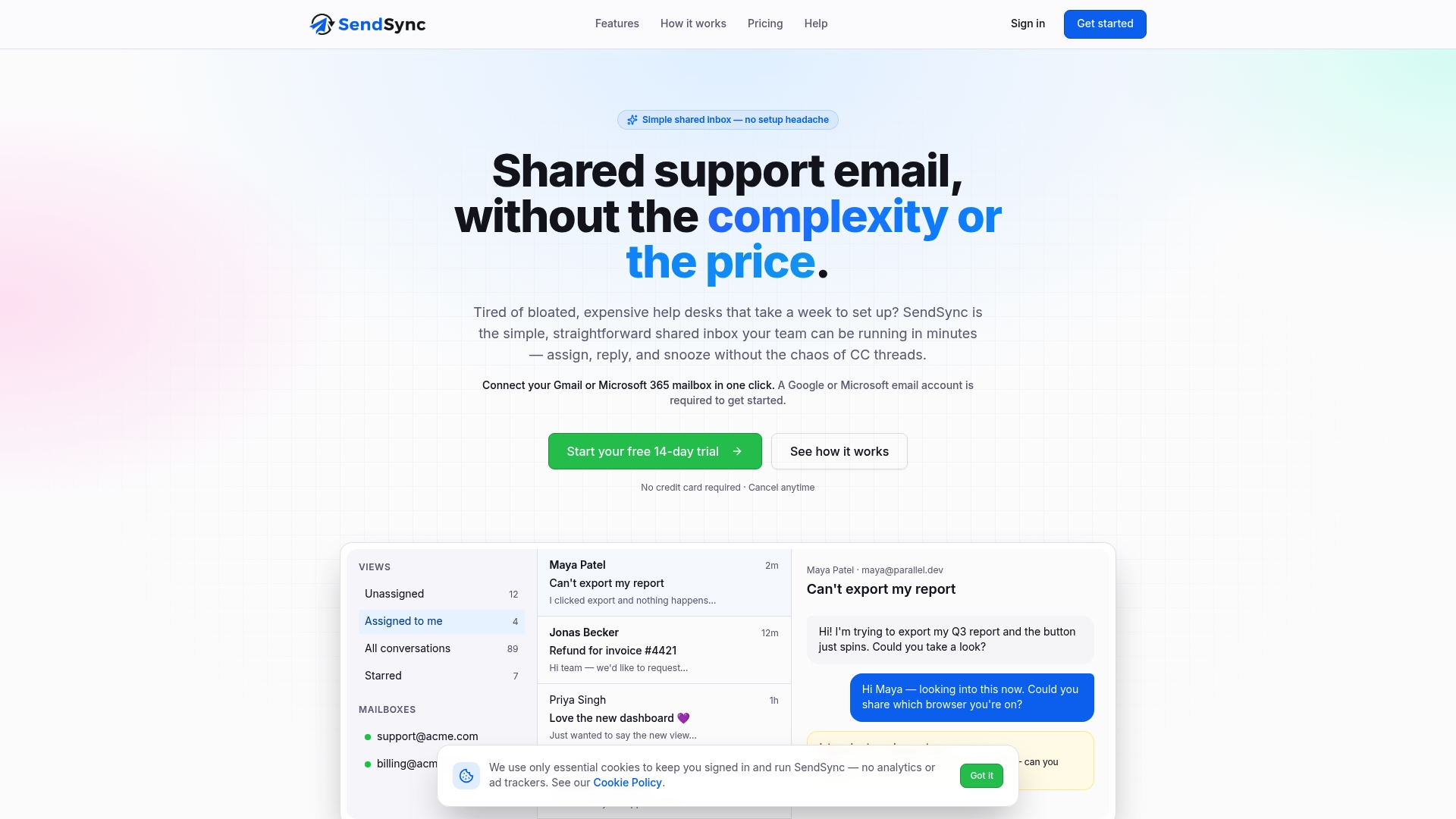
A lightweight shared inbox makes the policy above easier to run day to day. When mailbox mapping is simple and conversations aren’t duplicated across exports and forwards, there’s less to tag, less to retain, and less to purge later. A lightweight shared inbox can make the policy above easier to run day to day. With mailbox mapping kept simple, visible assignment and ownership on every thread, and support for unlimited users with no seat rationing.
For the mechanics of mapping multiple inboxes to retention categories, our guide on multi-client email management walks through the setup. Plans start at the Founder tier at $10 per month, with Starter, Growth, and Scale tiers available as your team grows, all with no per-seat fees. Start a trial and apply your retention bands to a mailbox that’s actually built to make them stick.
This article is general information, not a substitute for advice from a qualified lawyer. Consult a qualified legal professional about your own circumstances before acting on anything here.
FAQ
How long should a small business keep support emails?
A banded approach works best: roughly 3 years for routine support threads and roughly 7 years for financial, contractual, or dispute-related messages, following the baseline the National Archives uses for temporary email records. Messages under active legal hold are kept until the hold is released, regardless of band.
Does deleting a support email actually remove it?
Not immediately or completely. The FTC’s guidance on protecting personal information notes that standard deletion often leaves data recoverable, so compliance-grade disposal requires secure wipe tools or platform-level purge rather than a simple delete command.
What’s the difference between a retention rule and a legal hold in Gmail?
A Google Vault retention rule sets when messages become eligible for purge, while a hold overrides that schedule entirely and keeps messages in place regardless of their retention band. Holds also apply at the thread level, so one held message can preserve an entire conversation.
Do Microsoft 365 retention policies apply instantly to every mailbox?
Not always. Exchange retention features in Microsoft Purview may require a mailbox to hold a minimum amount of data before settings fully apply, and items typically pass through a recoverable items stage before permanent purge rather than disappearing right away.
What should never be sent through a support email thread?
Sensitive identifiers like Social Security numbers or full payment card numbers shouldn’t travel through regular support email at all. Direct customers to an encrypted form or secure portal instead, and if such data arrives by mistake, remove it from the routine retention band promptly rather than letting it sit for years.
Sources
- Protecting Personal Information: A Guide for Business | Federal Trade Commission
- Section 4: Questions related to Temporary Email and other types of Electronic Messages | National Archives
- Set retention rules for Gmail | Google Vault
- Retention policies for Exchange | Microsoft Purview