
Shared Inbox Security: Audit Cmdlets, CISA, and SendSync for IT
Shared Inbox Security: Audit Cmdlets, CISA, and SendSync for IT ! Administrator reviewing shared inbox audit activity Lock down delegation, enable auditing and alerts, enforce multi-factor authentication and least privilege: that sequence closes the most common shared inbox risks

Lock down delegation, enable auditing and alerts, enforce multi-factor authentication and least privilege: that sequence closes the most common shared inbox risks. Start by pulling a permissions inventory and checking that Microsoft Purview audit logs are actually capturing mailbox events, then layer in a monitoring routine. A streamlined platform like SendSync can reduce the configuration mistakes that create these gaps in the first place, though it never replaces the auditing work below.
TL;DR:
- Most shared inbox breaches stem from permission drift, like unchecked delegation creep and external forwarding rules, rather than sophisticated exploits.
- Conduct regular permission inventories and tighten access by replacing individual grants with group-based roles, removing obsolete ad-hoc privileges.
- Mailbox audit logs generally record delegate actions, but some detailed events require advanced licenses, making manual monitoring essential for smaller organizations.
- Alert on permission changes, forwarding rules, and unusual sign-in activity across channels to detect multi-stage attacks involving email, chat, and collaboration tools.
- Use a dedicated platform like SendSync to reduce configuration errors and simplify permission management, complementing native departmental security controls.
Table of Contents
- Shared inbox attack surface and common abuse patterns
- Permissions and delegation: inventory, least privilege, and fixes
- Audit logging and investigator-ready queries
- Detection and monitoring: alerts and cross-channel signals
- Platform-specific steps: Microsoft 365 and Google Workspace settings
- Operational controls: reviews, ownership, automation for offboarding
- Incident response playbook for a compromised shared mailbox
- How SendSync reduces operational friction and where it fits in security architecture
- Data encryption for shared inbox messages at rest and in transit
- Backup and recovery strategies for shared inbox data
- Integration with Data Loss Prevention (DLP) solutions
- Compliance and regulatory considerations related to shared inbox security
- Best practices for securing shared inboxes on mobile devices
- Balancing security and usability without breaking support operations
- Try SendSync to simplify shared inbox operations
- Sources
- FAQ
Shared inbox attack surface and common abuse patterns
Shared inboxes get compromised in a small number of predictable ways, and knowing them changes how you prioritize your time. The biggest risk is not usually a sophisticated exploit. It is quiet, incremental abuse of legitimate features that nobody is watching.
Delegation is the front door. Once someone gains Full Access or Send As rights on a shared mailbox, they can read, send, and delete mail without ever touching a password. Mailbox rules are the back door: an attacker with delegate access can quietly add a forwarding rule that copies every message to an external address, and that rule keeps working long after the original compromise is patched. App consent abuse is newer and harder to spot, since a malicious or over-permissioned OAuth app can read mailbox content without ever showing up in a sign-in log the way a stolen password would.
The patterns worth watching for:
- Delegation creep, where Full Access or Send As permissions accumulate over time and nobody revokes them when a project ends.
- Hidden or auto-deleting inbox rules that forward messages externally without the mailbox owner’s knowledge.
- Third-party app consent grants that give an application persistent mailbox access outside normal sign-in flows.
- Compromised delegate accounts, where the shared mailbox itself is fine but the individual who has access to it is not.
- Multi-channel pivots, where an attacker uses a compromised shared inbox to establish trust in an email thread, then moves into chat platforms like Teams to continue the attack.
Treating the inbox as an isolated system is the mistake that lets most of this persist. Correlating email events with chat and cloud-app signals matters because attackers increasingly use email to establish trust before pivoting across collaboration tools, according to Proofpoint’s collaboration security guidance. An email-based reconnaissance message followed by unusual Teams activity from the same account is a common multi-stage pattern that a mailbox-only view will never catch.
Platform matters too. Exchange Online’s permission model (Full Access, Send As, Send on Behalf) behaves differently from Gmail delegation, and each has its own blind spots that shape which controls you prioritize first.
Permissions and delegation: inventory, least privilege, and fixes
You cannot secure what you have not counted. Before changing anything, build a complete inventory of who has access to each shared mailbox and how they got it.

In Exchange Online, run Get-MailboxPermission against each shared mailbox to list Full Access and Send As grants, then follow up with Get-EXOMailboxFolderPermission to catch folder-level delegation that the mailbox-level command misses. In Google Workspace, export delegation settings from the Admin console or pull them programmatically through the Gmail API, since delegate counts and permissions are managed centrally rather than per-mailbox.
Once you have the list, fix what it shows you:
- Remove ad-hoc Full Access grants that were never documented or approved, starting with anyone who no longer works on that account.
- Replace individual delegate assignments with group-based role assignments so access maps to a job function, not a person.
- Block interactive sign-in on the shared mailbox account itself in Exchange Online, since a shared mailbox rarely needs its own credentials if delegates access it through their own accounts.
- Set a standard review interval for each mailbox’s permission list rather than waiting for an incident to prompt a look.
- Document an owner for every shared mailbox who is the single point of approval for future access changes.
Onboarding and offboarding are where most permission drift happens. When someone joins a team, grant access through the group, not a one-off Add-MailboxPermission command that nobody remembers to reverse. When someone leaves, remove them from the group immediately, but verify the change actually took effect: permission propagation in Exchange Online is typically 30 to 60 minutes and can occasionally take up to 24 hours to fully apply across services, according to Microsoft’s guidance on shared mailbox access issues. If access still works after that window, something did not propagate and needs manual follow-up.
Pro Tip: Run your permissions inventory on a recurring schedule, not just once, since delegate lists drift within weeks of the last review.
Audit logging and investigator-ready queries
Mailbox audit logging is turned on by default for shared mailboxes in Exchange Online and captures a wide range of delegate actions automatically, according to Microsoft’s documentation on managing mailbox auditing. That default coverage is good news, but it has limits worth knowing before you rely on it during an investigation.
MailItemsAccessed, the event that tells you whether a delegate actually opened or synced a specific message, requires an E5 license or an E5 add-on. Without it, you can see that a mailbox was accessed but not always confirm which items were read. Cross-geo mailboxes carry their own auditing quirks as well, so verify coverage explicitly rather than assuming it is complete.
When you need to investigate, Exchange PowerShell gives you the tools:
Search-UnifiedAuditLogpulls activity across the tenant, filterable by date range, user, and operation type.Search-MailboxAuditLognarrows the search to a specific mailbox and supports-Operationsfilters for targeted hunts.-FreeTextparameters let you search for the shared mailbox’s address across log entries when you are not sure which operation to look for.- Filtering on
FolderBindshows folder-level access attempts, useful for spotting a delegate browsing folders they have no business opening.
According to CISA’s countermeasure guidance on mailbox permission abuse, adversaries commonly modify mailbox permissions and add delegates to maintain persistent access, which means the cmdlets that grant access are also your best early warning signs. Watch for Add-MailboxPermission, Set-MailboxFolderPermission, New-InboxRule, and any unexpected SendAs or Move operation on a shared mailbox. A legitimate admin rarely runs these commands outside a documented change window, so unscheduled use of any of them is worth a look even before you know if it is malicious.
Even without Purview Audit Premium, you can still hunt for these patterns by monitoring PowerShell cmdlet use directly and setting basic alert policies on administrator-assigned permissions, viewable through the Microsoft Compliance Center or Microsoft Defender Portal, per CISA’s guidance. That means smaller organizations without premium licensing are not locked out of meaningful detection, they just have to build the habit of checking manually rather than relying on automated premium alerting.
Detection and monitoring: alerts and cross-channel signals
Logs are only useful if something reads them, so alerting is what turns audit data into an actual defense. Set up alert policies in Purview or your SIEM for the events that almost always precede abuse: a new Full Access or Send As grant, an unexpected forwarding rule, or a SendAs event on a shared mailbox from an account that has never sent from it before.
Build alerts around:
- Any
Add-MailboxPermissionorSet-MailboxFolderPermissioncall outside a scheduled change window. - New inbox rules that forward or redirect mail to an external domain.
- SendAs activity from a delegate account with no prior sending history on that mailbox.
- Sign-in patterns on delegate accounts that do not match their normal working hours or location.
None of this works in isolation. Correlating mailbox events with Azure AD sign-in logs and Teams or chat activity closes the multi-channel gap described earlier: a permission change on a shared mailbox followed by an unusual sign-in from a new location, followed by chat messages referencing that same mailbox, is a pattern worth escalating immediately rather than treating as three unrelated log entries.
When an alert fires, the triage sequence matters more than the tool that generated it. Confirm the change was not part of a scheduled onboarding or admin task first, since false positives from legitimate IT work are common. If it looks unauthorized, capture the audit log entries before anyone touches the mailbox further, since some remediation steps (like removing a delegate) can make certain log details harder to reconstruct later.
Pro Tip: Screenshot or export the specific audit entries as soon as you spot suspicious activity: log retention windows and permission changes can both obscure the trail if you wait.
Platform-specific steps: Microsoft 365 and Google Workspace settings
The two dominant platforms handle shared inbox permissions differently enough that a generic checklist will miss real gaps. Here is what to check on each.
For Microsoft 365 and Exchange Online:
- Block sign-in on the shared mailbox’s associated account object, since most organizations never need direct interactive login to a shared mailbox.
- Confirm mailbox audit logging is active and review which operations are captured by default versus which require an E5 license, particularly MailItemsAccessed.
- Set up Purview alert policies for administrator-assigned mailbox permissions so changes surface without a manual log pull.
- Run non-owner mailbox access reports periodically to see who has been accessing a shared mailbox that is not the listed owner.
- Consider
New-ApplicationAccessPolicyto restrict which registered applications can access mailbox content through Graph API, closing the app-consent gap described earlier.
Two caveats matter here. First, MailItemsAccessed genuinely requires E5 or an E5 add-on, and Microsoft’s own documentation on managing mailbox auditing is explicit about which tier is required for that level of detail. Second, permission changes are not instant. Expect a real-world delay before a new Full Access grant or removal fully takes effect, which means testing access immediately after a change can give a false negative.
For Google Workspace, delegation is managed centrally through the Admin console rather than per-mailbox. Administrators can limit which organizational units are allowed to delegate access at all, which is a useful control for locking delegation down to specific support or sales teams rather than leaving it open tenant-wide. Google’s own guidance also notes that delegation carries a practical limit of around 40 active delegates at a time under heavy usage, and that delegate management can be handled programmatically through the Gmail API for organizations that want to automate provisioning and deprovisioning rather than relying on manual Admin console changes.
For teams running Microsoft 365 specifically, a practical setup guide for team inboxes covers the configuration choices that affect both usability and exposure.
Operational controls: reviews, ownership, automation for offboarding
Technical controls decay without an operational routine behind them. The single most useful structural fix is assigning one owner per shared mailbox who has final say over who gets access, because ambiguous ownership is how permission requests get rubber-stamped without scrutiny.
Build a recurring cadence around that ownership model:
- A quarterly access review for every shared mailbox, comparing the current permission list against the group membership it should reflect.
- A change ticket requirement for any mailbox permission modification, so there is a record of who requested it and why.
- An automated hook into the HR offboarding process that revokes group membership the moment someone’s employment status changes, rather than relying on IT to remember.
- A standing rule that new access requests go through the mailbox owner, not directly to whoever happens to have admin rights.
Group-based access is what makes all of this practical at scale. When access is tied to a security group rather than a list of individual names, a quarterly review becomes a matter of checking group membership against a current team roster instead of manually verifying each named delegate. It also means offboarding is a single action, removing someone from the group, rather than hunting across every shared mailbox they may have touched. A breakdown of shared inbox best practices covers how support teams typically structure this kind of review cycle without adding much administrative overhead.
Incident response playbook for a compromised shared mailbox
When a shared mailbox compromise is confirmed or strongly suspected, speed matters more than completeness in the first hour. Work through containment, investigation, and recovery in that order.
- Remove any delegate accounts you cannot immediately verify as legitimate, even before you know exactly what they did.
- Block sign-in on the shared mailbox account and on any delegate account that shows suspicious activity.
- Disable any forwarding rules found on the mailbox, since these are the most common way attackers maintain data access after losing direct control.
- Rotate credentials for any delegate accounts involved, particularly if there is evidence of a phished password rather than pure permission abuse.
- Pull the full audit trail using
Search-UnifiedAuditLogandSearch-MailboxAuditLog, focused on the suspected compromise window, before making further changes that could complicate the record. - Check Graph API app consents tied to the mailbox or tenant for anything unfamiliar or overly broad in scope.
- Document forwarding destinations, affected message counts, and the timeline of permission changes for whoever needs the incident record, whether that is compliance, legal, or a cyber insurance provider.
- Restore any deleted or moved mail once the investigation confirms what needs recovering.
- Tighten the specific control that failed, whether that is a missing MFA requirement, an overly broad delegate grant, or a gap in alerting that let the activity run undetected.
- Run a short lessons-learned review and update your alert rules based on what this specific incident revealed.
Pro Tip: Preserve audit log exports before you start remediation, since some cleanup actions can shorten the window in which certain details remain queryable.
How SendSync reduces operational friction and where it fits in security architecture
A lot of shared inbox risk comes from configuration sprawl: too many ad-hoc delegates, unclear ownership, and permission grants nobody remembers approving. SendSync connects directly to a team’s existing Gmail or Microsoft 365 mailboxes, without DNS changes, and supports unlimited users with assignment, internal notes, and workflow tools built around a single shared inbox rather than a patchwork of forwarding rules and individual delegate grants.
That structure matters for security, not just convenience. When access to a shared inbox runs through one clearly owned tool with assignment and internal notes built in, teams have less reason to create individual mailbox delegates or ad-hoc forwarding rules just to keep work moving, which is exactly the kind of drift that leads to the permission creep covered earlier. It does not replace platform-level auditing: Purview and Exchange PowerShell remain the tools of record for forensic investigation. For teams evaluating a shared inbox platform, the practical next step is connecting a test mailbox, setting up assignment rules for a single team, and confirming that sent-items behavior and permissions still align with existing audit expectations before rolling it out further.
Data encryption for shared inbox messages at rest and in transit
Shared inbox messages typically travel and rest under the same encryption protections as any other mailbox on the same platform. Exchange Online and Gmail both encrypt mail in transit using TLS by default when the receiving server supports it, and both encrypt stored mail at rest on their respective infrastructure. This is platform-level protection that applies automatically. It is not something a shared inbox configuration changes or weakens on its own.
Where shared inboxes introduce a wrinkle is in how many people can see decrypted content once it is delivered. Encryption protects mail from interception and unauthorized access to underlying storage, but it does nothing to prevent an over-permissioned delegate from reading a message they legitimately have access to. That is why encryption and access control are separate problems: one protects the data itself, the other protects who gets to open it. Organizations handling regulated data in a shared inbox, such as health records or payment details, should confirm their platform’s encryption settings meet the applicable standard for that data category and treat delegation control as the complementary, not substitute, safeguard.
For messages that need protection beyond what standard TLS provides, both Microsoft 365 and Google Workspace offer additional message encryption options for sensitive content, though enabling these typically requires an administrator to configure the corresponding policy rather than relying on defaults.
Backup and recovery strategies for shared inbox data
A shared inbox holds institutional knowledge that individual employee mailboxes usually do not: customer history, ongoing case threads, and records multiple people rely on. Losing that data to accidental deletion, a failed migration, or a malicious actor with delete permissions is a real operational risk, separate from the security controls covered above.
Native retention tools in Exchange Online and Google Workspace provide a baseline, letting deleted items be recovered within a defined window before they are permanently purged. That window is useful but finite, and it will not help if the deletion goes unnoticed for weeks. For shared mailboxes that hold long-running customer or case history, a third-party backup solution that captures point-in-time snapshots independent of the platform’s own retention settings gives a longer recovery horizon and protects against the platform-level failures that native retention cannot cover.
Recovery testing matters as much as the backup itself. A backup nobody has restored from is unverified, so periodically confirming that a shared mailbox can actually be restored to a known-good state, not just that a backup job completed successfully, closes a gap that many teams discover only during an actual incident. Document who owns the restore process and how long a full mailbox recovery is expected to take, so that number is known before it is needed under pressure.
Integration with Data Loss Prevention (DLP) solutions
Shared inboxes are a natural chokepoint for data loss because multiple people send from the same address, often without the individual accountability that comes with a personal mailbox. DLP policies in Microsoft Purview or Google Workspace can be applied to shared mailboxes the same way they apply to individual accounts, scanning outbound mail for patterns like credit card numbers, national ID formats, or other sensitive identifiers before the message leaves the organization.
The practical value of DLP on a shared inbox is catching mistakes, not just malicious exfiltration. A support agent pasting a customer’s full payment details into a reply, intending to confirm an order, is a far more common event than a deliberate data theft, and a DLP rule that flags or blocks that pattern before send prevents an incident that would otherwise go unnoticed. Configuring these rules requires defining what sensitive data looks like for your organization specifically. A generic template rarely fits a support team’s actual traffic without some tuning.
DLP works best paired with the audit and alerting controls covered earlier rather than as a standalone measure. A DLP block event is itself worth logging and reviewing, since a pattern of frequent blocks from the same shared mailbox may indicate either a training gap or a compromised account being used to attempt exfiltration in smaller, rule-evading pieces. Treat DLP as one more signal feeding into the same monitoring routine, not a separate system running in isolation.
Compliance and regulatory considerations related to shared inbox security
Shared inboxes frequently touch regulated data, whether that is customer payment information, health details, or personal data covered under regional privacy law, and the compliance obligations attached to that data do not change simply because multiple people share access to the mailbox. If anything, the shared access model raises the bar, since regulators and auditors generally expect organizations to demonstrate who could have accessed sensitive data, not just who did.
That expectation is exactly what the permission inventory and audit logging covered earlier in this article support directly. Being able to produce a list of who had delegate access to a mailbox on a given date, and what they did with it, is often the specific evidence a compliance review or breach investigation asks for. Organizations subject to frameworks with explicit access control requirements should treat their shared mailbox permission reviews as part of that compliance evidence, not a separate IT housekeeping task.
Retention requirements add another layer. Some regulatory frameworks mandate minimum retention periods for business correspondence, which affects how long shared mailbox audit logs and message archives need to be kept, sometimes longer than a platform’s default retention window supports. Confirm your specific regulatory obligations with legal or compliance counsel rather than assuming a platform’s default settings satisfy them, since defaults are built for general use, not any particular regulatory framework.
Best practices for securing shared inboxes on mobile devices
Mobile access to a shared inbox introduces risks that desktop access mostly avoids: lost or stolen devices, unmanaged personal phones, and mail clients that cache messages locally outside IT’s visibility. The starting point is requiring mobile device management or at minimum a conditional access policy that restricts shared mailbox access to devices meeting a baseline security standard, such as a passcode and current OS version.
Multi-factor authentication matters even more on mobile, since phones are more frequently lost or left unattended than a managed desktop. Requiring MFA for any account with delegate access to a shared mailbox, checked at both the account level and through conditional access policies tied to device compliance, closes one of the more common paths to compromise on mobile.
Local caching is worth addressing directly. Many mobile mail clients store a local copy of messages for offline access, which means a lost device can expose shared mailbox content even after the account’s permissions are revoked remotely. Enforcing remote wipe capability for any device with shared mailbox access, and confirming that revoking a user’s access also triggers a wipe of cached mail data, closes that gap. Where possible, restrict shared mailbox access to approved mail clients that support these controls rather than allowing any third-party app to connect.
Balancing security and usability without breaking support operations
Tightening delegation and adding audit alerts always creates friction somewhere, usually for the support team that needs fast, flexible access to get customer issues resolved. The instinct to lock everything down immediately is understandable, but a support team that suddenly cannot add a temporary delegate during a staffing gap will find a workaround, and that workaround is usually less secure than the process it replaced.
The trade-off worth making deliberately is speed of rollout versus the number of exceptions you will need to build in later. Pilot stricter controls with a single team first, measure how often the new process actually slows someone down, and use that data to decide whether the friction is worth the risk reduction before scaling it tenant-wide. Pair any new control with brief, specific training on why it exists. People follow rules they understand far more consistently than ones handed down without context.
— Nick
Try SendSync to simplify shared inbox operations
Reducing the number of moving parts in your shared inbox setup is one of the more reliable ways to prevent the misconfigurations covered throughout this article. SendSync connects directly to Gmail or Microsoft 365 without DNS changes and supports unlimited users at a flat price instead of the per-seat fees common with larger help desk platforms.
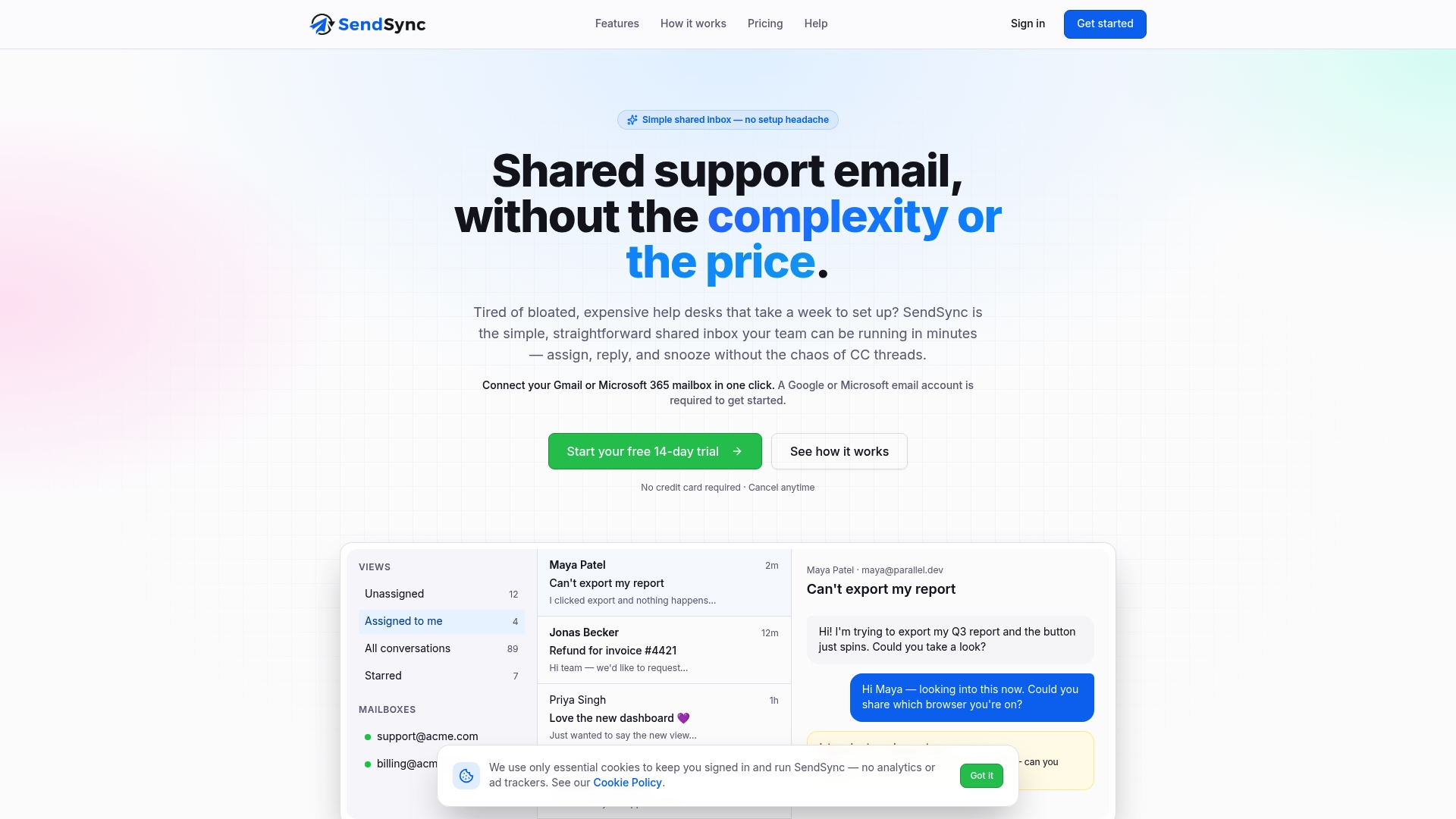
Assignment rules, internal notes, and a shared view of every conversation mean fewer reasons for a team to create individual mailbox delegates or forwarding rules just to stay coordinated, which keeps your permission list shorter and easier to audit. If you are evaluating options, a practical next step is connecting a mailbox, setting up assignment rules for one team, and checking that sent-items behavior lines up with what your auditing expects. Plans start at $10 per month with the Founder tier, scaling up to Starter, Growth, and Scale as a team grows.
Sources
- Investigate shared mailbox activities using audit logs | Microsoft Learn
- Auditing and restricting mailbox permissions detects and blocks adversary exfiltration (CISA CM0074)
- Proofpoint solution brief: Collaboration security
FAQ
What are the disadvantages of using a shared mailbox?
A shared mailbox spreads accountability thin, since messages sent from a common address make it harder to track which individual handled a given reply without internal notes or assignment tracking. Permission management also gets messier over time, as delegate access tends to accumulate without a clear owner reviewing it regularly, and native platform tools offer limited workflow features like ticket assignment or internal collaboration.
What is the best way to manage a shared inbox?
The most reliable approach combines least-privilege access through group-based permissions, regular audits using tools like Exchange PowerShell or the Google Admin console, and a single named owner responsible for approving access changes. Enabling audit logging and setting alerts for permission changes, following guidance from Microsoft Purview, closes most of the gaps that lead to abuse. Platforms like SendSync that centralize assignment and notes can also reduce the ad-hoc delegation that causes permission sprawl.
What is the most hacked email provider?
There is no single verified ranking of “most hacked” email provider, since breach data is typically reported per incident rather than as a comparative industry-wide figure. What matters more for a shared inbox specifically is how access is managed and monitored on whatever platform you use, since weak delegation controls and missing audit alerts create risk regardless of provider.
How do I find out who has access to a shared inbox?
In Exchange Online, run Get-MailboxPermission to list Full Access and Send As grants, then use Get-EXOMailboxFolderPermission to check folder-level delegation that mailbox-level commands miss. In Google Workspace, delegate access is managed and viewable through the Admin console, or it can be pulled programmatically through the Gmail API for teams managing access at scale.