
Diagnose Shared Inbox Search for Support Teams in 30 Seconds
Diagnose Shared Inbox Search for Support Teams in 30 Seconds ! Support lead testing shared inbox search Yes, you can search a shared inbox, but the right method depends on the platform: Outlook requires correct folder scope, Gmail runs through delegate access, and Google Groups u

Yes, you can search a shared inbox, but the right method depends on the platform: Outlook requires correct folder scope, Gmail runs through delegate access, and Google Groups uses its own assignment-based filters. Each system handles indexing and permissions differently, and most “search isn’t working” complaints trace back to one of those three things rather than a broken feature.
TL;DR:
- Searching a shared inbox depends on correct folder selection, permission levels, and platform-specific behaviors, with issues often caused by scope or access rights.
- Outlook requires selecting the specific folder within the shared mailbox, and permissions such as folder visibility and Full Access are critical for effective search results.
- Gmail users should check delegate activation times and understand that Collaborative Inboxes provide filtering by assignment and resolution status for more organized searches.
- Using search operators and saved searches can significantly improve retrieval speed, especially in large archives, by narrowing results based on specific criteria.
- A purpose-built shared inbox tool can unify search, permissions, and workflow automation, reducing response delays caused by fragmented systems and manual processes.
Table of Contents
- How to search a shared mailbox in Outlook (new and classic)
- How to search a shared inbox in Gmail: delegate access and Google Groups Collaborative Inbox
- Search operators, filters, and saved searches that speed up retrieval
- Troubleshooting checklist when shared inbox search returns no or partial results
- Team workflow practices that keep search useful
- Why a purpose-built shared inbox closes search and workflow gaps
- When search is enough, and when it isn’t
- Try SendSync for search and workflow in one place
- FAQ
- Sources
How to search a shared mailbox in Outlook (new and classic)
Outlook search only looks where you tell it to look. Before typing a query, select a folder inside the shared mailbox itself, not your personal inbox, because the selected folder determines the search scope in both new and classic Outlook.
- Open the shared mailbox in the folder pane and click into a folder inside it (Inbox, Sent, or a subfolder).
- Type your query into the Search box at the top of the window.
- Press Enter, then check whether the search bar shows “Current Folder” or “All Mailboxes,” since switching between them changes what gets returned.
According to Microsoft’s documentation on shared mailboxes, search results are based on whichever folder is selected at the time, and new Outlook treats an added shared mailbox the same way it treats your primary mailbox for search purposes. If results still look thin, confirm you have Full Access permission and that the folder is marked visible, since a missing “Folder visible” permission on a parent folder can block access to subfolders even when you technically have rights to them, per Microsoft’s guidance on sharing mailboxes and folders.
Pro Tip: If Outlook desktop search looks broken, open the same shared mailbox in Outlook on the web first. It isolates whether the problem is a client-side indexing issue or a permissions issue on the server.
If the web version works but desktop does not, that points to a local Outlook problem rather than a mailbox configuration issue, and an admin may need to look at Server Assisted Search settings.
How to search a shared inbox in Gmail: delegate access and Google Groups Collaborative Inbox
Gmail offers two different models for shared access, and they behave differently in search.
- Delegated inbox: Click your profile photo, select the delegated account from the switcher, and search it exactly like a normal Gmail inbox, using the same search bar and operators.
- Activation delay: According to Gmail Help’s delegation guide, delegate access can take up to 24 hours to activate after an admin grants it, and the invitation expires after one week if not accepted.
- Collaborative Inbox: A Google Group set up this way exposes workflow fields directly in search, letting you filter by Assigned to me, Assigned to anyone, or Not assigned, according to the Google Workspace Learning Center.
- Resolved status: You can also search by resolved or unresolved state inside a Collaborative Inbox, which is not something a standard delegated inbox offers.
Pro Tip: Choose delegate access for one-to-one mailbox sharing and Collaborative Inbox when multiple people need to claim, resolve, and search by ownership status.
For smaller teams just getting shared email off the ground, a partner guide on setting up a shared business inbox walks through the basic setup choices before you commit to one model.
Search operators, filters, and saved searches that speed up retrieval
Raw keyword search is slow once a shared inbox has years of history. Operators narrow things down fast.
- In Gmail, combine
in:anywherewithfrom:,to:, orsubject:to pull a message out of Spam, Trash, or any label at once, per Gmail Help’s search refinement guide. - Add
is:unread,category:, or a minus sign to exclude noise, such assubject:invoice -category:promotionsfor vendor emails buried under marketing mail. - In Outlook, switch scope between Current Folder, Subfolders, and All Mailboxes depending on whether you know which folder holds the message or need a mailbox-wide sweep.
Saved searches turn a one-time query into a standing view. A search like “unresolved, assigned to me” or “attachments older than 30 days from known vendors” becomes something your team can revisit daily instead of rebuilding the query each time. Our email triage best practices for support teams cover how to structure those saved views for a team inbox rather than a personal one.
Troubleshooting checklist when shared inbox search returns no or partial results
Most failed searches come down to a short list of causes, in this order of likelihood.
- Confirm you actually selected a folder inside the shared mailbox and not your own inbox by accident, since scope drives results more than query wording does.
- Check that you hold Full Access permission and that the folder itself (and its parent folder) is marked visible, since a hidden parent folder can block a subfolder you otherwise have rights to.
- Open the same mailbox in a web client (Outlook on the web or Gmail web) to separate a client-side indexing problem from a server-side permissions problem.
- Ask an admin about Server Assisted Search settings in classic Outlook, since Microsoft documents known issues where current-folder searches on shared mailboxes return no results or stale data, with registry toggles like disabling Server Assisted Search or turning off Download Shared Folders as mitigations.
- Escalate to an Exchange or Google Workspace admin when the problem persists across clients, especially if retention or deleted-items recovery might be involved.
Pro Tip: Always test the web client before assuming search is broken. It takes thirty seconds and rules out half the usual causes.
Team workflow practices that keep search useful
Search alone cannot carry a shared inbox once volume grows. Pairing it with consistent structure keeps retrieval predictable.
- Use assignment or status fields, not just search, to track who owns a message and whether it is resolved.
- Agree on shared naming conventions for labels and folders so a search for “vendor invoices” returns the same thing for everyone.
- Set up light automation rules to tag or assign incoming mail automatically, so search results stay consistent instead of depending on manual labeling.
- Document where archived or recovered items live, since retention policies vary by platform and a message search can miss them entirely.
Our guide to shared inbox best practices for support teams goes deeper on building these conventions before volume makes them hard to retrofit. For teams pulling structured data like orders or invoices out of email, a tool like Ampwise AI can automate that extraction into an ERP system rather than relying on manual search and copy-paste.
Why a purpose-built shared inbox closes search and workflow gaps
Search, permissions, and inconsistent labeling each create friction on their own, and most teams are fighting all three at once by the time volume gets heavy. Outlook and Gmail were built as personal mailboxes first, with shared access layered on afterward, which is why scope and delegation rules feel like workarounds rather than native features.
Our product connects a Gmail or Microsoft 365 mailbox without DNS changes, with setup measured in minutes rather than days. Once connected, assignment and conversation management sit alongside search by default, so retrieval and ownership are not two separate problems.
- Connect an existing Gmail or Microsoft 365 mailbox without DNS configuration.
- Assign conversations and track status without a separate labeling system.
- Apply automations to tag and route incoming messages consistently.
- Scale to unlimited team members without per-seat pricing.
One of the most common operational costs of fragmented shared inboxes is slower response times, which is exactly what consistent assignment and search are meant to fix.
When search is enough, and when it isn’t

Search is a useful tool, not a substitute for structure. A query finds a message, but it does not tell you who owns it or whether anyone has acted on it, which is why relying on search alone tends to break down as a team grows past a couple of people.
The one rule worth adopting everywhere: publish a shared saved search that surfaces unresolved items assigned to each person, and check it like a queue. If that still leaves gaps in response time after folder scope and permissions are fixed, the problem is the tool, not the habit.
— Nick
Try SendSync for search and workflow in one place
We offer a solution so a support team can connect Gmail or Microsoft 365 in minutes, skip the DNS setup, and get assignment, automations, and unlimited users without per-seat pricing getting in the way.
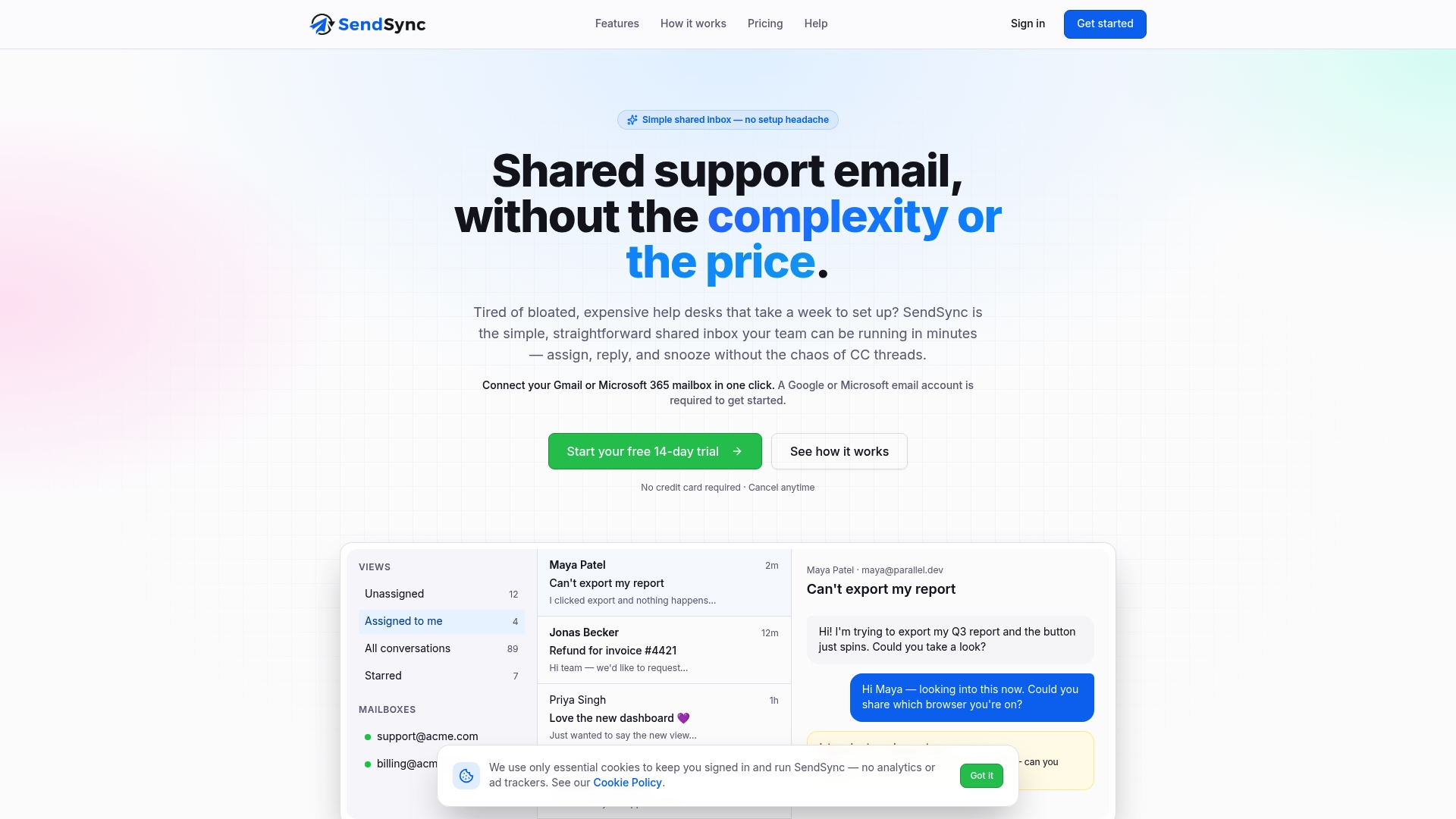
If scope and permissions fixes still leave your team hunting through threads, see our plans at SendSync and start a free trial to connect a mailbox and test assignment alongside search.
FAQ
Why can’t I search in a shared inbox in Outlook?
Search usually fails because the wrong folder or scope is selected rather than because search itself is broken. Confirm you have a folder inside the shared mailbox selected, check Full Access and folder visibility permissions, and test Outlook on the web to rule out a client-side issue.
How do I access a shared inbox?
Access depends on the platform: Outlook requires an admin to grant Full Access permission to the mailbox, while Gmail uses either delegate access or a Google Group set up as a Collaborative Inbox. Each model has its own setup steps and its own search behavior once you’re in.
Where do I find a shared inbox in Outlook?
A shared mailbox you’ve been granted access to appears in the folder pane below your own mailbox, once an admin has added the permission on their end. If it doesn’t show up automatically, you can add it manually through account settings, as described in Microsoft’s shared mailbox guide.
How do I access a shared inbox on Gmail?
Open the account switcher in Gmail and select the delegated account, which appears there once an admin has granted access; this can take up to 24 hours to activate, according to Gmail Help. For team-wide shared inboxes built around assignment and resolution status, a Google Group configured as a Collaborative Inbox is the other common path.
Sources
- Open and use a shared mailbox in Outlook | Microsoft Support
- Delegate & collaborate on email - Computer - Gmail Help
- Use a group as a Collaborative Inbox - Google Workspace Learning Center
- Refine searches in Gmail - Computer - Gmail Help