
Real-Time Inbox Visibility Benefits for Support Teams
Real-Time Inbox Visibility Benefits for Support Teams ! Support team lead monitoring live inbox emails Real-time inbox visibility is defined as the ability to see the live status of every email in a shared inbox, including who is handling it, whether it has been read, and what ac

Real-time inbox visibility is defined as the ability to see the live status of every email in a shared inbox, including who is handling it, whether it has been read, and what action has been taken. Support teams that adopt this practice gain immediate control over customer communications and eliminate the guesswork that slows response times. The benefits of real-time inbox visibility extend well beyond convenience: they directly reduce email collisions, improve deliverability health, and give teams the data they need to act before problems escalate. Platforms like Sendsync are built around this principle, connecting Gmail or Microsoft 365 mailboxes so teams can see inbox activity the moment it happens.
1. How real-time inbox visibility cuts response times
Faster response times are the most direct benefit of knowing exactly what is happening in your inbox at any given moment. When agents can see which emails are open, assigned, or awaiting a reply, they stop wasting time on internal coordination and start resolving customer issues.

Real-time presence indicators and lock states prevent two agents from responding to the same email simultaneously. That kind of collision creates customer confusion and wastes effort that could go toward other tickets. High-volume support teams depend on these features to keep operations clean.
The practical result is measurable. Customers receive a single, coherent reply instead of two conflicting responses. Agents spend less time checking in with teammates and more time writing quality answers.
Presence indicators show which agent has an email open right now
Lock states prevent a second agent from drafting a reply to an in-progress email
Assignment tags make ownership clear at a glance
Status labels (open, pending, resolved) give the whole team a live picture of queue health
Pro Tip: Enable lock states in your shared inbox as soon as a team grows beyond two agents. The collision risk rises sharply with headcount, and a single duplicate reply can undermine customer trust.
2. Inbox monitoring and its impact on deliverability health
Deliverability is not a one-time setup task. The Certified Senders Alliance treats it as an ongoing process where visible failures always mean early warning signs were ignored for too long.
Real-time inbox monitoring gives you those early warning signs before they become crises. Bounce rates, spam complaint rates, and domain reputation scores all shift in real time. Watching them continuously lets you intervene before thresholds are breached.
Bounce rates should stay below 2% and spam complaint rates between 0.1% and 0.3% to maintain deliverability standards in 2026. For cold email programs, the spam complaint threshold drops even lower, to under 0.08%. Exceeding either limit can permanently damage your domain reputation.
Process | Manual monitoring | Automated real-time monitoring |
|---|---|---|
Incident detection | Noticed after complaints arrive | Flagged the moment thresholds shift |
Diagnosis time | 2–4 hours per incident | Minutes with automated RCA tools |
Domain coverage | Spot-checking one domain at a time | All domains monitored simultaneously |
Ticket volume impact | Reactive, high ticket volume | 40–60% reduction within a quarter |
Team effort | High manual effort per incident | Low effort, high coverage |
Automated RCA Inspector tools compress diagnosis from hours into minutes and cover every domain at once rather than requiring spot checks. That scale shift is what makes proactive monitoring practical for growing teams.
Pro Tip: Set automated alerts for bounce rate and spam complaint thresholds before you need them. Waiting until a campaign fails to check these numbers means the damage is already done.
3. Why inbox placement rate matters more than delivery rate
Delivery rate is a misleading metric. An email can be delivered and still land in the promotions tab or the spam folder, where it will never be read. Actual inbox placement is what determines whether your message reaches a customer and whether your marketing budget produces a return.
Real-time visibility into inbox placement tells you whether your emails are reaching the primary inbox or being filtered out. That distinction directly affects revenue, campaign success, and customer satisfaction scores. Teams that track only delivery rate consistently overestimate how well their communications are performing.
The fix is straightforward. Monitor inbox placement alongside delivery rate and treat any gap between the two as a signal that your sender reputation or content needs attention. Sendsync surfaces this kind of status data so teams can act on it without digging through raw logs.
4. Engagement tracking: prioritizing outreach with live signals
Click tracking provides more reliable engagement signals than open tracking. Mail clients pre-fetch images and trigger false open events, making open rates an unreliable measure of actual human interest. A click, by contrast, is a binary and precise signal that a real person engaged with your content.
Real-time email tracking benefits go furthest when teams use live engagement data to decide who to follow up with and when. A prospect who clicked a pricing link three times in one hour is a warmer lead than one who opened an email once two days ago. Fixed follow-up schedules ignore that difference entirely.
Here is how an engagement-driven outreach workflow operates in practice:
An email is sent and click activity is tracked in real time
Contacts who click are flagged as high priority and moved to the top of the follow-up queue
Reply detection automatically pauses the sequence so a customer who responds does not receive another automated message
Contacts with no engagement after a set period receive a different message variant
The team reviews engagement trends weekly to refine subject lines and send times
This approach applies equally to sales outreach and customer support. A support agent who sees that a customer clicked a help article link but did not reply knows exactly what follow-up to send.
5. How shared inboxes with live updates strengthen team collaboration
A shared inbox without real-time visibility is just a group email address. The collaboration benefits only appear when every team member can see the live state of every conversation. Shared inbox best practices for 2026 consistently emphasize transparency of assignment and status as the foundation of effective team email management.
The advantages of inbox monitoring at the team level include more than speed. They include accountability, continuity, and coverage across time zones and shifts.
Transparent assignment shows which agent owns each conversation, preventing messages from being overlooked
Status labels give managers a live view of queue health without requiring status meetings
Handoffs between agents carry full conversation history, so customers never repeat themselves
Remote and distributed teams benefit from live updates that replace the informal awareness you get from sitting near a colleague
Cross-team visibility lets a sales agent see that support already handled a customer complaint before reaching out
Sendsync is built specifically for this model. Teams connect their existing Gmail or Microsoft 365 mailboxes and get live assignment, status, and conversation history without reconfiguring DNS or learning a new system from scratch.
6. Choosing the right visibility features for your team
Not every team needs every real-time inbox feature. The right set depends on your volume, your team size, and the problems you are actually trying to solve.
Feature | Core benefit | Best fit |
|---|---|---|
Presence indicators | Prevents duplicate replies | Teams with 3+ agents sharing one inbox |
Automated deliverability alerts | Catches threshold breaches early | High-volume senders and ESP teams |
Click-based engagement tracking | Prioritizes warm leads and follow-ups | Sales teams and outreach programs |
RCA diagnostic tools | Cuts incident resolution from hours to minutes | Teams managing multiple sending domains |
Assignment and status labels | Creates accountability and queue clarity | Any shared inbox with more than one agent |
A focused daily monitoring routine covering four metrics, specifically bounce rate, spam rate, domain reputation, and reply trends, prevents most deliverability issues. A 15-minute daily check paired with a weekly deep dive balances thoroughness with the reality of a busy support schedule.
Budget considerations matter too. Entry-level shared inbox tools cover presence indicators and assignment. Enterprise-grade platforms add automated RCA, multi-domain monitoring, and engagement analytics. Most support teams find that starting with the core features and adding analytics as volume grows is the most practical path.
Pro Tip: Block 15 minutes every morning to review your four core metrics before the day’s first customer interaction. Problems caught at 9:00 AM are far cheaper to fix than problems discovered at 4:00 PM.
Key takeaways
Real-time inbox visibility reduces response times, prevents email collisions, and protects deliverability by giving teams live data to act on before problems escalate.
Point | Details |
|---|---|
Collision prevention | Presence indicators and lock states stop two agents from replying to the same email. |
Deliverability protection | Monitoring bounce and spam rates in real time prevents permanent domain reputation damage. |
Engagement-based prioritization | Click tracking gives reliable signals to rank follow-ups by actual human interest. |
Team transparency | Live assignment and status labels replace status meetings and prevent overlooked messages. |
Daily monitoring routine | A 15-minute daily check of four core metrics catches most issues before they escalate. |
What I have learned from watching teams ignore their inboxes
The most common mistake I see support teams make is treating inbox setup as a one-time event. They connect their mailbox, assign a few labels, and assume the system will run itself. It does not. The teams that consistently outperform their peers are the ones checking live inbox data every single day, not just when something breaks.
The second mistake is trusting delivery rate as a proxy for success. I have watched teams celebrate a 99% delivery rate while their emails quietly piled up in spam folders. Inbox placement is the number that actually matters, and most teams are not tracking it.
Looking ahead past 2026, the inbox is going to get more competitive, not less. Mail clients are getting better at filtering, and customers are getting faster at marking irrelevant messages as spam. Teams that build a habit of proactive, real-time monitoring now will have a structural advantage over those that keep reacting to problems after the fact.
The good news is that the tools to do this well are accessible and fast to set up. There is no reason to wait for a deliverability crisis to start paying attention to your inbox.
— Nick
Sendsync gives your team real-time inbox control
Support teams that want the benefits of instant inbox updates without a lengthy setup process have a direct path forward with Sendsync. The platform connects to Gmail or Microsoft 365 in minutes, giving your team live presence indicators, assignment tracking, and conversation history from day one.
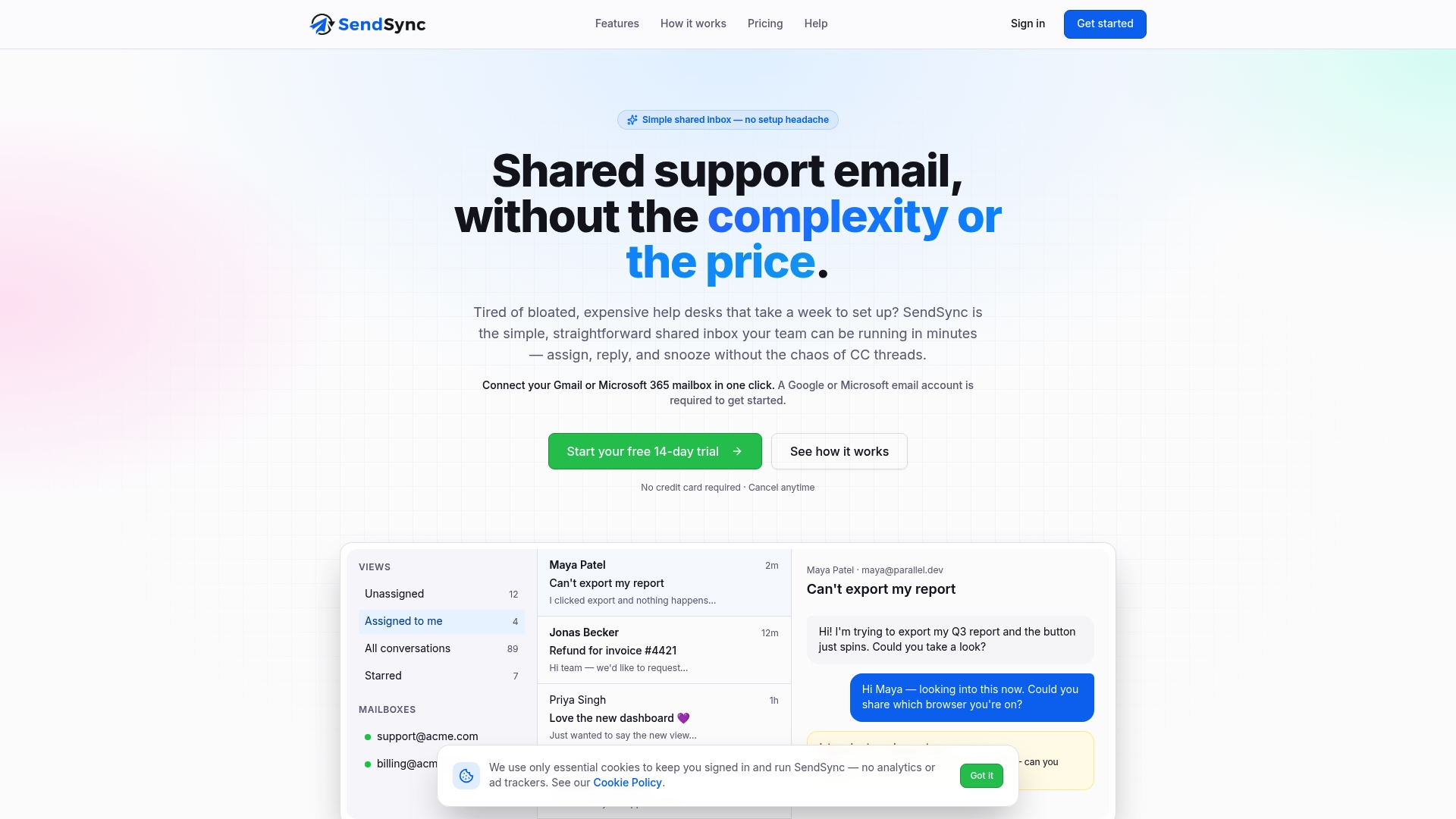
Sendsync offers unlimited users with no per-seat fees, which means the cost stays flat as your team grows. Agents assign, reply, and manage conversations in one place, and managers get a live view of queue health without scheduling a single status meeting. For teams ready to move from reactive email management to proactive inbox control, Sendsync’s shared inbox is built for exactly that transition. You can also review inbox organization strategies to get the most out of real-time visibility from the start.
FAQ
What is real-time inbox visibility?
Real-time inbox visibility is the ability to see the live status of every email in a shared inbox, including assignment, read state, and agent activity. It gives support teams immediate awareness of what is happening across all customer conversations.
How does inbox monitoring reduce support ticket volume?
Proactive real-time monitoring catches deliverability issues before they generate customer complaints, reducing ticket volume by 40–60% within a quarter compared to reactive manual monitoring.
Why is click tracking more reliable than open tracking?
Click tracking captures precise human engagement because a click requires deliberate action. Open tracking is undermined by mail clients that pre-fetch images and trigger false open events.
What metrics should teams monitor daily for inbox health?
Teams should track bounce rate, spam complaint rate, domain reputation, and reply trends every day. A 15-minute daily review of these four metrics prevents most deliverability problems before they affect customers.
How does a shared inbox improve team collaboration?
A shared inbox with live assignment and status labels gives every team member a clear picture of who owns each conversation. That transparency prevents duplicate replies, reduces handoff delays, and keeps distributed teams aligned without requiring status meetings.