
Outlook Shared Mailbox Setup: Who Creates It and How to Get Access
Outlook Shared Mailbox Setup: Who Creates It and How to Get Access ! Administrator adding a shared mailbox in Outlook A Microsoft 365 admin creates the shared mailbox and adds members.

A Microsoft 365 admin creates the shared mailbox and adds members. Ask your admin which permissions you need. Once you are added, the mailbox usually appears on its own in new Outlook through automapping. If it does not, you can add it yourself with “Add shared folder or mailbox.” Desktop Outlook and Outlook on the web offer the fullest feature set, while mobile apps stay limited.
TL;DR:
- If automapping fails, wait a few minutes, restart Outlook, add the mailbox manually, and ask an admin to verify Full Access and Send As.
- Use classic Outlook’s account settings when automapping is disabled or reminders matter; adding the mailbox as an account enables rules, categories, and notifications.
- Under 50 GB, shared mailboxes need no license; license existing mailboxes before conversion, and block the original account’s sign in rather than deleting it.
- Use desktop Outlook or the web for full triage; mobile apps limit folder management, while shared mailboxes lack assignments, internal notes, and automation.
Table of Contents
- How do you add a shared mailbox in new Outlook?
- How do you add a shared mailbox in classic Outlook?
- How do admins create and manage shared mailboxes?
- What do Full Access, Send As, and Send on Behalf actually do?
- How do you add a shared mailbox as an account?
- What works on Outlook on the web and mobile?
- Why isn’t my shared mailbox showing up?
- When is a shared mailbox enough?
- Need assignment and internal notes on top of Outlook?
- FAQ
- Sources
How do you add a shared mailbox in new Outlook?
In new Outlook, the mailbox normally shows up by itself. Microsoft says shared mailboxes typically appear automatically in the Folder pane for members, and the Shared with me page lists them too. If yours is missing, add it manually:
- Open new Outlook and find your primary account in the Folder pane.
- Right-click the account and choose Add shared folder or mailbox.
- Type the shared mailbox’s email address in the dialog and select it.
- Click Add, and the mailbox appears in your Folder pane.
You can also go to File > Accounts > Shared with me and add it from there. Institutional helpdesks document the same route and recommend restarting Outlook if nothing changes.
To send from the shared address, ask your admin which sending permissions are available and how to use them in your Outlook version.
Pro Tip: Wait a few minutes after your admin adds you, then restart Outlook before trying the manual route.
How do you add a shared mailbox in classic Outlook?
Classic Outlook uses the account settings route, which suits older clients or cases where automapping does not apply. Other institution guides show the same path:
- Select File > Account Settings > Account Settings.
- Choose your email account and click Change.
- Click More Settings, then open the Advanced tab.
- Under Mailboxes, click Add and enter the shared email address.
- Click OK, finish the wizard, and restart Outlook.
The mailbox then displays beneath your primary mailbox in the folder list, so you can watch its Inbox without switching views. Choose this route when automapping is turned off for you, when you need classic reminder behavior, or when your organization still runs the classic client.
How do admins create and manage shared mailboxes?
Admins do the heavy lifting in the Exchange Admin Center (EAC), reached through the Microsoft 365 admin center. Microsoft Learn is the canonical reference for the details below.
- Go to Recipients > Mailboxes and choose Add a shared mailbox.
- Enter a Display Name, email address, and alias, then save.
- Choose Add users to assign members to the new mailbox.
- Use Manage mailbox delegation to grant Full Access and Send As. Full Access lets people open the mailbox, and Send As lets them reply from its address. Most support teams need both.
- To convert an existing user mailbox, make sure a license is present before you convert.
- After conversion, remove the license if the mailbox stays under 50 GB, since shared mailboxes under that size don’t require one.
- Never delete the original user account. It acts as the anchor for the mailbox, and Microsoft’s admin guidance says to block sign-in instead.
For deeper admin context, see our explainer on what a Microsoft 365 shared mailbox is.
What do Full Access, Send As, and Send on Behalf actually do?
Permissions cause most of the confusion, so here is each one in plain terms:
- Full Access: lets you access the mailbox. Ask your admin which additional permissions are needed to send from it.
- Send As and Send on Behalf: ask your admin how each permission affects messages sent from the shared address.
- Automapping: can make a shared mailbox appear automatically in Outlook for members.
Microsoft states that shared mailboxes don’t need a license as long as they stay under 50 GB. That makes the native option cheap, but each permission still has to be granted deliberately.
Most teams pair Full Access with Send As. For admin-side advice on ordering these grants, read our piece on shared inbox permissions.

How do you add a shared mailbox as an account?
Adding the mailbox as an account unlocks settings that a plain shared folder hides. Microsoft documents the procedure for desktop Outlook.
- Go to File > Add Account and enter your own email address when prompted.
- Sign in with your usual credentials. Full Access is required.
- Once added, you can manage Categories, Notifications, Rules, and Automatic Replies for that mailbox.
- In new Outlook, open Shared with me and choose Convert to promote a shared folder to an account, or switch back with “Use as shared folder.”
- Doing this can also bring back reminders that automapped mailboxes do not show.
Pro Tip: Rely on automapping for everyday reading. Promote a mailbox to an account only when you need rules, reminders, or notifications.
What works on Outlook on the web and mobile?
Outlook on the web can be another way to access a shared mailbox. Check your Outlook settings for the available options.
- Mobile apps are limited. A university IT knowledge base notes the mobile experience for shared mailboxes lags behind desktop.
- Folder-level management and collaborative features are thin on a phone, which makes triage awkward.
- Use desktop Outlook or the web for full triage, and keep mobile for quick replies.
Why isn’t my shared mailbox showing up?
Work through these checks in order:
- Wait a few minutes after any role or membership change. Automapping can lag.
- Close and reopen Outlook, which often fixes it.
- Add the mailbox manually using the steps above.
- Ask your admin to confirm Full Access and Send As in the EAC.
- For a converted mailbox, confirm it held a license before conversion.
- If a user was offboarded, check that their account was blocked from sign-in rather than deleted. A deleted anchor account can be restored in the admin center, and that usually brings the mailbox back.
When is a shared mailbox enough?
My view: native shared mailboxes are a sensible choice for small teams and low-volume aliases like info@ or billing@. They cost nothing under 50 GB and take minutes to set up. The trouble starts when several people need to see who owns a conversation, leave internal notes, or automate triage. Those jobs sit outside what a shared mailbox does, and phones make it worse. Our write-up on Outlook shared mailbox limitations goes deeper.
— Nick
Need assignment and internal notes on top of Outlook?
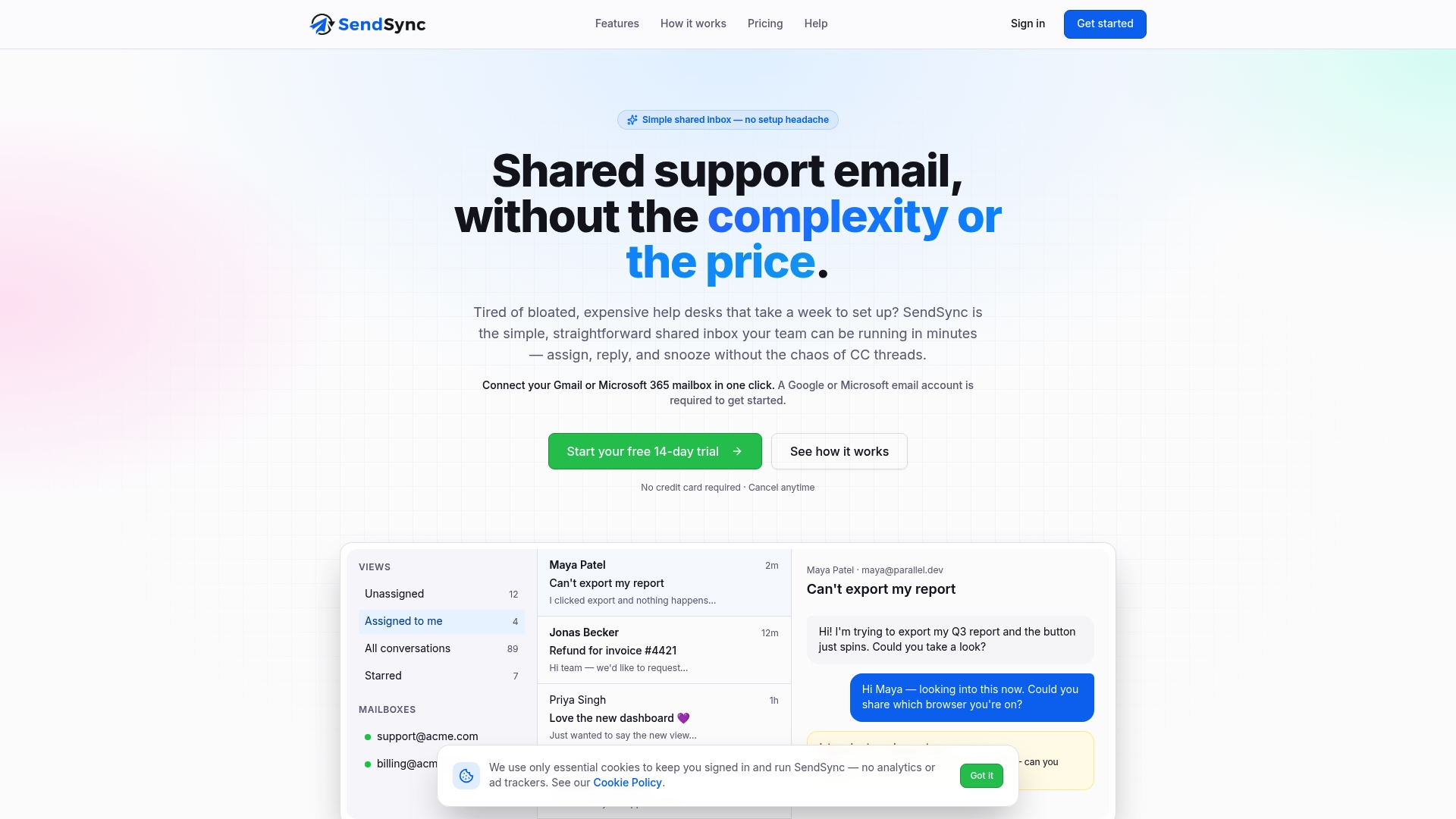
If your team has outgrown a plain shared mailbox, we built SendSync to sit on top of Microsoft 365. You connect your mailbox in minutes, with no DNS setup, and your team gets assignment, internal notes, tagging, and automation for triage. We charge no per-seat fees, so you can add everyone who touches support.
- Plans: Founder at 10 USD per month, Starter at 30 USD per month, Growth at 80 USD per month, and Scale at 200 USD per month.
- Not sure whether you need a platform? Our shared inbox vs helpdesk guide helps you decide.
Visit SendSync and see how it fits your inbox.
FAQ
How do I configure a shared mailbox in Outlook?
An admin creates the mailbox and adds you as a member with Full Access. It then appears automatically in Outlook, or you can add it through “Add shared folder or mailbox.” Restart Outlook if it does not show up right away.
How do I get a shared inbox to show up in Outlook?
Ask your admin to confirm you have Full Access, wait a few minutes, and restart Outlook. If it still does not appear, add it manually from the Folder pane or the Shared with me page.
What are the disadvantages of using a shared mailbox?
Native shared mailboxes lack assignment, internal notes, and workflow automation. Mobile access is also limited, which makes on-the-go triage hard for busy teams.
What is the main difference between a group email and a shared mailbox?
A shared mailbox is a real mailbox with its own inbox, calendar, and sent items that members open and send from. A group email typically distributes messages to people’s own inboxes instead.
Sources
- Open and use a shared mailbox in Outlook | Microsoft Support
- About shared mailboxes in Microsoft 365 - Microsoft 365 admin | Microsoft Learn
- Adding a Shared Mailbox to Outlook