
IT Admins: Migrate Google Groups to Shared Inboxes and Keep History
IT Admins: Migrate Google Groups to Shared Inboxes and Keep History ! IT administrator reviewing group migration plan Migrate off Google Groups by running a five-step sequence: inventory every group and its owners, prepare API and export access in Google Workspace, export message

Migrate off Google Groups by running a five-step sequence: inventory every group and its owners, prepare API and export access in Google Workspace, export messages and membership, pick a migration method that matches your scale, then validate and cut over. You can execute this with a migration tool, the Groups Migration API, or a manual CSV process. Before anything else, list your groups and confirm who owns each one.
TL;DR:
- Migrating monitored support or help addresses requires converting them into shared inboxes rather than distribution lists to maintain workflow consistency.
- Properly mapping user identities, aliases, and ownership details is critical to ensure message integrity and membership accuracy on the destination platform.
- Choosing the correct target for each group involves understanding whether it functions as a distribution list, monitored mailbox, or collaboration space, not just replicating email data.
- The migration process benefits from staged, incremental transfers—starting with archive pre-staging, then full message migration, followed by a delta pass just before cutover.
- Setting up a shared inbox solution after migration allows the team to assign, reply, and close conversations effectively without DNS or MX record changes.
Table of Contents
- How Do You Choose the Right Destination for a Migrated Group?
- What Should You Inventory Before Exporting Anything?
- How Do You Prepare Google Workspace for Migration?
- How Do You Export Messages and Map User Identities?
- Which Migration Method Fits Your Situation?
- How Do You Run the Migration and Handle Cutover?
- What Limits and Errors Should You Expect?
- What Support Teams Should Rethink About the “Group” Model
- Editorial Take: The Part of This Migration Everyone Rushes
- Get Your Migrated Group Addresses Into a Shared Inbox, Not Another List
- Sources
- FAQ
How Do You Choose the Right Destination for a Migrated Group?
Google Groups quietly does three different jobs, and most migration headaches start when admins pick a destination that only replicates one of them. A group can act as a routing address, a monitored team mailbox, or a full collaboration space with shared files and calendars. Before you touch an export tool, decide which job each group is actually doing.
A group used purely for announcements or list distribution maps cleanly to a distribution list. A group where people expect someone to read and respond to incoming mail, think support@, sales@, or hr@, is really a monitored mailbox in disguise, and a shared mailbox or a dedicated shared inbox tool fits that behavior far better than another list. A group tied to shared drives, calendars, and ongoing team discussion belongs in a Microsoft 365 Group or an equivalent collaboration space.
Run through this checklist for each group before assigning a destination:
- Posting rights: Who can post today, and does the destination support the same restriction?
- External posting: If outside senders can post now, confirm the target allows external mail without extra routing rules.
- Conversation history: Was it enabled? If not, your archive is incomplete no matter what tool you use.
- Moderation: Manual approval workflows rarely transfer automatically; you may need to rebuild them.
- Send-as needs: Does anyone need to reply as the group address, not just receive its mail?
A shared mailbox versus distribution list comparison is worth reading before you commit, since the two models solve different problems and swapping one for the other after go-live is painful.
What Should You Inventory Before Exporting Anything?
Skipping inventory is the single most common reason group migrations run long. Spend a day here and you’ll save a week later.
Capture these fields for every group, even ones you think you’ll retire:
- Group email address and display name
- Owner(s) and manager(s), separate from regular members
- Direct members versus members added through nested groups
- Posting permissions and whether external posting is allowed
- Conversation history status (on or off)
- Any aliases pointing to the group
- Retention or Vault policies attached to the group
- Rough message volume and archive size, if known
Owners can typically pull their own group’s membership and message data directly, but only a Workspace administrator can run an organization-wide export or access Vault holds. If you’re not sure who owns a group, that’s itself a finding: orphaned groups with no active owner are common in older Workspace tenants and often need admin-level takeover before migration.
Pro Tip: Check conversation history first. If it was ever disabled, the group’s archive is missing threads you can’t recover after the fact. Note this per group so you don’t promise stakeholders a complete history you can’t deliver.
How Do You Prepare Google Workspace for Migration?
Most migration failures trace back to skipped setup, not bad tooling. Get the access pieces right before you export a single message.
Start in the Google Cloud console by creating a project and a service account dedicated to the migration. Grant it the API scopes your chosen method requires (Groups Migration API, Admin SDK, or Groups Settings API, depending on whether you’re moving messages, membership, or both). If your organization holds messages under legal or compliance retention, confirm Vault access separately. Vault privileges and API scopes are not the same permission, and vendor migration guides consistently flag this as a setup step teams miss.
Next, decide between two export paths:
- Owner-level export: Fast, self-service, limited to what an individual owner can see and download for their own group.
- Admin organization export: Broader in scope, but the resulting archive lands in Google Cloud Storage and is not immediate. Budget at least 48 hours before the export is available.
If a group had conversation history disabled at any point, plan for that gap now. Rehydrating history later means reconstructing messages in proper RFC 822 format with accurate From, To, and Date headers, and every migrated message tops out at a 25 MB limit including attachments and metadata. Oversized archives need to be split before upload, not after a failed job tells you they were too big.
How Do You Export Messages and Map User Identities?
Exporting the data is the easy half. Mapping who owns what on the other side is where migrations quietly go sideways.
Google gives you three export shapes, depending on scope: organization Data Export to Cloud Storage for tenant-wide archives, per-group owner downloads for one-off groups, and CSV member lists pulled from the admin console or Groups Settings API. Message content, when moved through the Groups Migration API, has to arrive as properly formatted RFC 822 files rather than a generic export dump.
Identity mapping deserves its own pass, separate from the message import itself. Workspace Migrate’s own examples show explicit source-to-target address pairs rather than assuming a match. Build a mapping file that covers:
- Primary source address paired with its destination address or mailbox
- Any aliases that need to keep working after cutover
- External or non-Workspace addresses that were members but have no direct target equivalent
- A flagged list of members who need manual review (shared accounts, service addresses, departed employees)
Keep the original export archive untouched as a rollback point. Before you import anything, spot-check a sample of exported messages for header integrity and confirm your member CSV row count matches what the source group reported. A mismatch here almost always means a nested group didn’t expand the way you expected.
Which Migration Method Fits Your Situation?
The right tool depends less on preference and more on scale, archive completeness, and how much of the workflow you’re willing to script yourself.
A dedicated migration platform like MigrationWiz makes sense once you’re moving more than a handful of groups, especially when you need to provision shared mailboxes on the target side and carry attachments along with messages. These tools generally expect the prerequisites you already set up: a service account, correct API scopes, and Vault access confirmed ahead of time. Skipping that setup is the most common reason a migration project stalls in week one.
The Groups Migration API is the right call when you specifically need to rehydrate an archive, restore history that was previously missing, or push messages into a group programmatically. It accepts RFC 822 uploads via POST, with each message capped at 25 MB including attachments.
For smaller environments, admin tooling like GAM handles bulk member exports and CSV generation well without the overhead of a full migration platform. If you’re dealing with three or four groups and no archive complexity, manual CSV export and manual provisioning on the destination is often faster than standing up a tool for the job.
- Tool-based migration: Best for volume, attachment handling, and shared mailbox provisioning.
- Groups Migration API: Best for archive rehydration and programmatic message moves.
- GAM or manual CSV: Best for small group counts with simple membership.
How Do You Run the Migration and Handle Cutover?
Migrating in one giant pass is how teams lose messages. A staged approach gives you room to catch problems before they hit users.
- Pre-stage the archive. Move historical messages and membership first, while the source group stays live. This is your low-risk pass, since nothing depends on it yet.
- Run the full pass. Move the bulk of live messages and finalize membership once the pre-stage completes cleanly.
- Run a short delta pass right before cutover. Catch anything sent between your full pass and go-live so nothing falls through the gap.
Before flipping over, validate on both sides: member counts should match, message counts should be close (some variance is normal for spam-filtered items), attachments should open correctly, and moderator or posting settings need to mirror the source group’s rules, not just its membership.
For cutover itself, freeze posting on the source group or set an auto-reply pointing to the new address, update any distribution aliases or send-as permissions on the new destination, and notify affected users before, not after, the switch. Watch bounce reports closely for the first 48 hours; that’s usually when stale aliases or missed forwarding rules surface.
Pro Tip: Run your delta pass close to cutover, not days before it. A gap of even 24 hours between your last sync and go-live is enough for a customer reply or a manager’s approval thread to land in the old group and get missed.
What Limits and Errors Should You Expect?
Google Workspace enforces daily join limits, group creation caps, and ownership ceilings that rarely matter for day-to-day use but can block a bulk migration outright if you’re adding hundreds of members in a short window. Spread bulk membership changes across a few days if you’re near those thresholds.
Common failure points and their fixes:
- Malformed RFC 822 messages: Usually a missing or malformed header. Validate a sample before bulk upload rather than after a rejected batch.
- Missing group owners: If no active owner exists, an admin has to take ownership before an owner-level export works.
- API auth failures: Almost always a scope mismatch on the service account. Recheck the exact scopes the API method requires.
- Oversized messages: Anything approaching the 25 MB cap needs to be split or have attachments handled separately.
If a batch fails repeatedly, gather the request ID, timestamp, and full API error response before escalating to vendor support. That trio saves a support thread from becoming a week-long back-and-forth.
What Support Teams Should Rethink About the “Group” Model
If the address you’re migrating is a monitored inbox like support@ or help@, stop thinking of the destination as a group at all. A distribution list or Microsoft 365 Group replicates membership. It doesn’t replicate the actual job someone does when a customer email lands: assigning it, replying, and marking it resolved. That’s a shared inbox workflow, not a mailing list workflow, and treating it as one is why teams end up bolting a ticketing tool on top of a group six months later.

A shared inbox solution can connect directly to Gmail or Microsoft 365 mailboxes without requiring DNS changes, which matters most right after a migration when you don’t want to touch MX records twice in one quarter. Teams moving from a monitored Google Group to a shared inbox skip the distribution-list detour entirely and go straight to an assignable, trackable inbox.
Editorial Take: The Part of This Migration Everyone Rushes
Most migration advice treats Google Groups as a single thing you move once and forget. It isn’t. It’s three different behaviors wearing one interface, and the guides that skip straight to “here’s how to export” without asking what each group actually does for its members are setting admins up to rebuild the wrong thing on the other side.
The conventional advice oversells the tooling and undersells the mapping work. MigrationWiz, GAM, and the Groups Migration API all move data reliably when configured correctly. None of them decide whether support@ should become a shared mailbox or a shared inbox instead of a distribution list, and that decision matters more than which tool moved the bytes. Get the destination model wrong and you’ll be migrating again in six months.
If there’s one thing to prioritize first, it’s the function audit in the decision section above, not the export. Data you can always re-pull. A destination model that doesn’t match how your team actually works is what causes the second, more painful migration.
— Nick
Get Your Migrated Group Addresses Into a Shared Inbox, Not Another List
If support@ or help@ just moved off Google Groups, the last thing you want is another distribution list quietly forwarding mail nobody’s tracking. A shared inbox solution can connect a Gmail or Microsoft 365 mailbox in minutes with no DNS setup, so the address you just migrated becomes a workspace where your team can assign, reply, and close conversations instead of just receiving them.
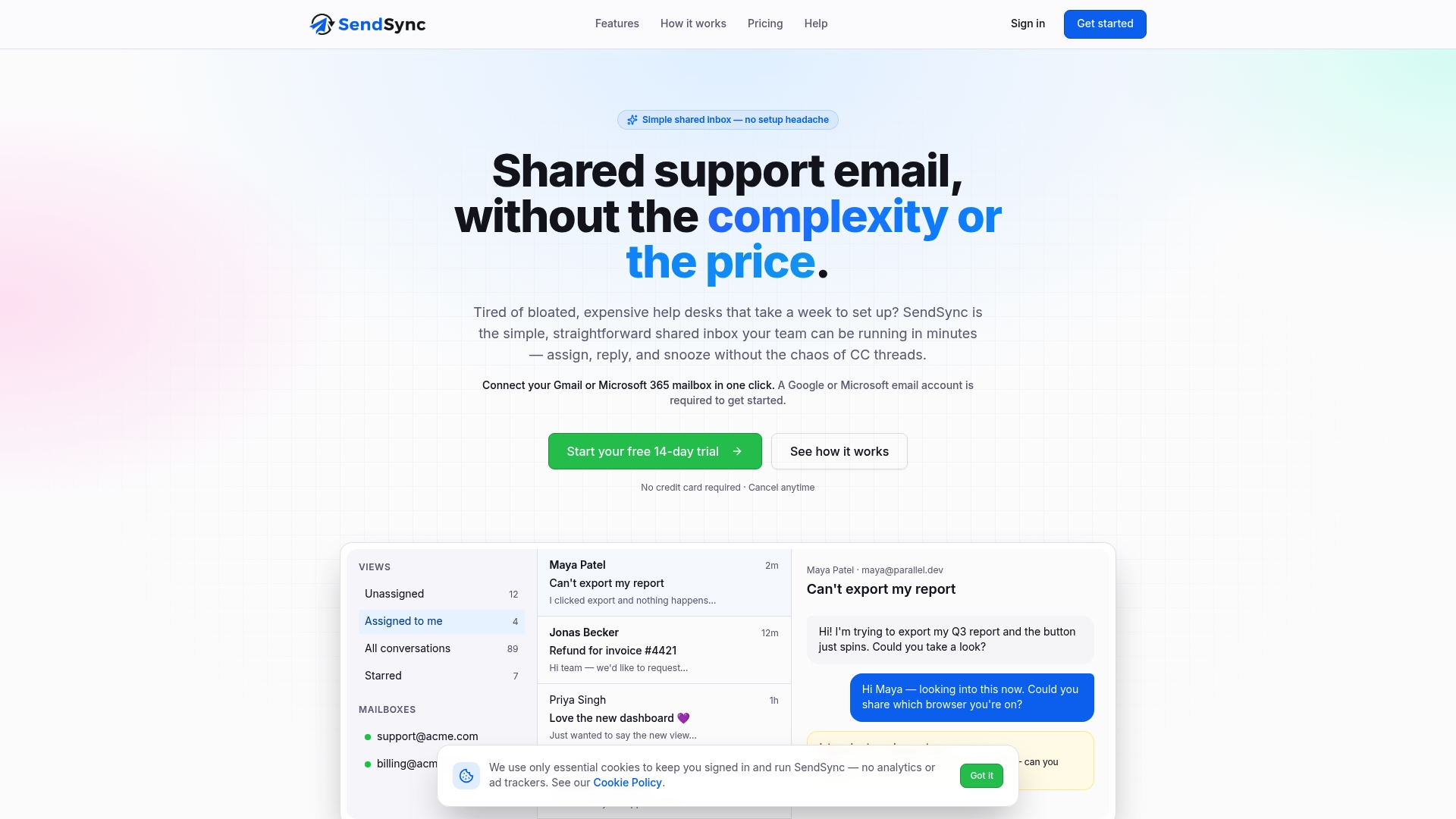
Plans often include unlimited users with no per-seat fees, which matters if your support team grows and you want to avoid repeating migration math every time you hire. Plans start at $10 a month with the Founder tier, scaling up to Starter, Growth, and Scale as your volume grows. If you’re setting this up on Microsoft 365 specifically, the team inbox setup guide walks through the exact steps. Start a trial and connect your migrated address today.
Sources
- Export your Groups data - Google Groups Help
- Migrate emails | Groups Migration API | Google Developers
- Google Groups to Microsoft 365 Groups Migration Guide – BitTitan Help Center
FAQ
Is Google Groups Still a Thing?
Yes, Google Groups remains active and functions as it always has: a mailing list where posting permissions, external posting, and conversation history controls determine who sees what. Many organizations are moving away from it not because it’s shutting down, but because it doesn’t handle monitored team inboxes the way a shared mailbox or shared inbox tool does.
What Replaced Google Groups?
Nothing replaced it outright. Organizations typically split their groups across three destinations based on function: distribution lists for pure announcements, shared mailboxes or a shared inbox tool like Sendsync for monitored addresses, and Microsoft 365 Groups for collaboration spaces with shared files and calendars.
What Is the Microsoft Equivalent of Google Groups?
The closest match depends on what the group actually does. A distribution list mirrors a simple mailing list, a shared mailbox mirrors a monitored address, and a Microsoft 365 Group mirrors a collaboration space with its own calendar and files, which is a broader feature set than most Google Groups ever used.
Can I Use Google Groups as a Mailing List?
Yes, that’s its core function: members receive mail sent to the group’s address, and admins control who can post and whether outside senders are allowed. If that’s all a group ever needs to do, a straight migration to a distribution list on the destination platform is usually the simplest path.
How Do I Migrate a Support Address Instead of a Regular Group?
Export the group’s membership and message history using the same steps as any other group, then provision the destination as a shared mailbox or shared inbox rather than a list. Sendsync connects to the destination mailbox directly without DNS changes, letting your team assign and reply to messages right away instead of just receiving them.