
Submillisecond Keyword Routing Gives Hybrid AI a Deterministic Layer
Submillisecond Keyword Routing Gives Hybrid AI a Deterministic Layer ! Analyst reviewing a keyword routing rule Keyword-based routing matches keywords or regex patterns against incoming text and sends each request down a fixed path, with sub-millisecond latency and a full audit t

Keyword-based routing matches keywords or regex patterns against incoming text and sends each request down a fixed path, with sub-millisecond latency and a full audit trail. It is the right tool for compliance rules, safety blocks and PII detection, and urgent or high-priority traffic. When users paraphrase or the vocabulary is fuzzy, layer a semantic router or classifier on top.
TL;DR:
- Assign higher priorities to safety and PII rules, rely on first match wins, and define a default route for unmatched requests.
- Use regex for structured identifiers, keep ordinary matching case insensitive, and test every rule with positive, negative, overlapping, and malformed input examples.
- Paraphrases, typos, and obfuscation can bypass literal rules, so monitor fallthrough and false positives, then send free form language to semantic routing.
- Log each matched rule and token, version changes with staged approvals, and replay a week of traffic before deployment to catch routing shifts.
Table of Contents
- How do keyword routing rules get evaluated?
- Why choose keyword routing: benefits and use cases
- What are the limitations and failure modes of keyword routing?
- Where does keyword routing fit in a signal-fusion hybrid?
- How do you implement keyword rules, regex and fallthrough?
- How should you test, monitor and govern routing rules?
- What I’d run in production
- Route support email with rules in SendSync
- FAQ
- Sources
How do keyword routing rules get evaluated?
A keyword router scans the incoming text for tokens or phrases, tests each rule against it, and fires the action of the first rule that matches. Matching can be a plain phrase check, optionally case-sensitive, or a regex pattern for structured tokens. For comparison, Azure Front Door evaluates exact matches before wildcard paths and applies most-specific-first logic, the same ordering instinct.
Rules combine with Boolean logic, and signal-driven architectures also use derived operators such as NOR and XOR:
- OR: any listed keyword triggers the rule.
- AND: every listed condition must hold.
- NOT: a keyword must be absent.
- Nested conditions: groups of the above in one expression.
signals:
  urgent_keywords:
    operator: OR
    keywords: ["outage", "urgent", "down"]
decisions:
  - name: urgent_route
    priority: 100
    signals: [urgent_keywords]
    action: escalate
  - name: default_route
    priority: 0
    action: general_queue
| Concept | Behavior |
|---|---|
| Priority | Higher number evaluated first |
| Short-circuit | First match wins, remaining rules skipped |
| Fallthrough | Default rule handles unmatched input |
Why choose keyword routing: benefits and use cases
Keyword routing earns its place when you need decisions that are fast, explainable and repeatable. Explicit keyword and regex rules make routing deterministic and auditable, which suits compliance and high-throughput scenarios. Because every decision traces back to a named rule and the exact tokens that matched, auditors can reproduce it without inspecting a model.
Keyword routing delivers sub-millisecond latency, deterministic and auditable decisions, with no model call in the path.
Typical use cases:
- PII and safety blocks: SSN-like patterns or banned terms stop a request before it reaches any model.
- Urgent message routing: words like “outage” or “chargeback” jump the queue.
- Domain-specific technical routing: tokens such as CVE identifiers or Kubernetes terms go to specialist handlers.
- Regulated workflows: SOC2 or HIPAA-style environments that demand explainable decisions.
Cost is also predictable. There is no ML inference overhead, so the cost of a routing decision does not grow with traffic or prompt length. For stable routing keys, the content-based routing pattern from WSO2 recommends match-based routing and an explicit default branch for unsupported content.
What are the limitations and failure modes of keyword routing?
Keyword rules know nothing about meaning. A rule for “refund” misses “I want my money back,” and every paraphrase you did not anticipate falls through. That brittleness shapes everything else you need to plan for.
- No semantic generalization: synonyms, typos and indirect phrasing slip past exact tokens.
- Maintenance burden: rules drift as products and vocabulary change, lists multiply, and each new rule demands test coverage.
- Adversarial input: spacing tricks, leetspeak and homoglyphs defeat literal matching. Regex helps, but patterns that tolerate obfuscation grow complicated and break easily.
- Overblocking: a broad rule such as “password” can capture harmless questions, trading recall for precision in ways users notice.
- Rule explosions: overlapping rules with unclear priority produce surprising winners.
The failure modes cluster around two errors: missed matches (low recall) and wrongly captured traffic (low precision). Plan to measure both, not just whether the router runs fast.
Pro Tip: Keep each rule narrow and give it an owner, a rationale and at least one positive and one negative test, so rule sprawl stays reviewable.
Teams that treat rules as code, with review and a deprecation path, avoid most of the pain. Treating them as a growing pile of exceptions is what turns a fast router into a liability.
Where does keyword routing fit in a signal-fusion hybrid?
Think of keyword routing as the determinism layer, not the whole stack. A proposed Signal Fusion Layer gathers keyword, regex and embedding signals and evaluates rules by priority. Keyword matches can short-circuit when appropriate, and the system falls back to semantic or classifier signals when no deterministic rule fires.
Keyword matching provides fast deterministic matches of roughly 1–2ms, and fusion policies use priorities and short-circuiting to mix signals safely.
That is the proposal’s own framing, and it maps to a practical split:
- Short-circuit to keywords: safety blocks, PII patterns and high-confidence tokens, where a wrong answer is expensive.
- Route semantically: open-ended language where meaning matters more than wording.
- Fall back to a classifier: inputs no rule or embedding handles confidently.
The alternatives are complementary. Semantic routers encode prompts and candidate routes into embeddings and pick pathways by similarity, sending complex prompts to reasoning-enabled models and simple ones to lightweight models. IPR predicts response quality per model and uses a tolerance parameter τ to filter candidates, then picks the most cost-efficient model that meets the quality constraint. CSCR maps prompts and models into a shared embedding space and uses FAISS k-NN lookups at inference time for cost-effective expert selection.
Operational knobs to tune:
- Tolerance parameter: how much quality loss you accept for lower cost.
- Gating thresholds: the similarity or confidence a signal needs before it wins.
- Fallback strategy: what happens when every signal is weak.
How do you implement keyword rules, regex and fallthrough?
Start from a small, copyable config. This pattern follows the keyword-routing tutorial’s style of keyword signals plus decisions with OR/AND operators and priorities:
signals:
  security_terms:
    operator: OR
    keywords: ["CVE-", "exploit", "vulnerability"]
  pii_pattern:
    regex: '\b\d{3}-\d{2}-\d{4}\b'
  billing_terms:
    operator: AND
    keywords: ["invoice", "refund"]
decisions:
  - name: block_pii
    priority: 200
    signals: [pii_pattern]
    action: block
  - name: security_route
    priority: 150
    signals: [security_terms]
    modelRef: security-specialist
  - name: billing_route
    priority: 100
    signals: [billing_terms]
    modelRef: billing-assistant
  - name: default
    priority: 0
    modelRef: general-model
Use regex for structured tokens like CVE identifiers or SSN-like patterns, and keep matching case-insensitive unless the token is an exact identifier where case carries meaning.
- Assign priorities so safety rules run first and broad rules last.
- Rely on first-match-wins so a high-priority hit ends evaluation.
- Always define a default rule so unmatched input has a destination.
- Write unit tests per rule, with positive and negative examples.
- Add synthetic edge-case prompts: misspellings, mixed case, partial tokens.
- Run load tests to confirm latency holds under peak traffic.
Testing checklist:
- Every rule has at least one matching and one non-matching test.
- Overlapping rules have a test that proves which one wins.
- Regex patterns are checked against pathological input.
- Latency is measured at realistic volume, not on a laptop.
Routing latency matters outside LLMs too. This partner guide on building a fast AI lead response system shows how response time shapes handling of incoming messages.
How should you test, monitor and govern routing rules?
Governance is what makes deterministic routing trustworthy. Log the matched rule, the matched tokens and the decision path for every request, and store them where auditors can query them. That record is the practical payoff of explainability.
- Monitor coverage: track what share of traffic each rule captures and how often requests fall through to ML.
- Track error rates: sample captured and uncaptured traffic to estimate false positives and false negatives.
- Version everything: keep rules in source control, deploy in stages with approvals, and keep a rollback plan.
- Set SLOs: define acceptable routing latency, a fallthrough ceiling and an incident runbook.
A sudden jump in fallthrough usually means vocabulary drift, a new product name or a changed template, and it is your cue to add or retire rules.
Pro Tip: Replay a week of logged traffic against any proposed rule change before it ships, and diff the routing outcomes.

What I’d run in production
My rule of thumb: use deterministic keywords for safety and fast paths, and bring in hybrid fusion where coverage and accuracy matter. Start with a small rule set, instrument it, and measure fallthrough before adding anything. Every rule you add buys precision and costs maintenance, so spend that budget only on high-value cases: safety, compliance and urgent traffic. Let semantic signals handle the long tail of phrasing you could never enumerate.
— Nick
Route support email with rules in SendSync
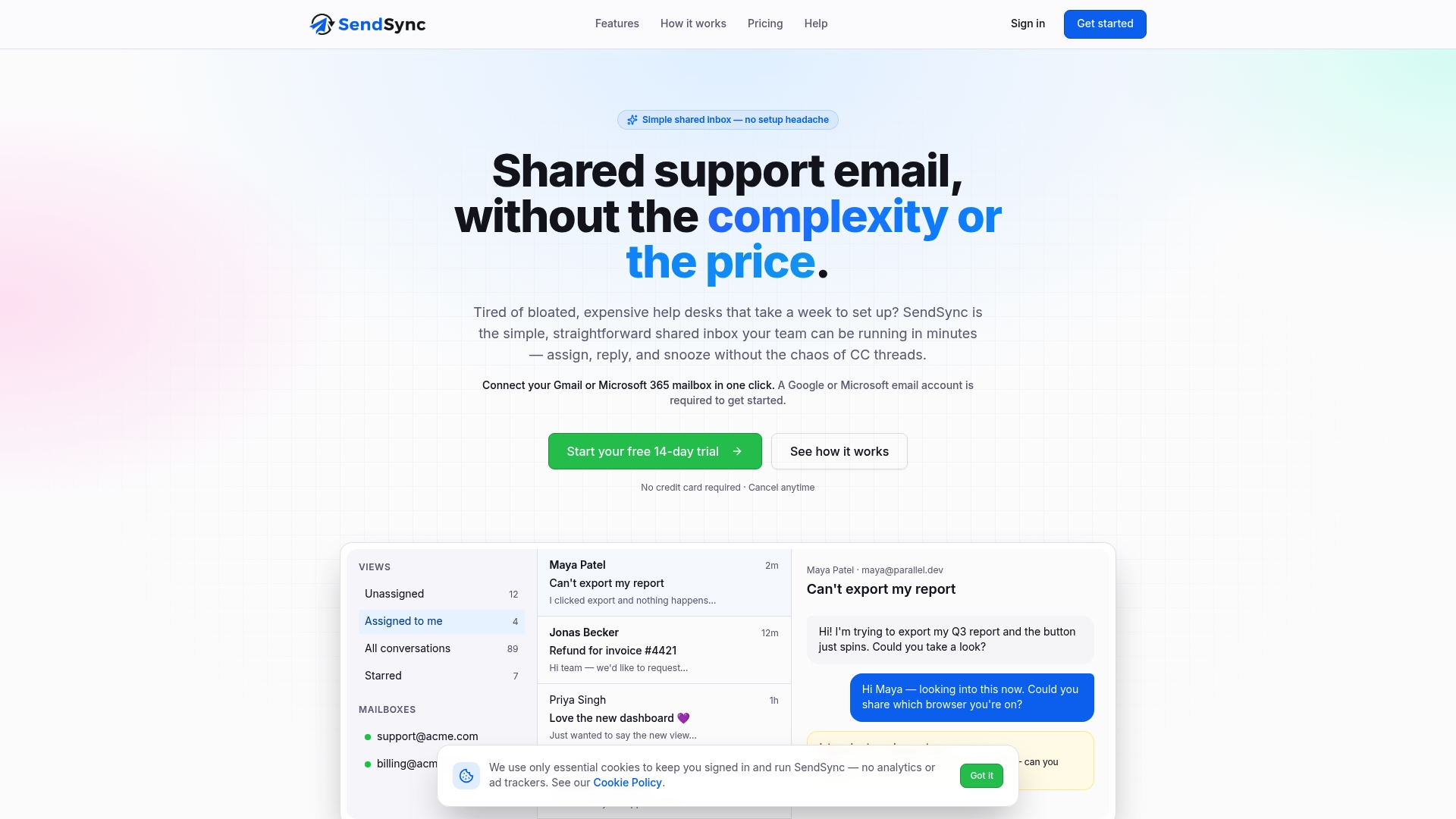
Rule-based routing is exactly how a good support inbox stays calm. In our shared inbox, you define rules that assign and route incoming support email, and you can connect Gmail or Microsoft 365 mailboxes with no DNS setup. Our guides on support routing rules and auto-assigning emails show how teams set this up.
- Rule-based auto-assign for incoming support email
- Gmail and Microsoft 365 connection with no DNS hassles
- Unlimited users with no per-seat fees
Compare our Founder, Starter, Growth and Scale plans at Sendsync.
FAQ
How does email routing work?
Email routing inspects attributes of a message, such as the recipient address, sender or subject keywords, and applies rules to pick a destination. The first matching rule typically decides the handler, and a default rule catches everything else. In a shared inbox, that destination is usually an assignee or queue.
Should I enable dynamic routing?
Enable dynamic routing when your traffic or targets change often enough that static rules cannot keep up. Keep deterministic rules for safety and compliance cases so critical decisions stay predictable. Measure how often dynamic paths are used before widening them.
What is the difference between host-based and path-based routing?
Host-based routing selects a target by the domain or subdomain in the request, while path-based routing selects by the URL path. AWS describes host-based routing with listener rules keyed on host headers that forward to specific target groups, with a default rule for unmatched hosts. Keyword routing works on the content of a message rather than its address.
What is the difference between keyword routing and semantic routing?
Keyword routing matches exact tokens or patterns and is deterministic, while semantic routing compares embeddings and handles paraphrases. Use keywords where you need guarantees and semantics where wording varies.
Sources
- website/docs/tutorials/intelligent-route/keyword-routing.md
- When to Reason: Semantic Router for vLLM
- How Requests Get Matched To a Route Configuration - Azure Front Door | Microsoft Learn