
Freelancer Inbox Management Checklist for 2026
Freelancer Inbox Management Checklist for 2026 ! Freelancer managing inbox at home desk A freelancer inbox management checklist is a structured set of workflow rules and scheduling habits that keeps client communication moving without pulling you out of focused work.

A freelancer inbox management checklist is a structured set of workflow rules and scheduling habits that keeps client communication moving without pulling you out of focused work. The goal is not inbox zero. It is reducing decision fatigue by replacing moment-to-moment choices with standing rules you follow automatically.
The most effective approach combines three proven methods:
- Scheduled sessions: Review email in 2–3 dedicated blocks of 15–20 minutes daily, not continuously throughout the day.
- The two-minute rule: If a reply takes under two minutes, send it immediately during your session block.
- Workflow stages: Route every message into one of four clear categories so nothing sits in limbo.
Customer support teams using shared inbox software get the most from this system because it maps directly onto assignment, visibility, and collaboration features built into those tools.

Best practices for a freelancer inbox management checklist
Effective email management for freelancers starts with protecting your work time, not your response speed. Here is what the research and productivity guidance for 2025/2026 consistently recommends:
- Batch your sessions. Schedule 2–3 email blocks of 15–20 minutes daily. Morning handles urgent approvals; midday processes new requests; end of day clears open loops.
- Apply the two-minute rule. During each session, if a reply takes under two minutes, send it immediately. Anything longer becomes a task.
- Set communication boundaries upfront. List your inbox check times in your email signature. Clients who know your reply window stop expecting instant responses, which cuts interruptions significantly.
- Write anticipatory replies in bilingual client follow-up. Clear, upfront answers that address the next likely question shorten communication cycles and reduce unnecessary follow-up threads.
- Use a minimal label system. Four labels cover almost every situation: Action Needed, Waiting, Admin, and Archive. More than that and the system becomes harder to maintain than the problem it solves.
- Disable non-critical notifications. Turn off email alerts on your phone and desktop during deep work. If something is truly urgent, clients can call.
- Build reply templates. Pre-written messages for project updates, payment reminders, and onboarding replies reduce emotional labor and keep your tone consistent across clients.
Pro Tip: Add a one-line note to your email signature stating your check times, such as “I review email at 9 AM, 1 PM, and 5 PM.” Most clients adapt within a week, and the pressure to reply instantly drops noticeably.
How the four workflow stages keep your inbox moving
A 4-stage inbox workflow removes the need to re-evaluate every message each time you open your inbox. Each stage has one job.
| Stage | Purpose | Example emails | Next action |
|---|---|---|---|
| Incoming | Landing zone only; scan, do not solve | All new messages | Triage into another stage |
| Action Needed | Requires a reply or decision | Client revision request, new inquiry | Reply, or convert to a task |
| Waiting | Sent; pending someone else | Proposal awaiting approval, invoice sent | Review in weekly follow-up block |
| Done / Archive | Completed or reference only | Finished project threads, receipts | No further action needed |
Movement between stages follows simple rules. After you send a reply, the thread moves to Waiting. Once a client responds, it returns to Action Needed. When the task is complete, it goes to Archive. This keeps messages flowing forward instead of sitting in a pile that forces repeated triage.
The low-stress email workflow principle behind this is straightforward: separate reading from responding, and make the next step obvious for every message.
The practical inbox management checklist, step by step
Use this as your daily and weekly operating routine.
Daily routine
- Open your inbox only at scheduled session times, not on demand.
- Triage every new message into Incoming, Action Needed, Waiting, or Archive before replying to anything.
- Handle all two-minute replies first, then convert longer items into tasks with due dates.
- Move completed threads to Archive before closing the session.
- At end of day, confirm nothing active remains in Incoming.
Setup checklist
- Create four labels or folders: Action Needed, Waiting, Admin, Archive.
- Write three to five reply templates for your most common message types.
- Set filters to route newsletters, receipts, and system notifications directly to Admin.
- Disable email notifications outside scheduled session windows.
- Add your reply schedule to your email signature.
Weekly review
- Open your Waiting folder and check every thread: has the client replied, is a reminder needed, or can the thread be archived?
- Delete or unsubscribe from any mailing list that reached your inbox this week.
- Update one template based on a reply you rewrote from scratch.
Security and privacy basics
Freelancer inboxes often hold contracts, payment details, and client files. Use a strong unique password and enable two-factor authentication on every email account. Avoid clicking links in payment-related emails without verifying the sender. When sharing inbox access with a team member or virtual assistant, grant the minimum permissions needed and review access quarterly.
Delegation in shared inboxes
When your team uses shared inbox software, assign each incoming thread to a specific person immediately during triage. Unassigned threads in a shared inbox behave exactly like unread messages in a personal one: they create false urgency and get missed. Clear ownership is the single biggest difference between a shared inbox that works and one that creates more chaos than it solves.
Why shared inbox software improves team efficiency
For customer support teams managing freelancer communication, a shared inbox removes the visibility problem that kills individual email workflows. Every team member can see which threads are assigned, which are waiting, and which are resolved, without forwarding chains or status-check messages.
Sendsync connects directly to Gmail or Microsoft 365 mailboxes with no DNS configuration required, so teams are operational within minutes rather than days. The platform supports assignment and collaboration across unlimited users with no per-seat fees, which matters when a support team scales or brings in contract help for a busy period.
The practical result is faster response times and less duplicated effort. When a thread is assigned in Sendsync, only one person replies. No more two agents sending conflicting answers to the same client. For teams already using the four-stage workflow above, Sendsync’s structure maps directly onto it: incoming threads get assigned, active ones get replied to, waiting ones stay visible, and resolved ones are archived with a clear record.
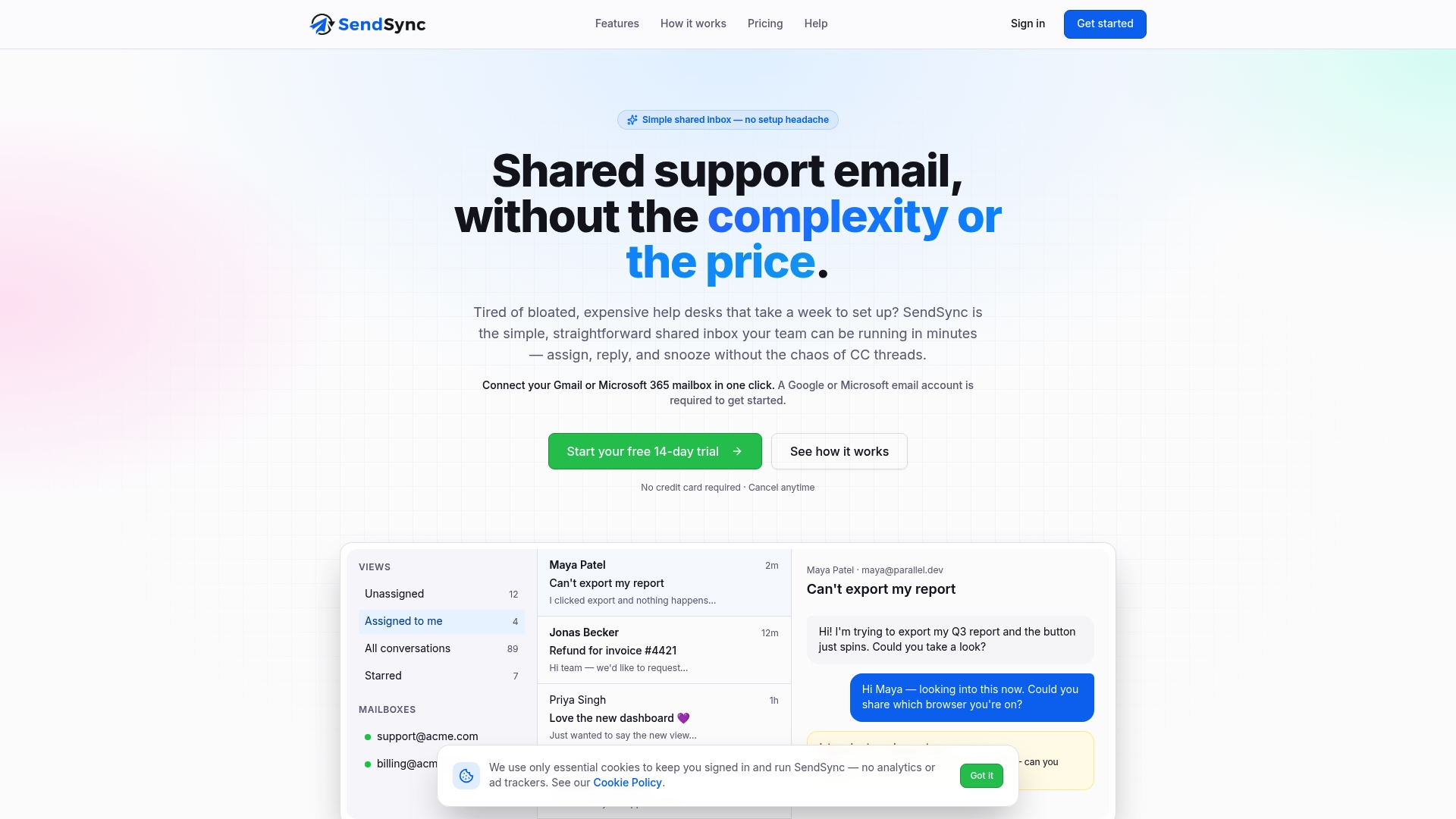
Ready to put this checklist into practice with your team? Sendsync sets up in minutes and gives your whole team visibility into every client conversation from day one.
Key Takeaways
A structured freelancer inbox management system built on scheduled sessions, four workflow stages, and clear delegation reduces decision fatigue and keeps client communication moving without interrupting focused work.
| Point | Details |
|---|---|
| Schedule sessions, not constant checks | Review email in 2–3 blocks of 15–20 minutes daily to protect deep work time. |
| Use four workflow stages | Incoming, Action Needed, Waiting, and Archive give every message a clear next step. |
| Apply the two-minute rule | Reply immediately to anything under two minutes; convert longer items to tasks. |
| Set boundaries with clients | List your reply schedule in your email signature to reduce pressure for instant responses. |
| Assign threads in shared inboxes | Clear ownership in shared inbox tools prevents missed messages and duplicate replies. |