
30 Day Plan to Clear Your Support Email Backlog
30 Day Plan to Clear Your Support Email Backlog ! Support team triaging shared email backlog Stop the bleeding with three moves: assign every thread to one owner, publish a single first-response-time target, and run triage on a fixed schedule with a weekly backlog count.

Stop the bleeding with three moves: assign every thread to one owner, publish a single first-response-time target, and run triage on a fixed schedule with a weekly backlog count. A tool like SendSync maps directly to those three habits. Do all three consistently and you should see the queue shrink within 1 to 2 weeks, especially once you rebalance who’s carrying the load.
TL;DR:
- Assign a single owner to each support thread and run regular triage sessions to ensure no thread remains unclaimed or unattended.
- Use six predefined statuses and five saved views to organize the support inbox and automatically surface overdue or unresolved messages.
- Start with basic automations like keyword routing and auto-draft replies, refining templates quarterly to save time and reduce repetitive work.
- Track median first response time and open backlog size weekly; aim for a four-hour response time by 2026 while maintaining manageable backlog levels.
- Transition from native email to a shared inbox when issues like duplicated replies and rising backlog signals become persistent, ensuring scalable support operations.
Table of Contents
- What Is Email Backlog Management for Support Teams?
- Quick 6-Step Checklist to Stop the Backlog From Getting Worse
- Ownership and Rota: How to Guarantee One Owner per Thread
- The State Machine Your Inbox Needs and 5 Views to Run It
- Which Automations Actually Save Time in a Support Queue?
- Metrics That Matter and the Weekly Backlog-Burn Routine
- When to Stop Patching Gmail or Outlook and Move to a Shared Inbox
- Your 30-Day Plan to Clear the Backlog and Keep It Clear
- What Most Teams Get Wrong About Clearing Backlog
- Clear Your Backlog Without the Setup Headache
- Sources
- FAQ
What Is Email Backlog Management for Support Teams?
Email backlog management is the practice of assigning, tracking, and clearing every unresolved message in a shared support inbox before it piles up into an unmanageable queue. It’s different from personal inbox cleanup. When five people share one support address, backlog forms because nobody owns individual threads, not because the volume is too high. A shared inbox that adds assignment, status tracking, and reporting fixes that root cause directly, and that’s the frame for everything below.
Quick 6-Step Checklist to Stop the Backlog From Getting Worse
Before you touch process documents or hire anyone, run this checklist during your next shift:
- Assign a triage lead for a 2 to 4-hour block. Short shifts keep attention sharp and stop context switching from wrecking focus.
- Claim before you draft. Nobody replies to a thread they haven’t formally taken. This single rule kills duplicate replies.
- Pull up 3 to 5 short templates for your most common questions. Personalize the first line, keep the rest.
- Set an escalation shortcut. Anything unresolved after two exchanges or touching billing/legal goes straight to a lead.
- Define “resolved” in writing. A thread is resolved when the customer confirms or 48 hours pass with no reply after a solution was offered.
- Run a five-minute end-of-day count of open threads, then a longer Friday review. That’s your backlog burn.
None of this requires new software. It requires everyone doing the same six things in the same order, every shift.
Ownership and Rota: How to Guarantee One Owner per Thread
Backlog rarely grows because a team lacks people. It grows because threads sit in a shared folder with nobody’s name on them, and three people read the same message assuming someone else will answer. Ownership, not headcount, is the actual failure point in almost every stalled queue.
Three rota models work well for small teams:
- Triage-lead rota: One person rotates through 2 to 4 hour shifts, assigning every new message the moment it lands.
- Auto-routes by topic: Billing questions go to one person, product questions to another, based on keywords or sender domain.
- Round-robin with thresholds: New threads distribute evenly until someone hits a cap, then the next person in line takes over.
Collision prevention comes down to one rule: assign before you draft, every time. Internal notes attached to the conversation (not a separate Slack thread) keep everyone aware of what’s already been said.
Pro Tip: When your triage lead is out sick, name a backup in the morning stand-up, not after the queue has already doubled.
The State Machine Your Inbox Needs and 5 Views to Run It
A shared inbox needs six statuses to function without chaos: New, Assigned, In Progress, Waiting on Customer, Waiting Internal, and Resolved. Defining this explicitly is what separates a queue people can actually manage from one that just accumulates.
Pair the states with five saved views:
- Unassigned & Unread: the fire alarm. Nothing sits here longer than an hour.
- Assigned to Me: each responder’s personal worklist.
- Waiting on Customer: parked threads that need a follow-up nudge after a set number of days.
- Overdue: anything past your published response target, regardless of status.
- Resolved (Archive): out of the working queue entirely, so it stops cluttering daily triage.
Separating the working queue from the archive is the single biggest cognitive-load fix here. A thread waiting on a customer for four days looks identical to a brand-new message in a flat inbox. In a proper view, it surfaces automatically under “Overdue” the moment it crosses your threshold, so nobody has to remember to check on it.
Which Automations Actually Save Time in a Support Queue?
Start with the boring automations before you touch anything resembling AI auto-reply. Keyword routing (billing terms go to billing, refund requests get tagged urgent), VIP tagging for high-value accounts, and auto-assignment by sender domain deliver most of the time savings with almost none of the risk.
- Auto-draft, don’t auto-send, for anything touching pricing, policy exceptions, or personal data. A human reviews before it goes out.
- Set a confidence threshold. Below it, the system creates a draft for review instead of sending automatically, which avoids policy mistakes and PII leaks.
- Rebuild your top-10 template library every quarter. Pull the ten most common questions from the past month and rewrite the answers based on what actually confused customers.
An email triage automation guide walks through setting these rules up without needing a developer. The goal isn’t to remove humans from replies. It’s to remove the repetitive 80% so people can spend time on the 20% that actually needs judgment.
Metrics That Matter and the Weekly Backlog-Burn Routine
Two numbers matter more than anything else: first response time (FRT) and open backlog size. Everything else, including total replies sent, is noise. Track those two together, not separately, because a fast FRT with a growing backlog just means you’re getting good at ignoring older threads.
Median email first response time has moved from roughly 10 hours in 2024 toward a projected 4 hours in 2026. Compare your team against that range, not against a competitor’s marketing claim.
Secondary metrics worth watching: time to assignment (how long a thread sits before someone claims it), resolution time, and SLA compliance rate.
The weekly backlog burn itself has four steps: close dead threads (customer went quiet, mark resolved), convert anything requiring engineering or product work into a task outside the inbox, rebalance assignments if one person is drowning, and update templates based on what came up repeatedly. If your backlog number climbs three weeks running despite this routine, that’s your signal to add headcount or rethink the process, not just work harder.

When to Stop Patching Gmail or Outlook and Move to a Shared Inbox
Three signals tell you native email has hit its ceiling: two people reply to the same customer within a day, nobody can answer “what’s our average response time” without manually counting, and backlog rises week over week despite everyone working hard. A shared inbox works fine for two or three people at low volume; once coordination itself becomes the daily friction, plain email stops scaling.
Before switching, run a short transition checklist:
- Map your current informal states to the six-status system above.
- Export existing filters, canned replies, and routing rules so nothing gets rebuilt from scratch.
- Assign one person as cutover triage lead for the first week.
- Pick a start date with lower volume, not your busiest Monday.
The tool connects directly to Gmail or Microsoft 365 without DNS changes, so the migration itself takes minutes rather than the days a full help desk setup usually demands.
Your 30-Day Plan to Clear the Backlog and Keep It Clear
- Week 1: Run emergency triage on the entire existing backlog. Assign an owner to every open thread, set your first FRT target, and do your first backlog-burn count so you have a baseline number.
- Week 2: Lock in your top-10 templates, turn on keyword routing and VIP tagging, build your five saved views, and start the triage rota properly instead of ad hoc.
- Week 3: Look at who’s overloaded and rebalance. Close out the last of the original backlog and write down your SOPs so a new hire could follow them without asking.
- Week 4: Review FRT and backlog size against your Week 1 baseline, run a short post-mortem with the team, and decide if you need another person or just a tighter process.
Pro Tip: Don’t skip the Week 4 post-mortem just because the queue looks clean. That’s exactly when teams quietly slide back into old habits.
What Most Teams Get Wrong About Clearing Backlog
The mistake I see most often isn’t a lack of effort. It’s vague ownership dressed up as teamwork. “We all handle support” sounds collaborative and functions as nobody handling anything, because everyone assumes someone else already replied. The second most common failure is skipping the weekly backlog report entirely. Teams measure how many replies went out, feel good about the number, and never notice the open queue has quietly doubled over six weeks.
Over-automation is the newer trap. Auto-routing and auto-drafting are genuinely useful, but teams that skip an escalation path end up with automated replies going to angry customers who needed a human two steps back. The fix in both cases is the same: fewer clever systems, clearer ownership.

— Nick
Clear Your Backlog Without the Setup Headache
This software helps teams avoid ownership guesswork by integrating with dance studio management software that streamlines scheduling and payments for small businesses. Users can connect their Gmail or Microsoft 365 mailbox quickly without DNS configuration, then assign threads, leave internal notes, and set up the automations covered above from day one.
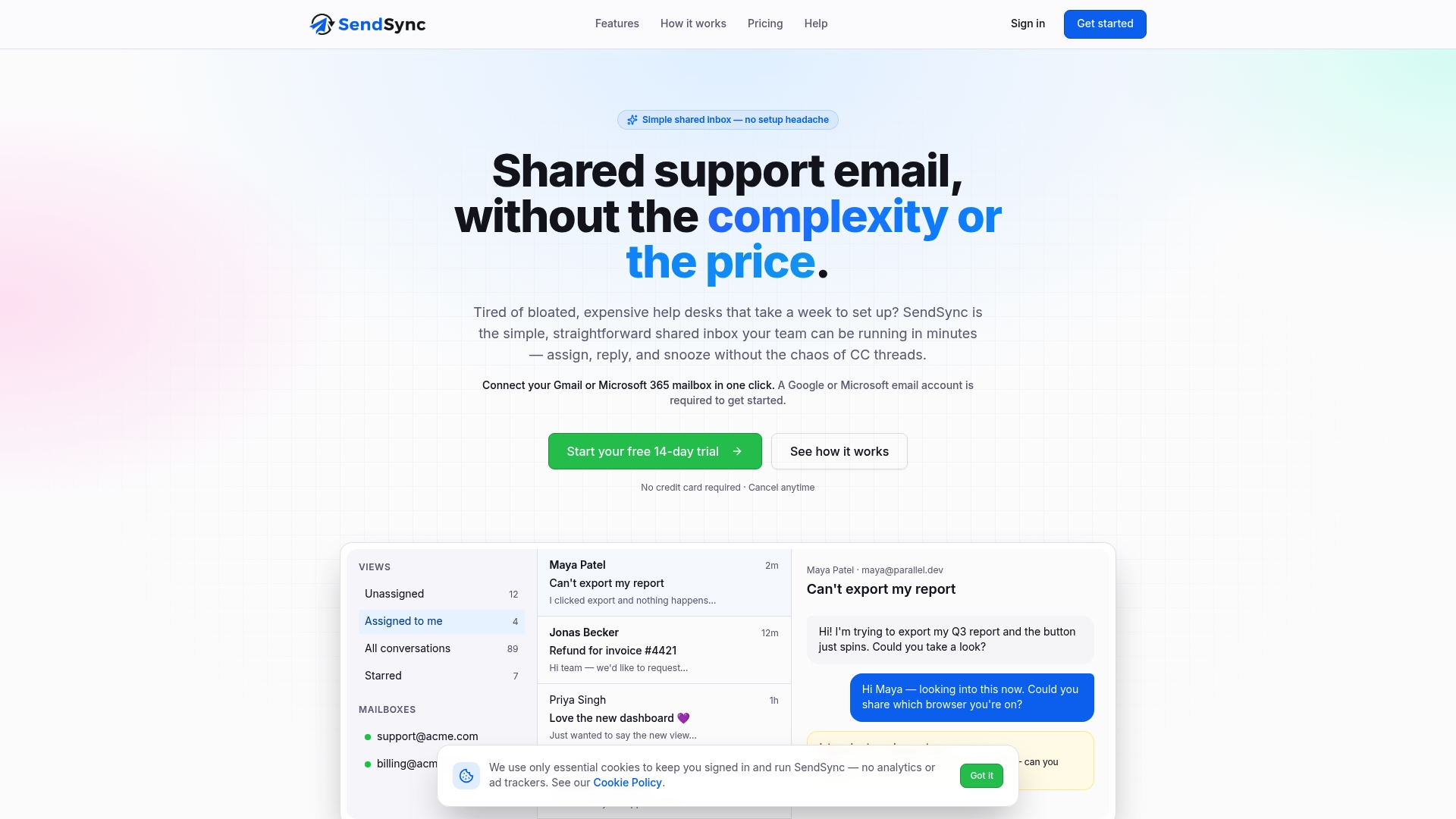
That maps directly onto the 30-day plan above: Week 1 assignment and FRT tracking, Week 2 automation and saved views, Week 4 KPI review, all inside one workspace instead of stitched together across filters and side chats. Pricing runs flat per plan rather than per seat, so adding additional responders never changes your bill. If your queue is already climbing, start a trial at SendSync and run this week’s triage inside it instead of your regular inbox.
Sources
- Shared Inbox Customer Service and Support: Best Practices
- Shared Mailbox Management Best Practices (2026 Guide)
- Knowledgelib
FAQ
What Is the Fastest Way to Reduce Email Backlog?
Assign every existing thread an owner today, then run a single triage session to sort everything into New, Assigned, or Waiting states. Combined with a weekly backlog count, most teams see a measurable drop within 1 to 2 weeks.
How Often Should a Support Team Triage Its Inbox?
Busy teams should triage in short 2 to 4 hour rotating shifts rather than one person owning the whole day, since shorter rota windows keep ownership clear without burning anyone out.
What’s a Good First Response Time Target?
Median email first response time is trending toward about 4 hours in 2026, though the right internal target depends on what your customers expect. Track it alongside open backlog size, not on its own.
Does SendSync Replace Gmail or Outlook?
No. SendSync connects to your existing Gmail or Microsoft 365 mailbox in minutes with no DNS setup, adding assignment, internal notes, and automation on top rather than replacing your email provider.
How Much Does SendSync Cost?
SendSync’s plans start at $10 per month for the Founder plan, with Starter, Growth, and Scale tiers available as teams grow, all with unlimited users and no per-seat fees.