
Customer Complaint Email: 4 Templates, Plus What Evidence to Include
Customer Complaint Email: 4 Templates, Plus What Evidence to Include ! Customer drafting a complaint email at home A complaint email works best in a set order: a specific subject line, a polite greeting, your transaction or account details, a concise description of what went wron

A complaint email works best in a set order: a specific subject line, a polite greeting, your transaction or account details, a concise description of what went wrong, the impact it had, the exact remedy you want, any supporting documents, and a reasonable reply deadline with your contact details. The templates and checklist below walk through each piece so you can send a message that gets a real answer.
TL;DR:
- Place your specific remedy and reply deadline in the opening paragraph, and include order, account, or invoice details so staff can investigate without another email.
- Name each attachment and state what it proves; neutral, factual wording with a specific impact is more useful than emotional language or threats.
- For product defects, include model or serial numbers and photos; service claims need dates and account numbers, while software issues need screenshots and plan details.
- If the business misses your deadline, keep copies and escalate to a state consumer office, the FTC for scams, or the CFPB for banking issues.
- Businesses should assign one reply owner and specify the next action and update date; vague reassurance gives customers no timeline.
Table of Contents
- Copy-and-paste complaint email templates for common scenarios
- Step-by-step checklist: what to include paragraph by paragraph
- How to phrase it: tone, clarity, and language to avoid
- Short professional response templates for businesses replying to complaints
- Practical workflow: manage complaint emails faster using a shared inbox
- Common mistakes to avoid when writing a customer complaint email
- Differences in complaint email style depending on the industry or product type
- Why specific, evidence-led complaints work
- A faster way to manage complaint emails as a team
- FAQ
- Sources
Copy-and-paste complaint email templates for common scenarios
Most complaint emails fail because they bury the request. The templates below put the problem and the fix in the first two lines, then follow with the details a business needs to act.
- Short complaint template. Subject: “Order #12345 — Damaged item received, requesting replacement.” Body: “Hello [Company], I received order #12345 on [date] and the [item] arrived damaged. I’m requesting a free replacement or a full refund by [date]. I’ve attached a photo of the damage. Thank you, [Name].”
- Complaint with attachments. Reference evidence by name instead of just attaching it: “Please see Attachment 1 for proof of purchase and Attachment 2 (photo1.jpg) showing the crack in the casing.” This small habit, recommended in the FTC’s sample complaint letter, lets the reader match your claim to the proof without digging through the thread.
- Escalation template after no response. Subject: “Follow-up: Order #12345, no response since [date].” Body: “I emailed on [date] about [issue] and haven’t heard back. I’m following up before escalating to [state consumer office / your bank / the BBB]. Please respond by [date].”
- Fill-in subject lines. “Billing error on invoice #[number], requesting correction,” “Service outage on [date], requesting credit,” or “Defective [product], requesting repair or refund.”
A downloadable template library from Consumer Action offers similar fill-and-send formats in multiple languages, including plain-text versions you can paste straight into an email client. If you manage support replies rather than send complaints yourself, our support email templates for small teams cover eight more scenarios and subject-line patterns worth keeping on hand.
Step-by-step checklist: what to include paragraph by paragraph
Every strong complaint email follows the same skeleton. Fill in each part before you hit send.
- Subject line: name the product or service and include a reference number if you have one, so the email can be routed without a reply asking “which order?”
- First sentence: answer first. State what happened and when, before any backstory.
- Transaction and account details: order numbers, dates, model or serial numbers, and the account or invoice tied to the issue.
- The problem itself: describe it factually in one or two sentences, then state the impact briefly, for example lost time, a missed event, or extra money spent.
- The remedy: ask for one specific outcome (refund, replacement, credit, repair), name a reasonable reply deadline, and mention an acceptable alternative if the first option isn’t possible.
- Supporting documents: list what’s attached and caption each one so it’s easy to match to your claim.
- Sign-off: a professional closing with your preferred contact method and the best time to reach you.
This sequence mirrors the structure in the FTC’s sample complaint letter, which recommends keeping records such as receipts, warranties, contracts, and canceled checks on hand before you write.
Pro Tip: Put your requested remedy and deadline in the first paragraph, not the last. Readers skim, and the request is the part most likely to get missed if it’s buried.
How to phrase it: tone, clarity, and language to avoid
A complaint email gets a faster, better reply when it reads like a factual report rather than a vent. Grammarly’s guidance on complaint emails recommends explaining the issue plainly, getting to the point early, and supporting the claim with evidence rather than adjectives.
- Prefer neutral, specific wording over emotional language: “the package arrived crushed” works better than “this is completely unacceptable.”
- State impact without exaggeration: “I missed a client meeting because the delivery was three days late” lands harder than “this ruined everything.”
- Avoid vague demands and threats. “Please issue a refund by Friday” beats “fix this or I’m never shopping here again.”
- Compare weak versus strong: weak is “your service is terrible,” strong is “the service was down for six hours on March 3, and I was not notified in advance.”
- Proofread for length, clarity, and active voice before sending: cut any sentence that doesn’t add a fact or a request.
Short professional response templates for businesses replying to complaints
A good response names an action, an owner, and a timeline. Vague reassurance reads as a stall even when the business intends to help.
- Acknowledge and apologize template: “Hi [Name], thank you for letting us know about [issue]. I’m sorry for the trouble this caused. I’ve assigned this to [name/team], and you’ll have an update by [date].”
- Investigating template: “We’re looking into [issue] now. [Name] on our team is handling it and will send you a specific update by [date], including what we found and next steps.”
- Remedy issued template: “We’ve issued [refund/replacement/credit] for [issue], reference #[number]. You should see it by [date]. Let us know if it doesn’t arrive by then.”
- Follow-up confirmation: “Confirming that [remedy] was completed on [date]. If anything about this still seems off, reply here and we’ll take another look.”
The common failure point is a reply like “we’ll look into it” with no name and no date attached. A sample business response to a complaint shows how naming the action owner and giving an exact timeframe produces a clearer sense of closure for the customer. If your team’s replies tend to sound more defensive than helpful, our guide on fixing support email tone walks through three before-and-after rewrites. For complaints that touch reputation and reviews directly, JobOS Pro’s guide on turning complaints into 5-star reviews covers the response side of recovering a customer relationship after a bad experience.
Practical workflow: manage complaint emails faster using a shared inbox
Complaint emails move fastest when they’re tagged, owned, and tracked in one place instead of bouncing between personal inboxes.
- Route on arrival: tag incoming complaints the moment they land and build a saved view that surfaces anything marked urgent.
- Assign one owner: a single named person per complaint, with internal notes capturing what’s been checked, prevents two people from sending conflicting replies.
- Keep evidence in the thread: attach receipts and photos directly to the conversation rather than as a separate email, so anyone picking up the case sees the full picture at once.
- Reduce setup friction: connecting a Gmail or Microsoft 365 mailbox without DNS changes, combined with unlimited-user pricing, means a small support team can get a shared view running the same day rather than spending a week on configuration.
Pro Tip: Before replying, check the thread for an existing internal note. A thirty-second scan prevents a duplicate reply that contradicts what a teammate already told the customer.
Teams that miss complaint emails entirely usually have a routing problem, not a staffing one. Our breakdown of why support teams miss customer emails covers the most common causes.
Common mistakes to avoid when writing a customer complaint email
The most frequent mistake is leading with history instead of the request: a long account of everything that happened before stating what you actually want. Put the ask near the top.
Other recurring problems include:
- Omitting the order number, account ID, or date, which forces a back-and-forth before anyone can look into it.
- Attaching photos or receipts without naming them, leaving the reader to guess what each file proves.
- Making the remedy vague (“fix this”) instead of specific (“replace the unit or refund $45”).
- Using an aggressive or sarcastic tone, which tends to slow a reply rather than speed it up.
- Skipping a reply deadline, which leaves the timeline entirely up to the business.
- Sending the complaint without keeping a copy for your own records, which matters if you need to escalate later.
The FTC’s sample complaint letter frames a strong complaint as evidence-led: a dated transaction, a clearly named product or account, a precise description of the failure, one requested remedy, and copies of supporting documents. Each mistake above is really a gap in one of those five pieces.
Differences in complaint email style depending on the industry or product type
A complaint about a physical product leans on documentation: model or serial numbers, purchase date, and photos of the defect. Retailers and manufacturers expect this level of detail because it lets them check the item against a warranty or return policy without a back-and-forth.
A service complaint, like a missed appointment or a billing error, relies more on dates and account numbers than on physical evidence. Stating exactly when the service failed and what it cost you in time or money matters more than attaching a photo.
Complaints about software or subscriptions usually need screenshots, error messages, and the exact plan or account tier, since the person reading it often can’t reproduce the problem without that detail. Financial complaints, such as a disputed charge, call for transaction dates, amounts, and account numbers, and often need to reference a specific regulation or policy the business is bound by.
Across all of these, the underlying structure stays the same: transaction detail, factual description, impact, and remedy. Only the type of evidence changes.

Why specific, evidence-led complaints work
The complaints that get resolved fastest are the ones that make the decision easy: here’s the transaction, here’s what went wrong, here’s the one fix I want. A vague complaint forces the reader to ask clarifying questions before they can even start helping you, and that back-and-forth is where most delays come from.
I’ve seen the same pattern play out over and over: a complaint with a clear deadline and a named remedy gets a same-week answer, while an open-ended “please advise” email sits for a month. Keep a copy of everything you send, and if a reasonable deadline passes with no response, escalate through the proper channel rather than repeating yourself in a louder tone.
— Nick
A faster way to manage complaint emails as a team
Writing a strong complaint email is half the job. On the receiving end, answering it quickly without duplicate replies or lost attachments is the other half, and that’s the problem a shared inbox solves. Connecting a Gmail or Microsoft 365 mailbox takes minutes with no DNS setup, and plans include unlimited users, so a growing support team does not pay per-seat fees to add more people who need to see the complaint queue.
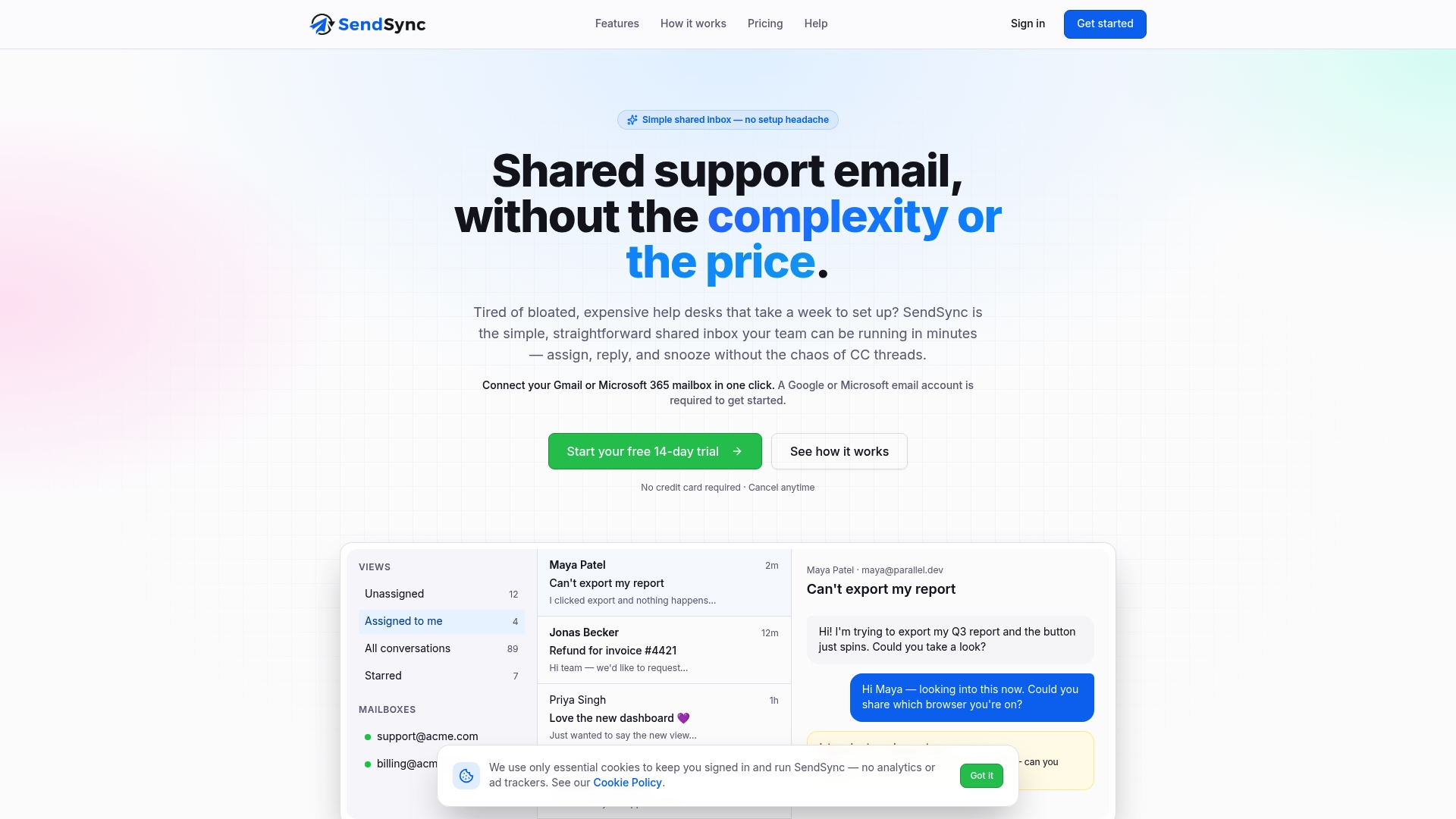
That combination means a complaint lands in one shared view, gets tagged and assigned to a single owner, and keeps its receipts and photos in the same thread instead of scattered across inboxes. If your current setup involves forwarding complaint emails between coworkers, take a look at our plans and pricing and start a trial to see how much faster handoffs get.
FAQ
How do I write an email for a customer complaint?
Start with a specific subject line naming the product or order number, then open with what happened and when. Follow with transaction details, the impact, your requested remedy, and a reasonable reply deadline, in that order, as outlined in the FTC’s sample complaint letter.
How do I email a complaint to customer service?
Send it to the official support address listed on the company’s website or receipt, using a subject line that names the issue and any order or account number. Keep the body factual, state your preferred remedy clearly, and attach any receipts or photos directly to the email.
Who do I contact for consumer complaints?
Contact the business first, and if that doesn’t resolve things, escalate to your state consumer protection office or attorney general, the FTC for scams, the CFPB for banking and credit issues, or econsumer.gov for some cross-border purchases. Our guide to building an escalation workflow walks through the same sequence from the business side.
How do I write a complaint email?
Use the structure recommended by the FTC and Consumer Action: a clear subject line, your transaction details, a factual description of the problem, the impact it caused, a specific remedy with a deadline, and any supporting documents, listed and referenced by name.
Sources
- Sample Customer Complaint Letter | Consumer Advice (FTC)
- Sample complaint letter and email | Consumer Action
- How to write a complaint email in 8 steps | Grammarly
- Usa