
30 Minutes to Reliable After Hours Email Support for Small Teams
30 Minutes to Reliable After Hours Email Support for Small Teams ! Specialist monitoring after-hours customer email The best approach for most small teams is a fast automatic acknowledgment paired with lightweight triage (AI or a simple rules engine), backed by human follow-up so

The best approach for most small teams is a fast automatic acknowledgment paired with lightweight triage (AI or a simple rules engine), backed by human follow-up sorted by priority. Pure automation feels efficient but erodes trust on anything complex. Full 24/7 staffing works but rarely fits a small budget. Set this up in the next 30 minutes: publish an honest response-time promise, then build routing rules behind it.
TL;DR:
- Small teams should implement automatic acknowledgment and AI triage to handle most overnight emails efficiently without eroding customer trust.
- Response time benchmarks suggest replying to pre-sale and urgent inquiries within one hour and resolving them within four hours for optimal customer satisfaction.
- Full 24/7 human coverage yields the highest satisfaction, but outsourcing or automation is more cost-effective for modest volumes and budgets.
- Setting up effective after-hours email support can be achieved easily within an afternoon using simple routing, templates, and escalation triggers.
- Using tools like Sendsync simplifies setup, eliminates per-seat fees, and allows small teams to implement reliable overnight support immediately.
Table of Contents
- What Is the Best After Hours Email Support Model?
- How Fast Should You Respond to Emails After Hours?
- What Does 24/7 Coverage Actually Cost?
- How Do I Set Up After Hours Email Support?
- How SendSync Speeds Up After Hours Email Support for Small Teams
- The Pragmatic Priorities for Small Teams
- Get After Hours Email Support Running Today with Sendsync
- Sources
- FAQ
What Is the Best After Hours Email Support Model?
Four models cover almost every small team’s overnight email load, and the right one depends less on preference than on ticket volume and complexity.
Automatic acknowledgment with a published SLA is the floor everyone should have. It costs nothing beyond setup time, tells the customer their message landed, and buys hours before anyone feels ignored. It resolves nothing on its own.
AI triage with human escalation adds a layer that sorts, tags, and sometimes answers routine requests overnight. AI handles clear-path issues like password resets or order status well; complex or emotionally charged messages still need a person, and HubSpot’s guidance on AI versus human service draws that line clearly.

Outsourced 24/7 agents or virtual assistants give you true round-the-clock coverage without hiring a night shift. This fits teams with steady overnight volume and enough budget for a contractor or agency retainer.
Follow-the-sun rotation works only if you already have staff in different time zones or enough headcount to split shifts. For a five-person team, it’s usually overkill.
- Under 20 after-hours emails a night: automatic acknowledgment plus AI triage
- 20 to 75 emails with mixed urgency: AI triage plus a part-time on-call escalation contact
- 75+ emails or regulated/high-stakes inquiries: outsourced 24/7 agents or follow-the-sun shifts
How Fast Should You Respond to Emails After Hours?
Response-time benchmarks break into three tiers, and knowing which one applies to your business keeps expectations realistic instead of aspirational. Email response time standards put best-in-class first response under one hour, good performance under four hours, and acceptable performance at twelve hours or less.
That acceptable ceiling matters because it’s already the norm most businesses fail to hit. Companies average 12 hours and 10 minutes to answer a customer service email, while customers commonly expect a reply within one to four hours. That gap is where after-hours coverage either builds loyalty or quietly bleeds it.
| Email type | Recommended acknowledgment SLA | Recommended resolution SLA |
|---|---|---|
| Pre-sale inquiry | Under 1 hour | Under 4 hours |
| Order or shipping issue | Under 1 hour | Under 12 hours |
| Billing question | Under 2 hours | Under 12 hours |
| Complaint or complex issue | Under 1 hour | Under 24 hours |
Split your SLA into two clocks. Acknowledgment SLA covers the automatic “we got this” reply. Resolution SLA covers the actual fix. Fast acknowledgments recover much of the CSAT loss that happens when full resolution takes longer, so treat the two numbers separately rather than promising one blended target.
A complaint sitting at 18 of 24 hours should ping someone before it breaches, not after.

What Does 24/7 Coverage Actually Cost?
Cost and quality move together, but not in a straight line. Automation is nearly free to run once built but caps out fast on anything beyond routine requests. Outsourced agents cost real money per month but buy you continuous human judgment. In-house shift coverage costs the most and is hardest for a small team to staff without burning people out.
The payoff for speed is measurable on the sales side: replying within minutes to a pre-sales lead significantly improves conversion compared to waiting hours. That’s a strong argument for prioritizing pre-sale and order-related emails in your overnight triage rules, even if complaints wait a bit longer.
Model comparison also shows a real quality gap: full 24/7 human coverage produces the highest CSAT and lowest abandonment, with AI-plus-escalation performing well but trailing slightly behind.
- Onboarding and training time for outsourced agents or new hires
- Ongoing supervision and quality checks on outsourced replies
- Escalation overhead when automation misclassifies a ticket
- Turnover costs if overnight shifts burn out in-house staff
Pro Tip: If you outsource, start with a narrow scope, order status, shipping, and basic account questions, and use scripted responses. Expand the scope only after a few weeks of clean quality checks.
How Do I Set Up After Hours Email Support?
Getting a working overnight setup live doesn’t require a big project. Most of this takes an afternoon.
- Turn on an automatic acknowledgment for every inbound email outside business hours.
- Build priority labels: urgent (complaints, account access), standard (orders, billing), and low (general questions).
- Write routing rules that send urgent labels to an on-call contact and everything else to a morning queue.
- Set escalation triggers at 75% and 100% of your resolution SLA using expiry alert escalations small teams can run with email templates so nothing sits silently.
- Test the whole chain before trusting it overnight.
Three templates cover most of what you need immediately.
Fast acknowledgment: “Thanks for reaching out. We’ve received your message and typically respond within [X hours]. Urgent issues are flagged for faster follow-up.”
Out-of-office that sets real expectations: “Our team is off until [time]. Messages sent after hours are reviewed first thing, with urgent requests prioritized. Expect a reply by [specific time], not just ‘soon.’”
Escalation handoff note: “Escalating this ticket. Customer: [name]. Issue: [one-line summary]. SLA deadline: [time]. Action needed: [specific ask].”
Before going live, run staged tests: send a spike of sample emails and a mock urgent ticket to confirm routing and escalation alerts fire correctly. Keeping overnight routing trees separate from your daytime queues, with their own priority tags, prevents messages from getting buried under the morning backlog.
Once live, track three numbers weekly: first response time, SLA breach rate, and after-hours CSAT. If breach rate climbs, your triage rules or on-call coverage need adjusting before customers notice.
How SendSync Speeds Up After Hours Email Support for Small Teams
A shared inbox removes most of the friction in the checklist above. Sendsync connects directly to Gmail or Microsoft 365 in minutes, with no DNS configuration and no waiting on IT. That matters overnight, because the setup that takes a traditional help desk days to configure is often what stands between a small team and a working escalation workflow.
Inside Sendsync, assignment, canned replies, and routing rules live in one workspace instead of scattered filters and shared logins. Support staff can build the acknowledgment templates and email triage automation described earlier without touching a separate automation tool.
- No per-seat fees, so adding after-hours or on-call staff doesn’t inflate your bill
- Unlimited users across every plan tier
- Assignment and internal notes replace the guesswork of forwarded emails
For a five to twenty-person team, this beats an enterprise help desk mainly on speed and simplicity: you’re live the same day, not after a configuration project.
The Pragmatic Priorities for Small Teams
Small teams overreach when they promise instant replies around the clock they can’t sustain. Fix acknowledgment and triage first. Everything else is secondary.
Publish an honest SLA and actually track first response time against it. Creeping expectations, not slow replies, are what kill customer trust. Keep escalation dead simple: one queue, one clear owner, one handoff note. Complexity is what breaks at 2 a.m., not lack of effort.
— Nick
Get After Hours Email Support Running Today with Sendsync
Sendsync is the quick-setup alternative to a traditional help desk for teams that need overnight coverage running now, not after weeks of configuration. Connect your Gmail or Microsoft 365 mailbox, import the acknowledgment and escalation templates from this guide, and assign your on-call rotation, all without touching DNS settings.
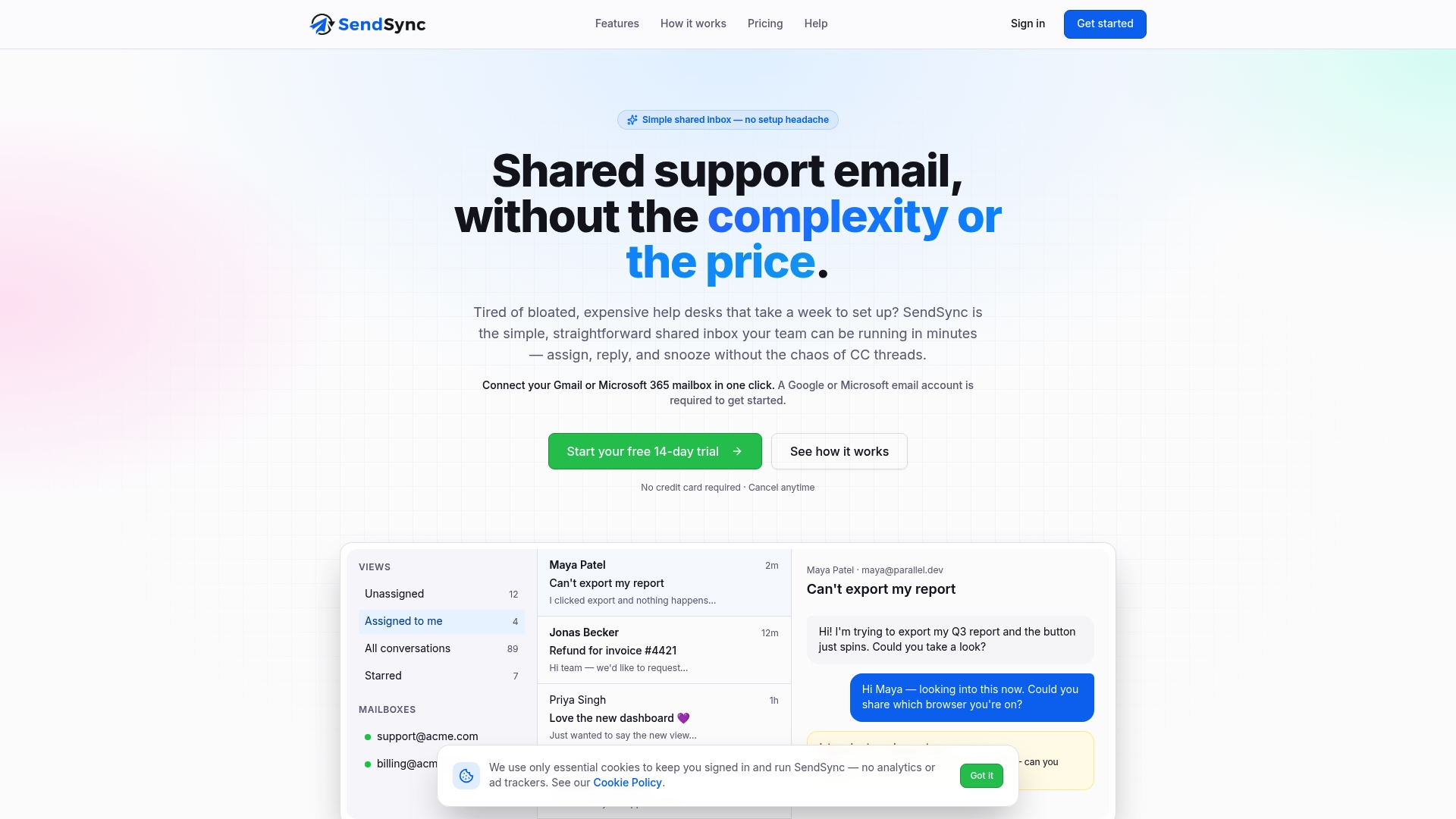
Pricing details are available on the Sendsync website, with plans that include unlimited users and no per-seat fees. That flat pricing means adding an after-hours on-call rotation doesn’t quietly inflate your bill the way seat-based help desks do.
Start a trial and get your acknowledgment templates, priority routing, and escalation rules live before your next overnight shift begins. Sign up on the Sendsync homepage to connect your mailbox and start testing.
Sources
- Customer Service Email Response Time Standards by Industry (+ Policy Template) (2026)
- Email Response Time Statistics: 2026 Verified Report
- HubSpot: AI vs Human customer service
FAQ
Can I Email Support After Hours?
Yes, most businesses accept emails after hours even without live staff; the message sits in the queue until reviewed. What separates good after-hours support from bad is whether that email gets an automatic acknowledgment and a clear expectation for when a real answer arrives.
How Do I Email for Support Effectively?
Include your account or order details, a clear one-line summary of the issue, and the urgency level right in the subject line if possible. This helps routing rules and AI triage sort your message correctly, whether you’re emailing a small business or a large one.
What Is a Good Out-of-Office Message for After Hours?
A good message states when the team is back, gives a specific response window rather than a vague “soon,” and flags that urgent issues get prioritized. Something like “Messages after hours are reviewed at [time], with urgent requests handled first” sets a real expectation instead of an empty promise.
What Response Time Should I Promise Customers Overnight?
Aim for an acknowledgment within one hour and a full resolution within four to twelve hours depending on the issue type, based on industry SLA benchmarks. Complaints and account issues deserve the tighter end of that range; general questions can wait longer.
Does Sendsync Support After Hours Email Workflows?
Sendsync supports assignment, canned replies, and routing rules that work for after-hours triage without needing a separate automation tool. Pricing starts at $10 a month on the Founder plan, with all tiers offering unlimited users.