
Why Remote Teams Lose Context in Emails: 2026 Guide
Why Remote Teams Lose Context in Emails: 2026 Guide ! Diverse remote team video conferencing from home offices Why remote teams lose context in emails, and why it costs more than you think Remote teams lose context in emails because the medium was never designed to carry the full

Why remote teams lose context in emails, and why it costs more than you think
Remote teams lose context in emails because the medium was never designed to carry the full weight of distributed collaboration. Email is asynchronous by nature, strips out non-verbal cues, and scatters decision history across inboxes that nobody else can see. A Berkeley study analyzing over 61,000 Microsoft employees found that remote work caused workers to spend 25% less time collaborating across groups, a direct consequence of communication becoming more siloed and asynchronous.
The effects show up fast:
Repeated questions because nobody can find the original decision
New hires who need weeks to get up to speed because context lives in someone’s inbox
Coordination overhead that grows with every timezone added
Alignment that feels solid until one person leaves and takes the institutional memory with them
None of this is a people problem. It’s a structural one, and email’s design makes it worse by default.
How email’s asynchronous format turns clear messages into misread ones

Email delays responses and leaves intent hanging. When you send a message and wait hours for a reply, the original context fades, and the recipient fills the gap with whatever they’re feeling at the moment they finally open it. Digital communication strips out tone, body language, and facial expression, so readers interpret messages through their own emotional state, whether they’re rushed, tired, or already frustrated.
The thread structure makes it worse. Important context gets buried three replies deep, and anyone joining the conversation late has to reconstruct the whole story from a chain of quoted text. There’s no real-time feedback loop to catch a misread before it becomes a misunderstanding.
Common signs your email threads are losing context:
Subject lines that no longer match the actual conversation
Replies that answer a different question than the one asked
Long CC lists where nobody is sure who owns the decision
Follow-up messages asking for clarification on something already explained
Pro Tip: Open every email with a one-line summary of what you need and by when. Put the context second, not first. Readers skim, and the most important information disappears when it’s buried in paragraph three.
How siloing and fragmentation quietly erode team cohesion
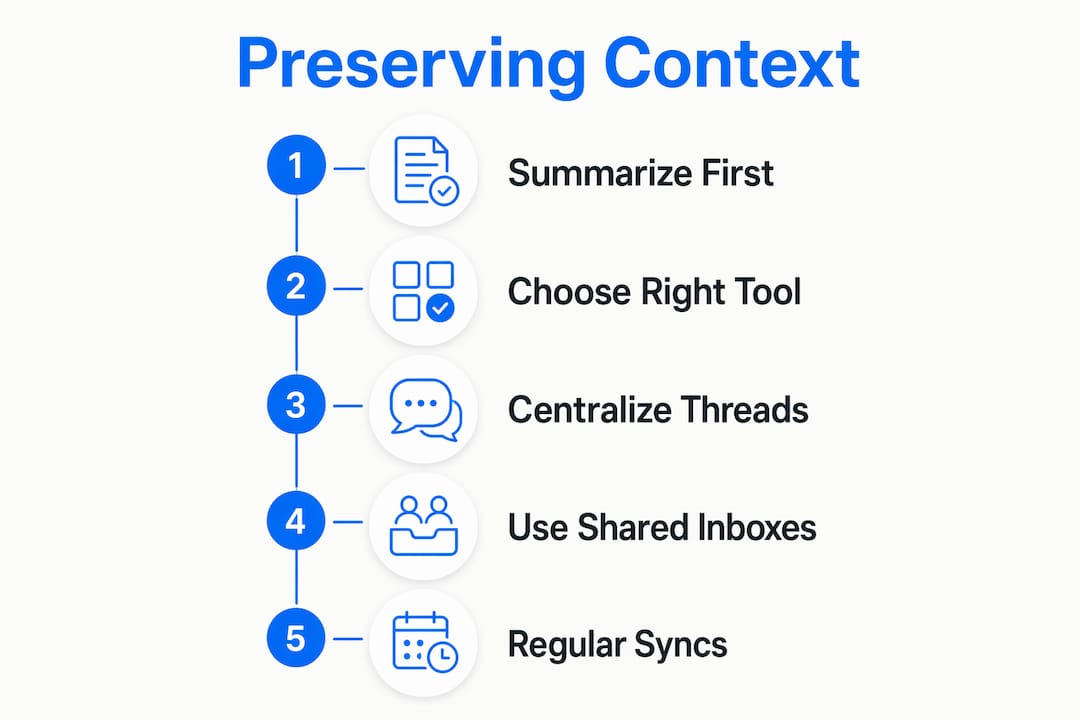
Email fragments communication into private threads that the wider team never sees. A decision made between two people over email doesn’t automatically connect to the task it affects, the project it belongs to, or the teammates who need to act on it. That gap is where context goes to die.

Fragmentation across tools compounds the problem. When a task lives in one system, the discussion about it lives in email, and the rationale behind the decision lives in someone’s memory, nobody is going to open three places to reconstruct the history. They ask again in a group chat instead, which creates more fragmented context. Leaders often misattribute this to a lack of documentation when the real cause is structural: the tools don’t connect.
The emotional toll is real too. Fragmentation symptoms that teams report:
Feeling out of the loop even when technically included on emails
Distrust when decisions appear without visible reasoning
Fatigue from scanning multiple inboxes and channels just to stay current
Reduced psychological safety when asking “why did we decide this?” feels like an accusation
Small teams mask this problem through shared memory. Once the team grows past ten people, or one key person leaves, the communication graveyard becomes visible. Decisions buried in old email threads become inaccessible, and onboarding slows to a crawl.
Practical strategies that actually preserve context beyond email
The fix isn’t writing more emails. Effective remote communication requires system design that captures context automatically, not individual behavior change that relies on people remembering to document things.
Strategies that work in practice:
Define channel norms explicitly. Decide which tool handles which type of message. Announcements go in one place, project decisions in another, quick questions somewhere else. Matching channels to task complexity builds clarity and reduces the cognitive load of figuring out where to look.
Write decisions down at the moment they happen. Not in a meeting recap sent two days later. A two-sentence record of what was decided and why, linked to the relevant task, is enough. Teams that do this find that “should we revisit this?” conversations resolve themselves because the original reasoning is already documented.
Use structured hand-off summaries. Short, queryable artifacts containing status, blockers, and timelines replace the informal hand-offs that extend timelines when nobody can ask a clarifying question in real time.
Consolidate where conversations live. When chat is attached to projects and decisions are linked to tasks, context is co-located. You click on a task and the history is there. You don’t have to search across tools.
Build microlearning into async updates. Short, repeated context-rich updates improve retention better than long documents nobody reads. The goal is making context sharing a habit, not an overhead.
Treat email visibility as a team asset. When the whole team can see relevant threads, not just the two people copied, decisions stay connected to the people who need to act on them.
Pro Tip: Before choosing a communication tool for a given message, ask one question: does the person receiving this need to act on it, discuss it, or just know about it? The answer tells you the right channel every time.
For teams managing external communication, professional digital presence also shapes how context is perceived and retained by clients as well as internally.
What the research actually says about the cost of lost context
The productivity numbers are harder to ignore than most teams expect. 40% of developers cite difficulty finding necessary context as a major productivity barrier, according to Cortex’s 2024 State of Developer Productivity report. That’s not a communication style issue. It’s a structural failure that compounds every time a new person joins or a decision gets revisited. Practitioner data shows that small distributed teams can lose over 50 person-hours each week to context reconstruction, even across just two timezones, not counting the downstream costs of decisions made on incomplete information.
Research finding | Source | Implication for team leaders |
|---|---|---|
a significant drop in cross-group collaboration | UC Berkeley / Microsoft study | Siloing is a structural outcome of remote work, not a personality issue |
40% of developers blocked by missing context | Cortex 2024 Developer Productivity | Context loss is a productivity tax, not a communication style problem |
50+ person-hours lost weekly per small team | Practitioner data | The cost of reconstruction exceeds the cost of capturing context upfront |
Context fragmented across multiple tools per task | Practitioner observation | Tool consolidation reduces search time and repeated questions |
The core finding: Remote teams don’t lose context because people fail to document. They lose it because the systems weren’t designed to keep context connected to the work it belongs to.
The Berkeley study also found that remote work pushed workers toward more asynchronous communication while reducing synchronous conversations, exactly the conditions where context loss in remote teams accelerates. The solution isn’t more meetings. It’s building the infrastructure that makes asynchronous work carry enough context to function.
Sendsync addresses this directly. Its shared inbox connects Gmail and Microsoft 365 mailboxes into a single workspace where teams can assign, reply, and track conversations without switching tools or losing thread history. There’s no per-seat pricing and no complex setup. Context stays visible to the whole team, not just the two people on the original thread.
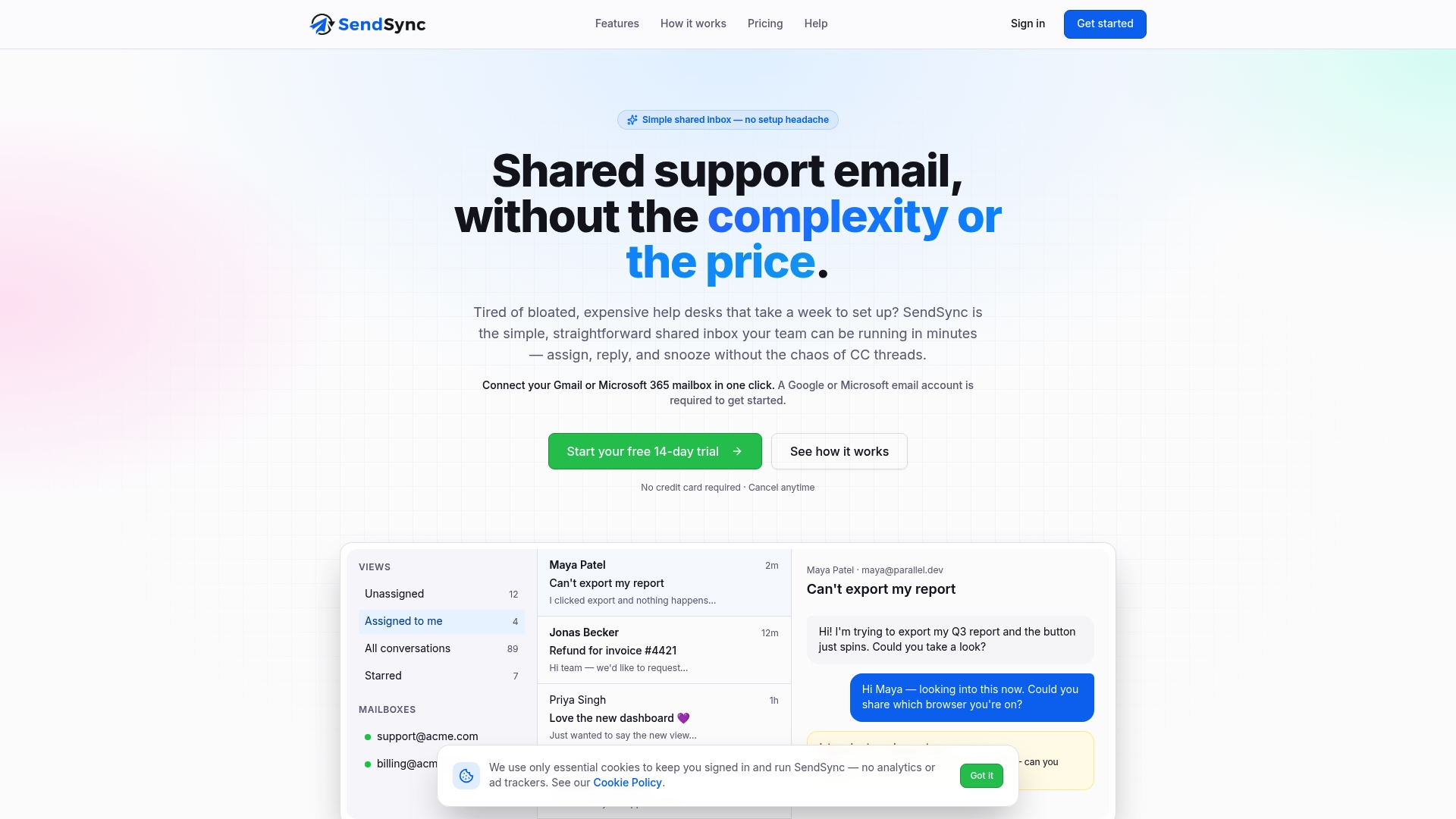
Start with Sendsync and give your team a shared inbox that keeps context where it belongs.
Key Takeaways
Remote teams lose context in emails primarily because email’s asynchronous format, absent non-verbal cues, and fragmented tooling scatter decision history in ways that compound as teams grow.
Point | Details |
|---|---|
Asynchronous format strips intent | Email delays responses and removes tone, causing readers to fill gaps with their own assumptions. |
25% less cross-group collaboration | UC Berkeley’s study of 61,000 Microsoft employees shows remote work structurally reduces cross-team communication. |
40% of developers blocked by missing context | Cortex’s 2024 report shows context loss is a measurable productivity barrier, not a soft communication issue. |
Capture decisions at the moment | A two-sentence record linked to the relevant task prevents costly context reconstruction later. |
System design beats behavior change | Effective context preservation requires tools that co-locate conversations with the work, not mandates to document more. |