
Unlimited Users Support Platform: What Actually Delivers in 2026
Unlimited Users Support Platform: What Actually Delivers in 2026 ! Hands connecting network cable to laptop If your team keeps hitting a per-agent bill every time you add a teammate to your help desk, switch to a shared-inbox platform with true unlimited-seat pricing.

If your team keeps hitting a per-agent bill every time you add a teammate to your help desk, switch to a shared-inbox platform with true unlimited-seat pricing. SendSync fits that description best for most growing teams: no per-agent fees, Gmail and Microsoft 365 mailboxes connect in minutes, and adding your tenth or fiftieth teammate costs nothing extra. That’s the core promise of an unlimited users support platform done right, and it’s worth demanding from any vendor you evaluate.
Three practical categories dominate this space, and each solves a different problem:
- Shared-inbox platforms with unlimited seats (SendSync fits here) — best for small to mid-size teams that want everyone, from support to sales to ops, working from one inbox without a per-seat invoice.
- AI-deflection platforms with volume-based billing — best for high-ticket-volume operations willing to trade unpredictable AI usage costs for reduced human headcount.
- Enterprise volume-ticket platforms with unlimited-seat add-ons — best for large organizations that already run complex ticketing workflows and can absorb per-ticket or per-resolution charges.
Two numbers matter more than any vendor’s marketing copy. First, Gartner projects agentic AI will autonomously resolve up to a large majority of common customer-service issues by 2029, which means AI-usage billing is becoming a bigger cost lever than seat count. Second, ecosystems like Microsoft AppSource now distribute dozens of support integrations, confirming that mailbox compatibility, not seat caps, is where the real product differentiation happens.
Key Takeaways
Shared-inbox platforms with genuinely flat, unlimited-seat pricing deliver more predictable costs and faster setup than per-agent or volume-billed alternatives for most small and mid-size support teams.
| Point | Details |
|---|---|
| Check the fine print | “Unlimited users” often hides feature gating, per-channel add-ons, or AI-usage billing that scales your real cost. |
| Compare pricing shapes | Flat-fee shared inboxes suit predictable budgets; volume and AI-deflection billing suits high-ticket-volume teams. |
| Test with real load | Run trials with actual team members and messy ticket threads, not clean sample data, before committing. |
| Secure every added seat | Require OAuth-based mailbox access, role-based permissions, and clear data-export rights before signing. |
| SendSync fits flat-fee collaboration | SendSync offers true unlimited seats, Gmail and Microsoft 365 integration, and setup in minutes with no DNS changes. |
Table of Contents
- Which Unlimited Users Support Platform Options Actually Deliver?
- What Does “Unlimited Users” Really Mean in Practice?
- How We Evaluated These Unlimited-User Claims
- How to Choose the Right Unlimited-User Support Platform
- Why SendSync Fits Teams That Need Real Unlimited Access
- Security Considerations for Unlimited-User Support Platforms
- What I’ve Learned Helping Teams Set Up Support Inboxes
- Try SendSync’s Unlimited-User Shared Inbox Free for 14 Days
- Useful Sources and Further Reading
Which Unlimited Users Support Platform Options Actually Deliver?
Not every platform that advertises “unlimited users” means it the way you’d expect. Some cap seats on premium automation features. Others let you add unlimited light users but charge per “full agent.” A few genuinely mean it: add as many teammates as you want, pay one flat monthly rate.
The table below breaks down how each platform category actually treats the unlimited-user promise, using generic category labels rather than picking a winner among named competitors.
| Dimension | Shared-inbox unlimited-seat platforms | AI-deflection volume-billed platforms | Enterprise ticketing with unlimited-seat add-ons |
|---|---|---|---|
| Pricing model | Flat monthly fee per mailbox or workspace tier | Per-resolution or per-conversation billing, often with a seat-free base | Per-ticket or per-resolution volume pricing, with unlimited seats as a paid add-on |
| True unlimited users? | Yes, in most cases, with few functional caveats | Often yes for seats, but AI usage itself is metered | Sometimes, but usually only on higher-cost enterprise tiers |
| Free plan/trial limits | Typically capped by mailbox count or a 14-day trial window | Usage-capped trials (limited conversations or resolutions per month) | Rarely free, sometimes a sandbox with restricted ticket volume |
| Best for | Small to mid-size teams wanting flat, predictable costs | High-volume operations trying to cut human headcount | Large organizations with complex, multi-department workflows |
| Channels supported | Email, and increasingly chat and social | Chat, email, and social, with AI-first channel routing | Email, phone, chat, social, and self-service portals |
| Key integrations | Gmail, Microsoft 365, common CRMs | Chat widgets, knowledge bases, CRM APIs | ERP systems, CRM suites, custom API connectors |
| Automation/AI features | Triage rules, saved views, tagging | AI agents, automated resolution, sentiment routing | Workflow automation, SLA-based routing, AI copilots |
| Setup time/mailbox requirements | Minutes, no DNS changes for most Gmail/Microsoft 365 setups | Days, often requires chatbot deployment and knowledge base training | Weeks, frequently needs DNS, SSO, and IT provisioning |
| Reporting & SLA | Basic dashboards, response-time metrics | Resolution-rate and deflection analytics | Advanced SLA tracking, custom reporting suites |
Three billing traps show up again and again once teams sign contracts:
- Feature-gated seats. The platform is free to add users, but automation, reporting, or AI features only unlock for “full” paid agents, so your real cost scales anyway.
- Per-channel add-ons. Unlimited email seats, but chat or social support requires a separate paid module per agent.
- Token or resolution billing disguised as “free” seats. No per-seat fee, but every AI-handled ticket burns a metered credit that adds up fast at scale.
Read the fine print on “active user” definitions before you sign anything. Some vendors count a user as active only if they log in a certain number of times per month, which can quietly shrink your real seat count on paper while the invoice stays the same.
What Does “Unlimited Users” Really Mean in Practice?
Marketing pages love the word “unlimited.” The actual mechanics behind that word vary enormously depending on which platform category you’re looking at, and the difference determines whether your support costs stay flat as you grow or creep upward every quarter.
SendSync: Shared Inbox With Genuinely Unlimited Seats
SendSync’s pricing model charges by workspace or mailbox tier, not by headcount. That means your support team, your sales team, and your customer success team can all work from shared inboxes without triggering a new invoice line every time someone joins.

Seats are unlimited in the way most buyers actually want: no feature gating that forces you onto a pricier tier once you cross a certain number of users. The free trial runs 14 days with full feature access, so you can test collaborative assignment, internal notes, and automation before committing. Setup takes minutes because SendSync connects directly to existing Gmail or Microsoft 365 mailboxes. There’s no DNS record to update, no MX record migration, and no waiting period for email routing to propagate, which is the single biggest friction point with traditional help desks.
Channel coverage centers on email, which is intentional. Rather than trying to be an omnichannel platform that does chat, social, and phone support adequately, SendSync focuses on making shared email support genuinely excellent. Integrations include Gmail, Microsoft 365, and the CRM connections most small and mid-size teams already rely on. Automation covers email triage, tagging rules, saved views for prioritizing incoming threads, and metrics dashboards that show response times and workload distribution across the team.
Pros: No per-seat fees at any team size, fastest setup time in this comparison, minimal learning curve for teams already living in Gmail or Outlook.
Cons: Narrower channel coverage than omnichannel enterprise suites, and teams needing deep phone or social-media ticketing will want a supplementary tool.
Verdict: For teams whose primary support channel is email and who want to add collaborators without financial friction, this is the strongest option in the category.
Shared-Inbox Platforms With Unlimited Seats (Category Overview)
Beyond SendSync, a handful of shared-inbox tools compete in this exact category, and most follow a similar logic: charge for the workspace or the mailbox count, not the number of humans using it. Help Scout and Freshdesk’s entry-level plans lean this direction, bundling multiple users into flat pricing tiers, though both introduce per-agent costs once you climb into their higher feature tiers.
The pricing shape here typically ranges from a flat monthly fee for a small team plan up to a higher flat fee for a mid-size team plan, with the jump usually triggered by advanced automation or reporting features rather than raw seat count. That’s worth watching closely during a trial, because the vendor’s marketing page will say “unlimited users” on the homepage while the pricing page buries a seat cap three tiers down.
G2’s review data on Freshdesk and comparable platforms shows a recurring pattern in user feedback: teams report satisfaction with entry-level pricing but frustration when advanced routing or AI features suddenly require an upgrade to a per-agent plan. Read the actual feature comparison chart, not just the seat-count promise, before signing.
Setup for this category generally takes longer than SendSync’s minutes-based onboarding. Many shared-inbox competitors still ask for DNS verification or custom domain setup to activate certain email-forwarding features, adding a day or more to deployment.
AI-Deflection Platforms With Volume-Based Pricing
This category flips the pricing logic entirely. Instead of charging for seats, these platforms charge for AI-driven resolutions, conversations, or tokens consumed. Zendesk’s AI-forward tiers and dedicated AI-agent tools like Guzli market themselves around eliminating per-seat costs while billing for conversation volume or AI usage instead.
The catch is that your bill now scales with ticket volume rather than headcount, which can be worse for growing companies. A traffic spike from a product launch or an outage can spike your AI-usage bill in ways a flat per-seat plan never would.
Pro Tip: During any AI-deflection platform trial, deliberately run a burst test. Send 200 to 300 sample tickets through the AI agent in a single day and watch what happens to your usage meter, not just your seat count. That’s the number that determines your real cost at scale, and most vendors won’t volunteer it upfront.
Given Gartner’s projection that agentic AI will handle up to a large majority of routine service issues by 2029, this category is only going to grow more sophisticated and more common. Platforms like Gleap are already positioning unified, AI-agent-backed inboxes with an unlimited-seat angle layered on top of AI billing, which suggests the market is converging toward hybrid pricing that combines flat seats with metered AI usage.
Channels supported in this category tend to skew heavily toward chat and web widgets, with email as a secondary channel. Integrations focus on knowledge-base connections and CRM syncing so the AI agent has context to draw from. Setup time runs longer than a shared inbox, often a week or more, because you need to train the AI on your knowledge base and test its resolution accuracy before trusting it with live traffic.
Pros: Can meaningfully reduce human headcount needs at high volume, sophisticated routing and sentiment analysis.
Cons: Costs are much harder to forecast, heavier setup lift, and quality of AI resolutions varies significantly by vendor and knowledge-base maturity.
Verdict: Worth it only if your ticket volume is high enough that AI deflection produces real headcount savings that outweigh the unpredictable usage bill.
Enterprise Volume-Ticket Platforms With Unlimited-Seat Tiers
Enterprise-grade platforms like Zoho Desk, HubSpot Service Hub, and Jira Service Management typically start with per-agent pricing and only offer unlimited-seat options on their highest, most expensive tiers. LiveAgent follows a similar shape, with unlimited-seat access effectively requiring you to buy into enterprise-level features you may not need.
Salesforce’s approach to integrated, AI-augmented contact center capabilities illustrates the enterprise end of this spectrum well: deep CRM integration, omnichannel routing, and AI copilots, but a pricing structure built around per-agent licensing that only becomes “unlimited” once you’re spending enterprise-scale budget.
G2’s review pages for HubSpot Service Hub and similar enterprise platforms consistently show a pattern: strong satisfaction with feature depth, paired with complaints about pricing complexity and the difficulty of predicting total cost as ticket volume grows. Jira Service Management, in particular, draws praise for workflow customization but criticism for how quickly costs escalate once you add automation rules and multiple service projects.
Setup for this tier is the most involved of the three categories. Expect DNS configuration, SSO integration, and often a multi-week implementation period involving your IT department. Reporting and SLA tracking are the strongest in this category, which matters if you’re running a support center with contractual uptime and response-time commitments to enterprise customers.
Pros: Deepest feature set, strongest SLA and reporting tools, built for complex multi-department workflows.
Cons: Slowest setup, least predictable cost at scale, and unlimited seats typically locked behind the most expensive plan tier.
Verdict: Makes sense for large organizations with dedicated IT resources and complex ticketing needs, but overkill and expensive for small to mid-size support teams.
How We Evaluated These Unlimited-User Claims
Judging whether a platform’s “unlimited users” promise holds up requires looking past the pricing page headline. The evaluation criteria here center on nine factors: pricing model, actual seat limits versus advertised limits, channel coverage, Gmail and Microsoft 365 integration quality, automation and AI feature depth, API and message-volume caps, onboarding and DNS requirements, SLA and reporting capabilities, and how each platform performs under real-world scale.
Verification involved a consistent process across categories. That meant provisioning multiple test seats to see whether adding users triggered any billing change or feature restriction, then running simulated team workflows across those seats to check for collaboration friction like assignment conflicts or duplicate replies. Response times and escalation paths were tracked under simulated load to see whether performance held up once several agents worked the same inbox simultaneously. API and mailbox quotas got checked directly against each vendor’s documentation, since these limits rarely appear on the main pricing page. Contract language around “unlimited” seat clauses was read closely, because that’s where feature-gating caveats typically live.
Readers evaluating vendors on their own can run a shorter version of this same checklist:
- Add five or more test users during your trial and confirm no feature locks kick in.
- Send a burst of tickets through automation and AI features to see how quickly you approach any usage cap.
- Ask the vendor directly for their written definition of an “active user.”
- Check whether chat, social, or phone support requires a separate paid seat tier.
- Confirm DNS or mailbox setup requirements before you commit to a migration timeline.
- Test with real team members, not just admin accounts, since permission bugs often surface only with limited-access roles.
- Document every usage meter you can find in the account settings before your trial ends.
How to Choose the Right Unlimited-User Support Platform
Start every vendor conversation with the same blunt question: “Do you charge per active agent on any feature, including automation or AI tools?” If the answer is yes for anything beyond the base inbox, you’re not actually getting unlimited users. Follow up by asking whether they cap API calls or outgoing message volume, and get their exact definition of what counts as an “active user” in writing.
Watch for these red flags during any sales conversation:
- The vendor hedges when asked to define “unlimited” in the contract.
- Automation, reporting, or AI features require a separate per-seat upgrade.
- Channel add-ons (chat, social, phone) come with their own per-agent pricing.
- Trial limits are so restrictive you can’t realistically test multi-user workflows.
Estimating total cost of ownership matters more than the sticker price. A simple formula works: base platform fee + (average monthly ticket volume × per-resolution or per-message cost, if any) + per-channel add-on fees. Run that formula against your actual ticket volume from the last three months, not a vendor’s optimistic estimate, and you’ll see which pricing model actually wins for your team.
Pro Tip: Before signing anything, ask the vendor to put their pricing structure and seat definition directly into the contract, not just the sales deck. Verbal promises about “unlimited users” mean nothing if the master service agreement says something different.
For procurement, keep the pilot scope tight: 14 to 30 days, real tickets, every team member who’ll actually use the tool. Require SLA commitments, data export rights, and retention terms in writing before your trial converts to a paid contract. Teams coordinating across departments should also check how a platform’s shared-inbox model plays with existing multi-client email management workflows they’ve already built.
Why SendSync Fits Teams That Need Real Unlimited Access
SendSync was built around one specific frustration: support teams that wanted to add a new teammate to their shared inbox without a finance conversation first. That design choice shows up in every part of the product, from pricing to setup to daily workflow.
The core strengths line up directly with what growing teams need:
- True unlimited-seat pricing with no per-agent fee at any team size, and no feature gating that quietly forces an upgrade.
- Gmail and Microsoft 365 integration that connects existing mailboxes in minutes, without DNS changes for most setups.
- Collaborative assignment and internal notes that let teams divide incoming email without duplicate replies or dropped threads.
- Automation for email triage, tagging, and saved views that surface the right conversations to the right person automatically.
- Metrics dashboards that track response times and workload distribution across the whole team.
This fits particularly well for three groups: small to mid-size support teams that live primarily in email, agencies managing multiple client inboxes who need every account manager to see relevant threads without buying extra licenses using white-label solutions for platforms and agencies, and professional-services teams coordinating client communications across several people at once. Teams researching how a unified team inbox benefits business teams will recognize the exact collaboration problem SendSync was built to solve.
Setup benefits compound over time. Because there’s no DNS migration and no waiting period, a team can go from signup to fully functional shared inbox in the same afternoon, which matters when a support backlog is piling up and you can’t afford a week of technical configuration.
Teams that switch from a per-seat help desk to a flat, unlimited-user model consistently report the same shift: adding a new person to the support rotation becomes a two-minute decision instead of a budget approval process.
Security Considerations for Unlimited-User Support Platforms
Adding unlimited users doesn’t mean adding unlimited risk, but it does change what you need to check before rolling a platform out company-wide. More seats means more login credentials, more permission levels to manage, and more surface area for a mistake.

Start with mailbox-level security. Any platform connecting to Gmail or Microsoft 365 should use OAuth-based authentication rather than requiring you to hand over your email password directly. That’s a meaningful distinction: OAuth means the platform never sees your actual credentials and you can revoke access instantly if a device is lost or an employee leaves.
Role-based permissions matter more as your user count grows. Confirm the platform lets you restrict who can view sensitive conversations, export data, or change automation rules, rather than giving every added user full administrative access by default. This becomes critical for agencies managing multiple client inboxes, where one client’s data should never be visible to a team member working a different account.
Ask about data retention and export rights before signing anything, not after. You want a contractual guarantee that your conversation history and customer data remain exportable at any point, and that the vendor has a clear data-deletion policy if you cancel. Encryption in transit and at rest should be a baseline expectation, not a premium feature, regardless of which platform category you choose.
What I’ve Learned Helping Teams Set Up Support Inboxes
Helping teams get support inboxes running has surfaced the same failure pattern over and over: pilots fail not because the software is bad, but because teams test with a handful of clean, low-volume sample tickets instead of the messy, high-volume threads that actually define a busy week. A platform that looks smooth with ten test emails can fall apart under fifty simultaneous threads with three people replying at once.
The fix is simple and most teams skip it anyway. Run your pilot with real team members handling a real backlog, including your ugliest, most-forwarded, most-argued-about email threads. That’s where routing rules, assignment logic, and automation either prove themselves or reveal exactly where they’ll break once the whole team depends on them.
Try SendSync’s Unlimited-User Shared Inbox Free for 14 Days
Everything covered so far points toward the same conclusion: a shared inbox that doesn’t charge per seat is the most predictable way to scale collaboration. SendSync is built specifically around that model, and getting started takes less time than reading this article did.
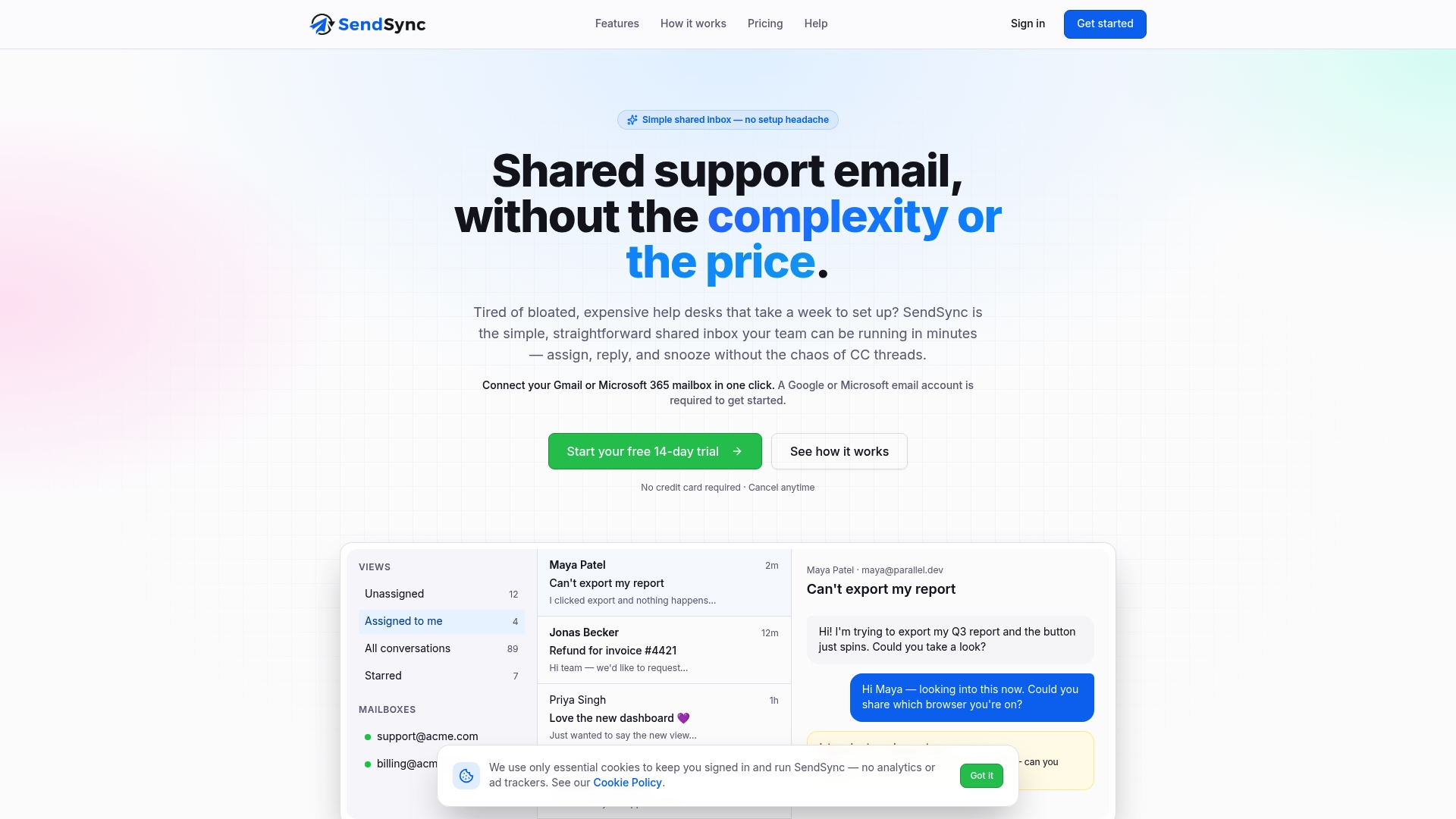
During the 14-day free trial, you connect your existing Gmail or Microsoft 365 mailbox in minutes, invite your entire team at no extra cost, and start assigning, replying, and tagging conversations from one shared view. No DNS changes, no IT ticket required, no per-agent invoice waiting at the end of the month.
Three things you get immediately:
- Predictable pricing that stays flat whether you add three teammates or thirty.
- Fast setup measured in minutes, not the weeks typical of enterprise ticketing platforms.
- Collaboration tools, including internal notes and saved views, built for teams working the same inbox together.
Start the free trial on SendSync today, connect your mailbox, and see whether your whole team fits in one inbox without a single per-seat fee.
Useful Sources and Further Reading
- Gartner’s press release on agentic AI resolving up to a large majority of routine service issues by 2029
- Microsoft AppSource, for browsing third-party support integrations built for Microsoft 365
- G2’s Zendesk seller profile, for real user sentiment on enterprise pricing models
Vendor pricing and contract terms change often. Run your own trial and confirm the latest terms directly with each vendor’s sales team before signing anything.