
Remote Team Accountability Tools List for Support Teams
Remote Team Accountability Tools List for Support Teams ! Remote team manager reviewing accountability tools For remote customer support teams, a lightweight shared inbox is the single most effective daily accountability layer.

For remote customer support teams, a lightweight shared inbox is the single most effective daily accountability layer. It automates ownership where messages already arrive, requires no behavior change from agents, and connects directly to Gmail or Microsoft 365 in minutes. To start: connect one mailbox, define who owns what, and run a two-week pilot.
Quick reasons it wins for support teams:
- Visibility without extra steps — every conversation has an owner, and the whole team can see it
- Minimal setup — no DNS configuration, no lengthy onboarding
- Preserves shared context — threads, replies, and assignments live in one place alongside your existing mail system
Table of Contents
- How do you choose an accountability tool that works for a remote support team?
- What are the three categories of accountability tools, and which does your team actually need?
- Why a lightweight shared inbox is the practical accountability layer for remote support teams
- What does a practical rollout checklist look like for a remote support team?
- Key Takeaways
- The tool is only half the job
- Sendsync gives your team daily accountability without the setup tax
- Further reading and sources
How do you choose an accountability tool that works for a remote support team?
The single most important rule: pick the tool that surfaces daily visibility automatically, without asking anyone to log status updates in a second place. If agents have to copy a status from their inbox into a separate accountability tool, adoption dies within two weeks. Adoption fails when tools add manual steps.
Evaluate any tool against these seven criteria, scoring each 0–3:
- Integrations — does it connect to your existing mail, chat, or ticketing system?
- Ownership model — can you assign a specific person to every item?
- Visibility and audit trail — can a manager see who owns what, right now, without asking?
- Daily-execution surfacing — does it flag unassigned or overdue items automatically?
- Automation and SLAs — can you set response-time rules that trigger without manual input?
- Security and compliance — does it meet your data-handling requirements?
- Predictable pricing — flat fee or per-mailbox beats per-seat when your team size fluctuates
Score each criterion 0–3. Any tool scoring below 12 total is a shortlist cut. The common trade-off is feature depth versus cognitive load: a tool packed with dashboards and goal trees sounds good until your agents spend more time updating it than answering customers. A shared inbox scores high on criteria 1–5 with almost no cognitive overhead.
Pro Tip: Before evaluating any tool, map every place your team currently logs status. If a new tool would create a third place to update, it will fail. Prioritize integrations that eliminate a step, not add one.
What are the three categories of accountability tools, and which does your team actually need?
Practitioners categorize accountability tools into three groups. Knowing which category you are buying matters more than comparing feature lists.
Execution-focused tools handle task assignment, due dates, and ownership tracking. They answer “who owns this, and is it done?” Use cases: project management, ticket routing, recurring task workflows. They work well for teams with structured, predictable work. The gap: they do not surface drift in real time unless someone checks the dashboard.

Communication-focused tools center on async check-ins, standups, and status updates. They answer “what did you do today, and what is blocking you?” Teams spread across time zones benefit most. The gap: check-ins without a connected execution layer become a reporting ritual that does not change behavior.
Performance-management platforms combine manager feedback, goal alignment, and structured reviews. They answer “are we hitting our targets over time?” They are built for quarterly cycles and manager-led conversations. The gap: they are too slow for daily support-team execution.
| Category | Surfaces ownership | Inbox integration | Enforces SLAs | Audit history |
|---|---|---|---|---|
| Execution-focused | Yes | Rarely | Sometimes | Sometimes |
| Communication-focused | Partially | Rarely | No | No |
| Performance-management | No | No | No | Yes (reviews) |
| Shared inbox | Yes | Native | Yes | Yes |
For customer support teams, the right answer is almost always execution-focused tools combined with a shared inbox as the daily layer. The inbox is where support work actually arrives. Putting accountability there means it happens automatically.
Which category to prioritize:
- Start with a shared inbox if your team’s work is primarily email-driven
- Add async check-ins only after the inbox layer is stable
- Defer performance-management platforms until you have baseline KPI data to discuss
Why a lightweight shared inbox is the practical accountability layer for remote support teams
A lightweight shared inbox meets the core selection rule because it puts ownership exactly where messages land. There is no separate system to check. Tools that keep discussions and action items in the place where work arrives improve follow-through because agents never have to leave their workflow to log a status.
Sendsync connects directly to Gmail or Microsoft 365. That means your team’s existing mail infrastructure becomes the accountability layer. Assignments, replies, and conversation history stay in one thread. Integrations with chat and ticketing systems are handled at the mailbox level, so shared context travels with the conversation rather than getting stranded in a separate tool.
Treat the shared inbox as the team’s operating system for message-driven work: capture ownership, automate SLAs, and make follow-ups auditable. When every conversation has a named owner and a visible status, drift surfaces in hours, not weeks.
A shared operating system reduces context switching and keeps ownership clear for every team member. For support teams specifically, that means an agent in a different time zone can pick up a thread without a handoff meeting.
Setup timeline: connect mailbox → define ownership rules → set SLA automations → run two-week pilot → review KPIs → full rollout. Sendsync’s setup takes minutes, not days. First-week gains typically show up as a drop in unassigned messages and faster first response times, both measurable before the pilot ends.
What does a practical rollout checklist look like for a remote support team?
A two-week pilot is enough to prove value. Success looks like: every inbound message has an owner within your SLA window, backlog is not growing, and first response time has improved from your baseline.
Rollout checklist:
- Week 0, Day 1 — Baseline your KPIs: average first response time, percent of messages unassigned at end of day, mean time to resolution, backlog count
- Week 0, Day 2 — Connect your primary support mailbox to Sendsync
- Week 0, Day 3 — Define ownership rules: who handles which message types, what the escalation path is
- Week 0, Day 4 — Set SLA automations: flag any message unassigned after X minutes
- Week 0, Day 5 — Brief the team: five minutes, focus on what changes for them (less chaos, clear ownership)
- Weeks 1–2 — Run daily check-ins (ten minutes max): review flagged items, surface blockers, confirm ownership
- End of Week 2 — Compare KPIs against baseline; decide on full rollout
Structured check-ins combined with clear goal alignment prevent the long-term drift that only shows up in quarterly reviews. Catching it in week two is the point.
KPI pilot table:
| KPI | Measure how | Target improvement by Week 2 |
|---|---|---|
| First response time | Average minutes from receipt to first reply | Reduce noticeably from baseline |
| Percent unassigned messages | Messages with no owner at end of day / total | Below 5% |
| Mean time to resolution | Average hours from open to closed | Reduce noticeably from baseline |
| Backlog drift | Net change in open conversations week over week | Flat or declining |
On pricing: predictable flat-fee or per-mailbox pricing simplifies pilots for small-to-medium support teams. Sendsync offers unlimited users with no per-seat fees, which means your pilot cost does not scale with headcount.
Key Takeaways
A shared inbox is the fastest path to daily accountability for remote support teams because it automates ownership where work already arrives, requires no behavior change, and delivers measurable KPI improvements within two weeks.
| Point | Details |
|---|---|
| Start with the execution layer | A shared inbox automates ownership at the source; add async check-ins only after it is stable. |
| Score tools on seven criteria | Integrations, ownership model, visibility, daily surfacing, SLAs, compliance, and predictable pricing. |
| Run a two-week pilot | Baseline KPIs on Day 1; target faster first response and under 5% unassigned messages by Week 2. |
| Culture beats surveillance | Transparent ownership and a reliable daily cadence outperform time-tracking tools for long-term engagement. |
| Sendsync as the daily layer | Sendsync connects Gmail or Microsoft 365 in minutes, with unlimited users and no per-seat fees, making it a low-risk pilot choice. |
The tool is only half the job
Most accountability conversations in support teams focus on the wrong thing. Leaders pick a tool, configure it carefully, and then wait for behavior to change. It rarely does, because the tool surfaces what is happening but does not tell anyone how to respond to it.
Accountability works when it is visibility plus generosity. When a message sits unassigned for two hours, the right response is a quick, direct conversation: “I noticed this one slipped. What got in the way?” Not a formal review. Not a performance note. A short, specific exchange that treats the agent as someone who wants to do good work and ran into an obstacle.
RACI-style ownership for email threads sounds bureaucratic, but it does one thing nothing else does: it removes ambiguity. When everyone knows who owns a thread, no one waits for someone else to pick it up. That is not surveillance. That is just clarity.
For teams across multiple time zones, the cadence matters as much as the tool. A ten-minute async check-in posted at the start of each shift, reviewed by the lead at the end of theirs, catches drift six weeks before it shows up in a quarterly number. Outcome-based leadership paired with short structured check-ins is what actually scales accountability across geography.
Sendsync gives your team daily accountability without the setup tax
Most shared inbox tools promise accountability but bury it under configuration menus and per-seat pricing that punishes growth. Sendsync is built differently: connect your Gmail or Microsoft 365 mailbox in minutes, assign ownership rules, and your team has a live accountability layer before the end of day one.
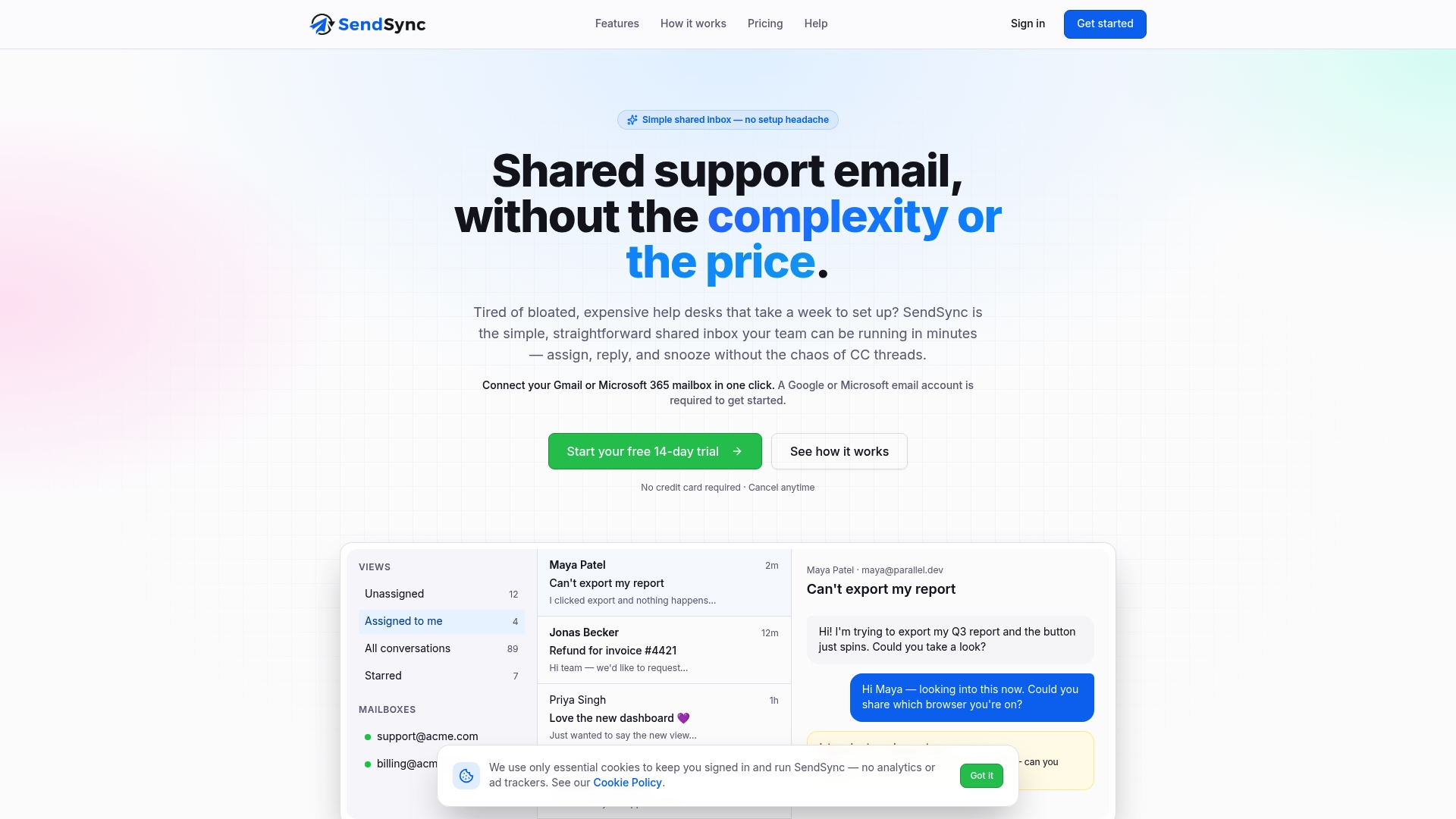
No DNS headaches. No per-seat fees. Unlimited users on every plan. The pilot structure from this article works out of the box: baseline your KPIs, connect your mailbox, set your SLA automations, and check your numbers at the end of week two. Most teams see unassigned messages drop and first response times improve before the pilot closes.
Start your pilot today and see what your support team’s accountability looks like when the inbox does the tracking for you.
Further reading and sources
- Remote team accountability tools (Coommit, 2026) — covers integration-first selection and the adoption failure pattern
- Build team accountability in 5 minutes per day (Range) — three-category taxonomy and cadence guidance
- Team goal accountability (Goalite) — the assignment-to-completion gap and daily execution layer rationale
- Team operating system (TeamCadence) — shared operating system concept and duplicate-status-update pitfall
- Team accountability (HiveDesk) — outcome-based vs. surveillance accountability and RACI ownership frameworks
- Best employee accountability software (Gitnux) — buyer guide trends and KPI recommendations for pilots
- Best team accountability software (ProofHub) — pricing model comparison for small-to-medium teams
- Collaboration tools for remote teams (The Digital Project Manager) — keeping work and conversation together in one workflow