
Keep Outlook Rules for Support Teams Until 3–4 People, Then Switch
Keep Outlook Rules for Support Teams Until 3–4 People, Then Switch ! Support specialist testing an email rule Outlook rules for support handle the repetitive part of triage automatically: moving messages by sender or subject, tagging tickets, forwarding to the right agent, and au

Outlook rules for support handle the repetitive part of triage automatically: moving messages by sender or subject, tagging tickets, forwarding to the right agent, and auto-replying with a case number. They run in a strict top-to-bottom order, so poorly sequenced rules can silently overwrite each other. They also break more than most support leads expect, usually after a mailbox migration or a client change. For a two-person team, rules are often enough. Past that, most teams eventually replace them with something built for shared visibility.
TL;DR:
- Support rules should be carefully ordered, with urgent emails moving before general support mail to prevent overwriting or missed messages.
- Rules built with client-only actions in classic Outlook may not survive platform migration, requiring recreation with server-side actions.
- Running rules on existing backlog emails is possible but often overlooked; it requires manual application or using classic Outlook to process previous messages.
- Troubleshooting broken rules involves checking enablement, folder existence, and whether rules are client- or server-side compatible, especially after migrations.
- Shared inboxes provide a more scalable solution for larger teams, offering better visibility, assignment management, and automation features beyond Outlook rules.
Table of Contents
- How Do You Create, Edit, and Delete Outlook Rules for Support?
- Rule Order and the “Stop Processing More Rules” Setting
- Can You Run a Rule on Messages Already in Your Inbox?
- Diagnosing and Fixing Broken Outlook Rules
- Server-Side Rules vs. Client-Side Rules: Why This Matters
- Rule Patterns and Best Practices for Support Teams
- When Rules Work and When They Stop Working
- A Simpler Path Once Rules Stop Scaling
- Where to Go for Official Microsoft Guidance
- Sources
- FAQ
How Do You Create, Edit, and Delete Outlook Rules for Support?
The fastest way to build a support rule is to right-click a message and choose Create rule. Outlook pre-fills the sender and subject as conditions, which works fine for simple cases like “everything from this customer goes into a Priority folder.” For anything more complex, skip the quick option and go straight to More options, which unlocks multiple conditions, exceptions, and a longer list of actions like forwarding, categorizing, or replying with a template.
Where you manage rules depends on which client you’re running:
- New Outlook: Go to Settings > Mail > Rules. You can add, reorder, and delete rules from this single screen.
- Classic Outlook (desktop): Go to File > Manage Rules & Alerts. This is the only client that still supports client-side rules with local actions like playing a sound or displaying a desktop alert.
- Outlook on the web: Go to Settings > Mail > Rules, which mirrors the New Outlook interface almost exactly since both run on the same server-side engine.
Deleting a rule is permanent, so for anything you’re not sure about, toggle it off instead. Every platform lets you disable a rule without removing its conditions, which matters when you’re testing changes to a live support queue.
One detail trips up a lot of support staff during a client switch: rules built with local-only actions in classic Outlook do not carry over cleanly. Every rule requires a name, a specific condition, and a defined action, with optional exceptions to refine when it runs, and it’s worth checking that action type at creation time. If it’s server-side (move, forward, categorize), it will survive a platform migration. If it’s client-side, plan to rebuild it.
Rule Order and the “Stop Processing More Rules” Setting
Outlook runs rules in the order they appear in your list, from top to bottom, applying each one that matches until it either runs out of rules or hits a stop instruction. That order is not automatic or logical. It’s whatever sequence you (or whoever built the rules before you) left them in, which means a badly ordered list can quietly undo itself.
Here’s where that causes real problems in a support inbox:
- A rule that moves urgent SLA emails to a Priority folder needs to run before a general “move everything from support@ to Archive” rule, or the urgent message never reaches the folder it’s supposed to.
- A forward rule and an auto-reply rule targeting the same messages can create a loop if a downstream account also has an auto-forward set up.
- A “move to folder” action should typically come before a “mark as read” action, not after, so you don’t lose track of what still needs a human look.
The Stop processing more rules checkbox tells Outlook to halt after that rule fires, ignoring anything below it for that message. Turn it on whenever you need exactly one outcome, like routing a VIP client straight to a dedicated folder without other rules also tagging or moving it.
Pro Tip: Build a test message that matches multiple rule conditions on purpose, then send it to yourself and watch which rule actually wins. It’s the fastest way to catch order conflicts before they hit a real customer email.
Can You Run a Rule on Messages Already in Your Inbox?
Yes, and it’s the step people skip most often. New rules only apply going forward by default, which means the 200 backlogged support emails sitting in your inbox won’t get sorted unless you tell Outlook to catch them up.
- In classic Outlook, open File > Manage Rules & Alerts, select the rule, and click Run Rules Now. Choose the folder to apply it to and the message types to include.
- In New Outlook and Outlook on the web, this option is more limited or unavailable for some rule types, so you may need to sort backlog manually or temporarily use classic Outlook for the batch run.
- Before running anything with a delete or move action, copy the target folder first and test on the copy. If the rule catches messages you didn’t expect, you haven’t touched the originals.
If a rule relies on a client-only action that can’t run retroactively, your fallback is a manual multi-select and drag, which is tedious but safer than guessing on a bulk automation you haven’t verified.
Diagnosing and Fixing Broken Outlook Rules
Broken rules usually announce themselves one of two ways: an error banner when Outlook tries to run them, or a rule that shows as grayed out with a message that it “can’t be edited or viewed.” Both are worth taking seriously, since a silently failing rule means support emails are landing somewhere nobody’s checking.
Start with the basics before assuming something’s fundamentally broken:
- Check whether the rule is actually enabled. It’s easy to toggle one off during testing and forget to turn it back on.
- Look for a folder target that no longer exists. Renaming or deleting a folder after building a rule around it is one of the most common causes of a quiet failure.
- Check whether the rule was built in classic Outlook with a client-side condition or action, then migrated to New Outlook, which only supports server-side rules. This is very often the actual root cause when a rule “used to work fine.”
The fix for most of these is straightforward: recreate the rule from scratch using only server-side-compatible actions, point it at the correct current folder, and re-enable it. Common troubleshooting guidance also recommends duplicating a rule per account type if you manage more than one mailbox with different settings.
Pro Tip: If a rule looks fine but still isn’t firing, check whether it’s a redirect or forward rule first. Those fail for a different reason entirely, covered next, and no amount of re-enabling will fix it.
Some failures aren’t yours to fix at all. If a rule needs to forward or redirect mail and nothing you do resolves it, or if a mailbox seems to ignore rules across the board, that’s when you escalate to an admin rather than keep troubleshooting solo.
Server-Side Rules vs. Client-Side Rules: Why This Matters
Every Outlook rule runs in one of two places, and knowing which one explains most “it worked yesterday” complaints. Server-side rules live on Exchange itself and run whether or not any Outlook client is even open. Client-side rules only fire when the specific desktop app that created them is running in the background, which is why they’re fragile.

New Outlook and Outlook on the web support server-side rules exclusively. Classic Outlook desktop supports both, which is exactly why rules built there don’t always survive a switch to the newer client.
A few Exchange-level settings can block rules regardless of how well you built them:
- Journaling mailboxes and certain license tiers such as F1 don’t run inbox rules by design, not by misconfiguration.
- A mailbox with forwarding already enabled will block your redirect rules outright. Exchange sets
DeliverToMailboxAndForwardto prevent duplicate delivery and forwarding loops, and an admin has to runSet-Mailbox -DeliverToMailboxAndForward $Falsevia PowerShell before a redirect rule will function. - Forwarding a rule to a long list of individual addresses can hit Exchange Online’s recipient limits. A rule with a single distribution group avoids that ceiling entirely, and it’s a fix worth making before you hit the wall rather than after.
None of these show up as an obvious error in the Outlook interface. They just look like a rule that mysteriously does nothing, which is why so many “broken rule” tickets are actually tenant-level settings an end user can’t touch.
Rule Patterns and Best Practices for Support Teams
The rules that hold up long-term in a support inbox tend to follow a handful of repeatable patterns rather than one-off fixes for whatever broke last week.
- Auto-folder by client or issue type. Route messages from a known domain or containing a specific subject keyword straight into a dedicated folder, so nothing from a major account gets lost in a general queue.
- Tag for SLA priority. Categorize anything matching urgent-sounding subject lines or specific senders so it’s visually distinct the moment it lands.
- Auto-forward to a group inbox for assignment, using a distribution group instead of five individual addresses, both for the recipient limit reasons above and because it’s far easier to update later.
- Auto-categorize into a triage queue so agents can filter by category rather than reading every subject line to figure out what’s new.
A naming convention matters more than it sounds like it would. Practitioners who manage rules at scale recommend a consistent prefix and a running note of what changed and when, since six months from now nobody remembers why “Rule 14” exists or what it’s supposed to catch.
Pro Tip: Keep a plain-text changelog next to your rules, even just three lines per edit. It saves hours the day something breaks and you need to know what changed last.
Watch for the failure points: too many overlapping conditions on one rule, client-only actions that vanish on the next client update, and forward lists that grow one address at a time until they hit a limit. Once your team is untangling rule conflicts more than actually resolving tickets, that’s usually the signal to look at a shared inbox instead of another rule.
When Rules Work and When They Stop Working
Rules are genuinely good at one thing: quiet, repetitive sorting for a small number of people. A solo founder or a two-person support desk can run entirely on well-built rules for a year or more without hitting a wall.
The cracks show up with headcount. Once three or four people are pulling from the same inbox, rules can’t tell you who’s already replying to a thread, so two agents draft the same response to the same customer — a problem solved by a letter preview workflow for organizations. Nothing in the rules engine tracks assignment, ownership, or response time. It just moves mail. Add a migration or a licensing change on top of that, and rules built for a small team start breaking in ways that take real time to diagnose, as covered earlier.
A shared inbox solves the part rules were never built for: who owns a conversation, whether someone already answered it, and how long a customer actually waited. A shared inbox solution that connects directly to a Microsoft 365 mailbox without DNS changes, and account options that remove the incentive to hoard rules or dodge per-seat costs. For teams already fighting rule conflicts, that’s a structural fix rather than another patch.
— Nick
A Simpler Path Once Rules Stop Scaling
An alternative to stacking more Outlook rules on top of the ones already causing conflicts is a shared view where the whole team sees the same inbox, who’s handling what, and what’s still waiting.
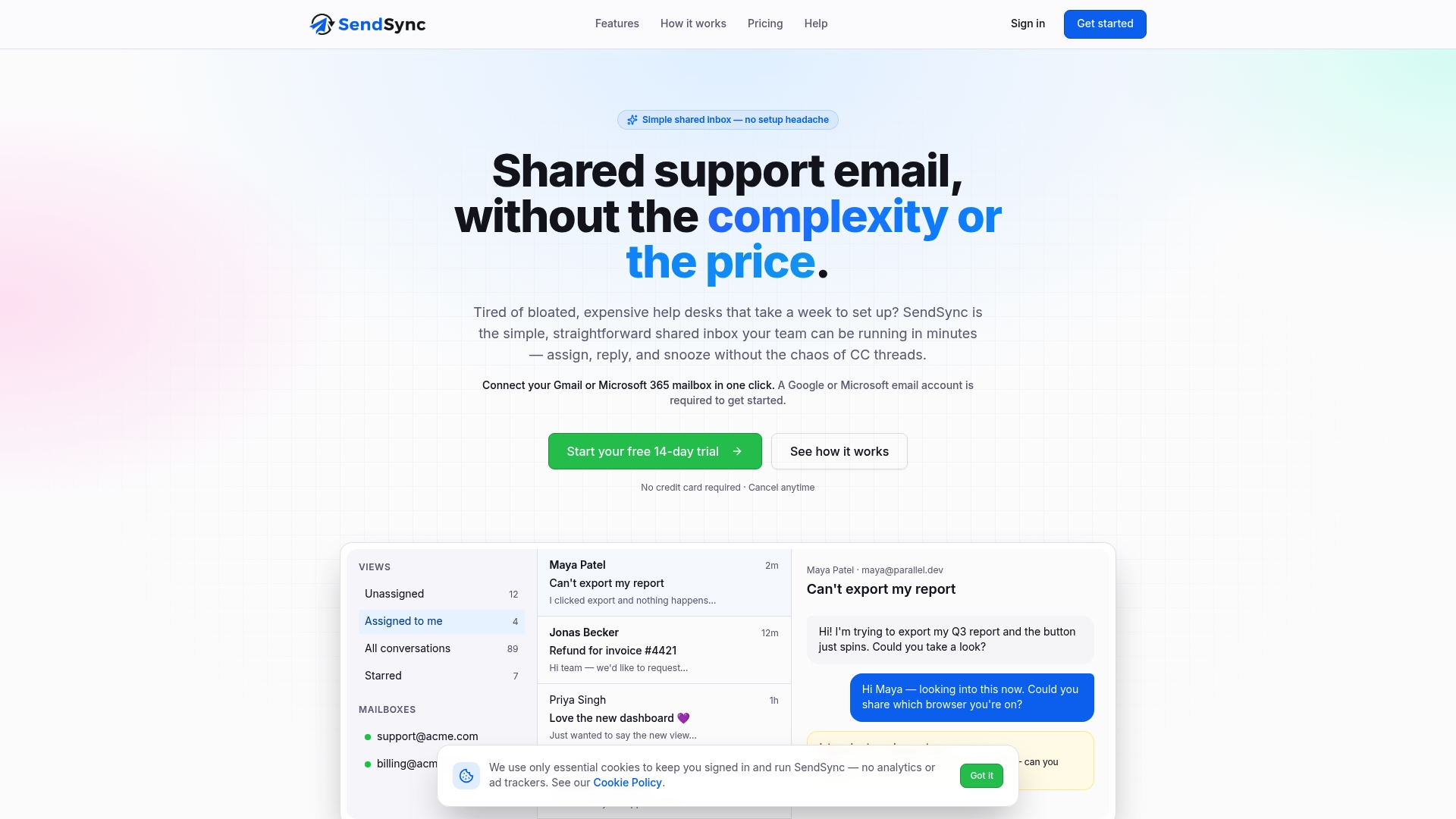
Connecting a Microsoft 365 or Gmail mailbox can take minutes, without DNS record configuration or per-seat pricing. Features include:
- Conversation assignment to prevent duplicate replies
- Internal notes attached directly to threads
- Automation for tagging and triage independent of the client used
- Metrics dashboards showing response times across the team, not just one inbox
If your rules list has turned into something only one person understands, or new hires keep asking why a message went to the wrong folder, it’s worth exploring what a shared inbox setup looks like for your own support volume, with options to try connecting your existing mailbox before committing.
Where to Go for Official Microsoft Guidance
For exact steps and admin-level commands, Microsoft’s own documentation stays current with client changes faster than any third-party guide. The rules management overview covers the basic building blocks of any rule. The Exchange troubleshooting guide walks through the PowerShell forwarding fix in detail. The broken rule guide explains what happens to rules during a client migration.
FAQ
What Are Some Useful Outlook Rules for Support Teams?
The most useful ones sort by sender or subject into dedicated folders, categorize urgent messages for SLA tracking, and forward specific ticket types to a distribution group rather than individual agents.
How Many Rules Does Outlook Support?
Exchange Online mailboxes have a rule storage limit set by Microsoft, and complex rules with many conditions use up that space faster than simple ones. Most support inboxes stay well under the limit unless dozens of overlapping rules have accumulated over time without cleanup.
Can I Create a Rule to Manage Emails Received for Someone Else?
Yes, if you have delegate or full-access permissions on that mailbox, you can build rules that apply to it, though shared or delegated mailboxes sometimes have their own forwarding restrictions worth checking first.
Does the New Outlook Support Rules?
Yes, but only server-side rules. Client-side actions like desktop alerts or custom sounds from classic Outlook won’t transfer, and any rule built around them needs to be recreated with server-side-compatible actions.
When Should a Support Team Stop Relying on Rules?
Once assignment conflicts, duplicate replies, or rule migration failures start costing more time than the rules save, a shared inbox like Sendsync typically handles the same triage work with far less ongoing maintenance.