
Google Workspace Shared Inbox: 3 Native Paths or Faster SendSync
Google Workspace Shared Inbox: 3 Native Paths or Faster SendSync ! Support lead testing a shared inbox reply For most teams, the right starting point is a Google Groups Collaborative Inbox or an Admin-console shared mailbox, both built into Google Workspace at no extra per-user l

For most teams, the right starting point is a Google Groups Collaborative Inbox or an Admin-console shared mailbox, both built into Google Workspace at no extra per-user license cost. Pick the Collaborative Inbox when you need assignment and status tracking, or an Admin-created mailbox for a simple department address. If you need faster setup and built-in workflow features without touching DNS, SendSync is a practical alternative.
TL;DR:
- A Collaborative Inbox requires conversation history, group features, and permissions to moderate metadata; members can take, assign, and resolve conversations.
- Delegation suits one assistant or a small alias, but because access belongs to one person’s account, teams above two or three regular delegates should switch.
- To prevent duplicate replies, members should take a conversation before drafting, then use unassigned or older than 24 hours filters to catch neglected messages.
- Native tools offer limited audit trails and lack templates or SLA reporting; teams needing those features should review a marketplace app’s requested access before installation.
Table of Contents
- Which native shared-inbox option fits your team?
- How to create a shared inbox from the Admin console
- Mail delegation: configure delegates and know when it’s the right fit
- Turning a Google Group into a Collaborative Inbox
- Running a shared inbox without reply collisions
- When a marketplace app makes more sense than native tools
- Where SendSync fits for fast-moving teams
- Our take: start simple, scale when the workload demands it
- Get a shared inbox running today with SendSync
- FAQ
- Sources
Which native shared-inbox option fits your team?
Google Workspace gives you three built-in patterns, and each one solves a different problem. Picking the wrong one usually means rebuilding your setup a few months later, so it helps to match the tool to the scenario before you touch the Admin console.
- Admin-created shared mailbox: best for a department address like support@ or sales@ where you want centralized control and a predictable inbox.
- Mail delegation: best for manager-assistant setups or a single person running a small business alias who needs someone else reading and replying on their behalf.
- Google Groups Collaborative Inbox: best for teams that need to see who owns which message, mark items complete, and filter by status.
Each option lives inside your existing Google Workspace subscription, and groups do not consume a separate user license, so adding five or ten people to a Collaborative Inbox costs nothing extra in seats. The feature set does vary by edition, so check what your specific Workspace plan includes before planning a rollout. If your team is small and the volume of email is light, any of the three native paths will work. The decision gets harder once you need audit trails, templates, or reporting, which native tools handle only loosely.
How to create a shared inbox from the Admin console
Setting up a shared mailbox through the Admin console takes a few minutes once you know the sequence. Before you start, decide on the email address you want, identify who needs delegate access, and confirm your Workspace edition supports the shared mailbox feature you’re planning to use.
- Sign in to the Admin console and go to Directory > Users.
- Select Set up a shared email address (sometimes listed under user creation options).
- Enter the shared address, such as support@yourdomain.com.
- Add the team members who should have delegate access to that mailbox.
- Send sign-in or access instructions to those users so they can start replying from the shared address.
If you already have an existing account you want to turn into a shared inbox, Google’s admin documentation walks through searching for that user, selecting them, and reassigning delegate access so the account becomes a team resource instead of a personal one. Once delegates are added, each person can open Gmail settings to check Grant access to your account, which confirms who can read and send from that address, and to review how “sent by” information appears on outgoing messages.
Pro Tip: Run the setup with a pilot group of two or three people first, send a handful of test replies, and confirm the “sent by” label looks right before rolling the shared address out to the whole team.
Mail delegation: configure delegates and know when it’s the right fit
Delegation is the simplest way to give someone access to your inbox without creating a new shared address. It works well for an assistant managing a manager’s calendar and email, or a solo business owner who wants a part-time helper answering messages under their own name.
- Delegation lets one user grant another user permission to read, send, and delete messages from their account, as described in Google’s delegation guide.
- Admins may need to enable delegation in the Admin console settings before individual users can add a delegate inside Gmail.
- Once enabled, a user adds a delegate directly from Gmail’s Accounts and Import settings, and the delegate sees the inbox listed as a separate account they can switch into.
Delegation has real limits. It ties access to one person’s individual account, so if that person leaves the company or changes roles, every delegate relationship built on top of their inbox has to be rebuilt. Never share account passwords as a workaround. Google explicitly recommends against shared credentials and favors delegation or groups instead, since shared logins break audit trails and security controls.
Once more than two or three people need regular access, or once the address needs to survive staff turnover, convert to a proper shared mailbox or a Collaborative Inbox instead of stretching delegation further than it was designed for.

Turning a Google Group into a Collaborative Inbox
A Collaborative Inbox adds the assignment and status tracking that a plain shared mailbox lacks. Setting it up takes two stages: enabling the right group features, then assigning permissions so the right people can actually use them.
- Open Google Groups, go to the group’s settings, and turn on conversation history, which is required before Collaborative Inbox features will work.
- Enable the additional Group features, as outlined in Google’s Groups feature guide, then switch the group type to Collaborative Inbox.
- Assign the Who can moderate metadata permission to the members who should be able to take and assign conversations, since this permission gates most of the workflow actions.
Once it’s live, members can work through messages with a short set of actions: take a conversation to claim ownership, assign or reassign it to a teammate, and mark it complete, duplicate, or no action needed when it’s resolved. Google’s Collaborative Inbox documentation confirms that these states can be filtered, so a team member can search for conversations assigned to me or filter by resolution status to see what’s still open.
- Keep the list of people with moderate-metadata permission short, since too many moderators tends to create conflicting reassignments.
- Review conversation history settings periodically, since turning it off later will disable the workflow features you just set up.
A small pilot group, as suggested in Google’s Collaborative Inbox learning center, helps catch permission mistakes before they spread across a larger team.
Running a shared inbox without reply collisions
The biggest day-to-day risk in any shared inbox is two people replying to the same message at the same time. A simple convention solves most of this: whoever takes a conversation marks it taken immediately, before drafting a reply, not after.
- Use the take and assign actions as your single source of truth for ownership rather than a side channel like chat or a spreadsheet.
- Build a handful of saved searches or filters, such as unassigned messages or messages older than 24 hours, so nothing sits untouched.
- Apply labels for quick triage, like billing or technical, so messages route to the right person without someone manually reading every subject line.
Check how sent by visibility is configured for your shared address, since this determines whether replies show the shared mailbox name, an individual’s name, or both. Admins can review and adjust this under the mailbox or delegate settings described in Google’s shared inbox guidance.
Run a quick audit every month or so: confirm the right people still hold delegate or moderate-metadata permissions, and remove anyone who has changed roles. Permissions tend to drift as teams grow, and an outdated delegate list is one of the more common sources of missed messages.
Pro Tip: Set a weekly five-minute check of the “unassigned” filter so nothing sits in limbo over a weekend.
When a marketplace app makes more sense than native tools
Native Google Workspace features cover the basics well, but a few signals suggest it’s time to look at a Workspace Marketplace app or a cloud-based business communications platform or a dedicated shared-inbox tool. If you’re seeing reply collisions despite a take/assign convention, needing templates for repeated answers, or wanting SLA and volume reporting that Groups doesn’t provide, a purpose-built app closes that gap.
When evaluating one, prioritize:
- Assignment and locking: can two people avoid replying to the same thread at once?
- Audit trail and shared labels: can you see who touched a conversation and when?
- Templates and automation rules: does it save time on repeated replies?
- Easy Gmail integration: does it avoid requiring DNS changes or a mailbox migration?
Marketplace listings like Drag for Gmail advertise these kinds of assignment and workflow additions directly inside Gmail. Before installing any app, check the OAuth scopes it requests and confirm your admin console allows the level of access it’s asking for, since that access determines what the app can read or change in your mailboxes.
Where SendSync fits for fast-moving teams
We built SendSync for teams that want the assignment and workflow benefits of a Collaborative Inbox without the permission setup. Connecting a mailbox can be done quickly without DNS changes or migration steps. From there, teams get assignment, internal notes, and reporting out of the box.
Compared with native options, the difference is speed to production: instead of configuring conversation history, group permissions, and moderate-metadata access, you connect your existing mailbox and start assigning conversations immediately. We do not charge per-seat fees, so adding more teammates will not affect the bill.
Our take: start simple, scale when the workload demands it
Most small teams do fine starting with a Collaborative Inbox or an Admin-created mailbox, piloted with two to five people before a wider rollout. The native tools are free within your existing Workspace plan and good enough until volume or reporting needs outgrow them. Once assignment conflicts or SLA tracking become a weekly headache, that’s the signal to move to a dedicated SaaS tool rather than layering more manual process onto Gmail.
— Nick
Get a shared inbox running today with SendSync
We know the native setup works, but it takes real admin time: enabling group features, assigning moderate-metadata permissions, testing “sent by” visibility. With SendSync, you connect your Gmail or Microsoft 365 mailbox and are assigning conversations the same day, with no DNS changes required.
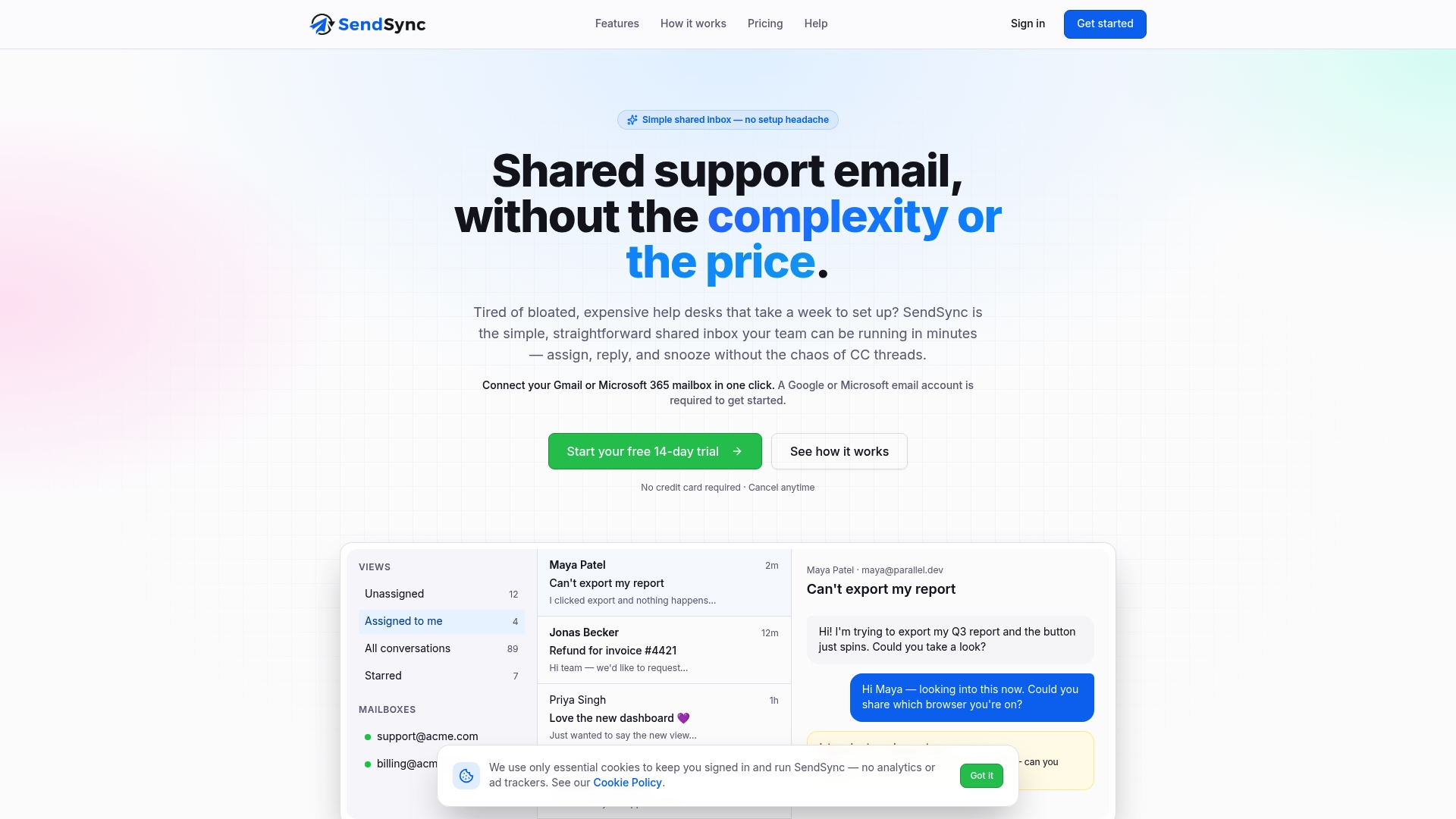
Our plans are designed to support team growth without increasing fees based on the number of users. Plans start with Founder at $10 per month, with Starter, Growth, and Scale tiers available as your team’s needs expand, all listed on the SendSync pricing page. If you’re ready to skip the permission configuration and start assigning messages today, visit Sendsync to start a free trial.
FAQ
What is a shared inbox in Google Workspace?
A shared inbox is an email address that multiple team members can access, reply from, and manage together, set up through an Admin-created mailbox, mail delegation, or a Google Groups Collaborative Inbox. Each method differs in how much setup it needs and what workflow features it offers.
What are the disadvantages of using a shared mailbox?
A basic shared mailbox has no built-in way to track who is handling a message, which can lead to reply collisions and missed follow-ups. Native options like delegation also tie access to individual accounts, so permissions need rebuilding when staff change roles, and reporting or SLA tracking generally requires a dedicated tool.
How do I access a shared inbox?
Access depends on how the inbox was set up: delegates added through Gmail delegation see it as a separate account inside their own Gmail, while members of a Collaborative Inbox access it through Google Groups once they have the right permissions. Admin-created shared mailboxes are accessed by signing in with the credentials or delegate access the admin assigned.
What is the main difference between a shared mailbox and a Google Group email?
A shared mailbox is a single email account that delegates access directly, while a Google Group with Collaborative Inbox features adds a workflow layer on top, letting members take, assign, and mark conversations as resolved. The Collaborative Inbox setup requires enabling conversation history and group features that a plain shared mailbox doesn’t need.