
Start a Business Hours Support Email in Minutes for Small Teams
Start a Business Hours Support Email in Minutes for Small Teams ! Coordinator setting business email hours Official support email addresses and business hours live on a vendor's help center or contact page, and sometimes on a status page or inside the app itself.

Official support email addresses and business hours live on a vendor’s help center or contact page, and sometimes on a status page or inside the app itself. If your question falls outside those posted hours, the fastest path is usually a ticket form or priority channel, where one exists. Teams that manage their own inbox, including ones running on SendSync, use these same published hours to set expectations with customers.
TL;DR:
- Support hours typically follow patterns like 24/7, 8×5, or business days only, depending on the service tier and incident severity.
- Including your account ID, clear subject line, detailed problem description, and relevant attachments speeds up resolution times.
- Most vendors provide automated replies with ticket IDs and estimated reply windows, with high-priority issues often addressed within a few hours.
- A shared inbox setup with automated assignment and internal notes ensures support teams respond reliably during posted hours, even with limited staffing.
- Publishing accurate support hours and setting realistic response expectations build customer trust more effectively than striving for around-the-clock availability.
Table of Contents
- Where support email addresses and hours get published
- How support hour patterns shape what you can expect
- How to write a support email that gets a fast reply
- What happens after you hit send
- How small teams keep business hours support reliable
- Why predictable hours matter more than round-the-clock coverage
- Publish and manage support hours without the setup headache
- FAQ
- Sources
Where support email addresses and hours get published
Most companies post contact details in a small number of predictable places, and checking the right one saves you a round trip.
- Help center or contact page: usually lists a support email, a ticket submission form, and sometimes phone or chat, alongside stated hours of operation.
- Status page: often carries temporary notes about outages, delayed replies, or holiday closures that the main contact page has not been updated to reflect.
- In-app dashboard or account settings: many SaaS products embed a support link or chat widget that routes directly to the current support queue.
Auto-reply messages and ticket confirmations are also a legitimate source of hours information. When you email a support address, the automated confirmation frequently states the expected first-reply window and sometimes the hours during which a human will pick up the ticket. Fastmail’s support policy, for example, publishes its support email and confirms that replies often arrive within a few hours and typically within 24 hours. Reading that confirmation message carefully is often faster than searching the website again.
How support hour patterns shape what you can expect
Support hours generally follow a handful of recognizable patterns, often written in shorthand like 8×5 (eight hours a day, five days a week) or 24/7 (round the clock, every day). Knowing which pattern a vendor uses tells you whether a reply tonight is realistic or whether Monday morning is the earliest you will hear back.
Firstup’s support documentation illustrates how this works in practice: self-service resources are available 24/7, while assisted human support commonly starts at a minimum of eight hours a day, five days a week, with higher subscription tiers unlocking extended coverage. Google Cloud’s support documentation follows a similar structure, defining business days and hours of operation by language and region, and reserving 24/7 coverage for high-priority incidents under premium plans.
| Pattern | Typical meaning | Who usually offers it |
|---|---|---|
| 24/7 | Support available every day, all hours | Email-based or self-service tools, premium incident tiers |
| 8×5 | Eight hours a day, five business days | Standard-tier assisted support |
| Business days only | No weekend coverage | Smaller teams, lower-cost plans |
The practical takeaway: your plan level or ticket priority often determines which column you fall into, so checking your own account tier matters as much as checking the vendor’s general policy.
How to write a support email that gets a fast reply
A support email that includes the right details the first time avoids a slow back-and-forth. Before you hit send, make sure your message covers the basics a support agent needs to act.
- Account or order ID so the agent can pull up your record immediately.
- A specific subject line that names the problem, not just “Help needed.”
- What you expected to happen versus what actually happened.
- Steps to reproduce the issue, numbered if there is more than one.
- Screenshots or log files, attached as images or text rather than pasted into the body.
- Your preferred contact method if email is not your first choice for follow-up.
A short template covers most cases: “Subject: Unable to process refund for order #4521. Body: I requested a refund on March 3 and received no confirmation; attached is the order screenshot and the error message I see when I retry.” That is enough for most teams to start working the ticket without asking a clarifying question first.
Pro Tip: Save screenshots as PNG files and name them something the agent can scan at a glance, like “error-checkout-step3.png” instead of “Screenshot 2026-03-03.png.”
Avoid inflating urgency. Saying “this is blocking our entire team” when it affects one user tends to slow down triage once the agent reads past the subject line.
What happens after you hit send
Most vendors confirm receipt within minutes through an automated reply, and that message usually contains your ticket ID and an estimated first-reply window.
- A priority or high-severity ticket often gets a human reply within a few hours.
- A standard ticket commonly gets a first reply within 24 hours on business days.
- Weekends and holidays typically push that window out, even for vendors that otherwise reply quickly.
Fastmail’s published policy states that first replies often arrive within a few hours and typically within 24 hours, which Fastmail documents on its support page as a general benchmark rather than a guarantee for every ticket. OpenSesame’s support page similarly notes business-day coverage with limited weekend availability, which is a common pattern worth checking before you assume a Saturday email will get same-day attention.
If a day passes with no update on a standard ticket, replying to the same thread, rather than opening a new one, keeps your history intact and usually gets faster attention than starting over.
How small teams keep business hours support reliable
Publishing hours is only half the job. The other half is making sure every email that arrives during those hours actually gets answered, and that nothing slips through when volume spikes.
- State expected first-reply time in your auto-reply, not just “we received your message.”
- Assign incoming emails to a specific person so no message sits unclaimed in a shared folder.
- Use tags and saved views to separate urgent issues from routine questions at a glance.
- Staff your busiest 2 to 4 hour window first, then expand coverage once ticket volume data shows where the gaps are.
Teams running support through SendSync connect an existing Gmail or Microsoft 365 mailbox in minutes, without DNS changes, which means the setup step that often delays publishing clear hours is no longer a blocker. Assignment, internal notes, and shared views then handle the coordination that used to require a forwarded inbox and a spreadsheet.
Pro Tip: Before adding staff hours, check how many emails actually arrive outside your current window. Often the number is small enough that an auto-reply with a morning follow-up promise solves it.

Why predictable hours matter more than round-the-clock coverage
Small teams tend to assume that competitive support means being available at all hours, but the bigger win is almost always clarity, as explained in The Best After Hours Call Handling Setup. A customer who knows a reply will land within a stated window stays calmer than one guessing whether anyone saw their email at all. Publishing hours honestly, backing them with an auto-reply that states a real first-reply estimate, and routing messages through a shared inbox so nothing gets missed does more for customer trust than chasing 24/7 coverage a small team cannot staff anyway.
— Nick
Publish and manage support hours without the setup headache
Getting business hours support right is mostly a workflow problem, not a staffing problem, and that is the gap SendSync was built to close. Connecting a Gmail or Microsoft 365 mailbox takes minutes, with no DNS configuration standing between you and a working shared inbox.
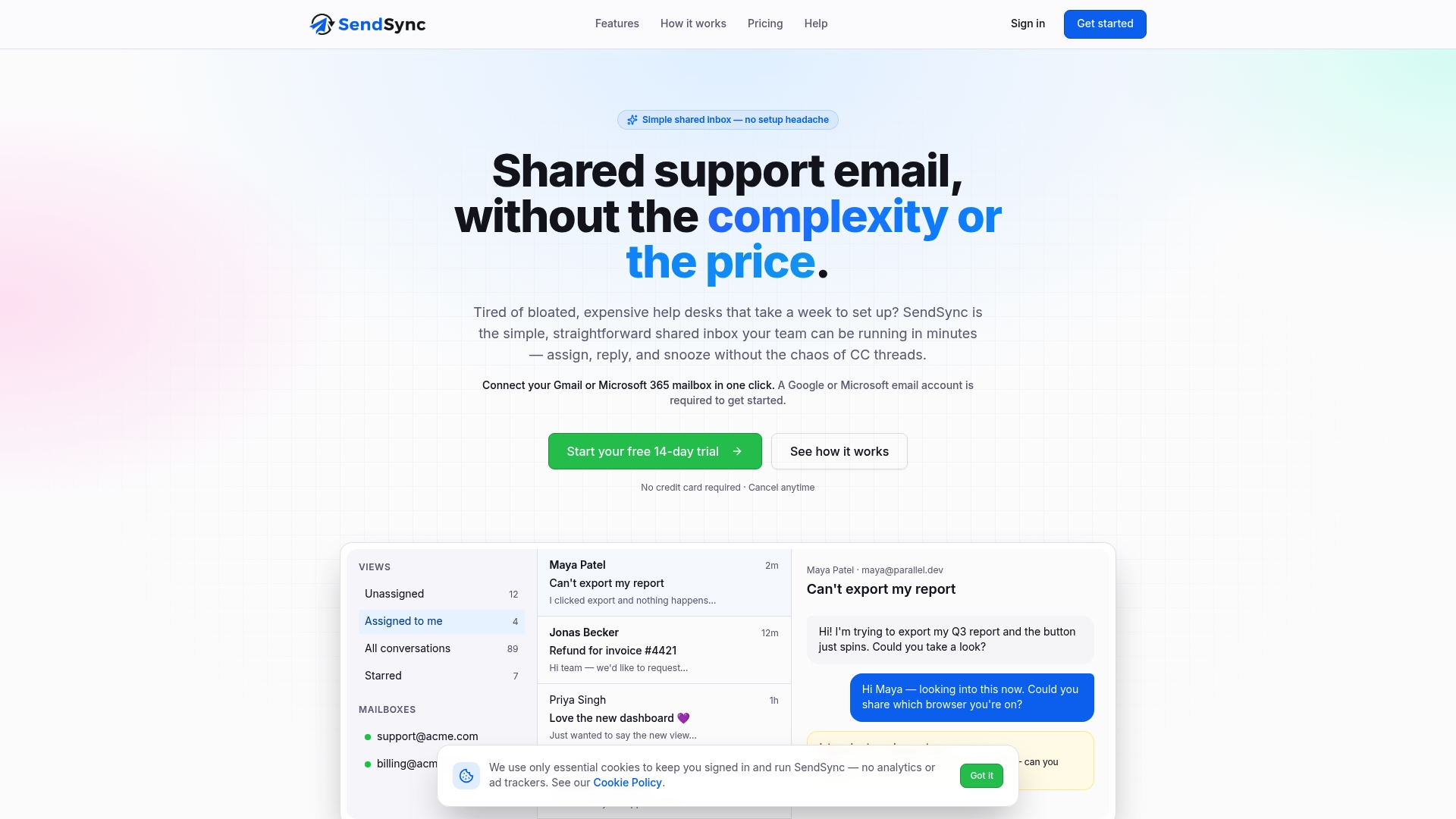
From there, assignment, internal notes, and shared views make sure every email sent during your posted hours reaches someone accountable for it, while unlimited users on every plan mean adding a teammate to cover a shift never adds a per-seat cost. Pricing details and plan tiers are available on the vendor’s website. If your current setup makes publishing clear hours feel harder than it should, see SendSync’s plans and get a shared inbox running before your next support email arrives.
FAQ
How do I email customer support?
Look for the official support email or contact form on the company’s help center, contact page, or app dashboard, since these list the address and current business hours. Include your account details and a specific description of the issue so the first reply can actually resolve it rather than ask for more information.
How do I write an email to customer support?
Start with a specific subject line naming the problem, then state what you expected versus what happened, include your account or order ID, and attach any relevant screenshots. Keeping the message to a few clear sentences, as shown in the template above, helps support teams triage and respond faster.
How do I write an email to ask for support?
State the problem plainly in the first sentence, provide identifying details like an account number or order ID, and describe any steps you already tried. Avoid vague language like “it’s not working” since a specific description shortens the back-and-forth needed to resolve it.
How do I write an email to technical support?
Technical support emails benefit from the same structure as general support requests, with the addition of reproduction steps, error messages, and system details like browser or app version. Attaching logs or screenshots as separate files, rather than pasting them into the body, makes the issue easier for an agent to diagnose quickly.
What should I do if I email support outside business hours?
Most vendors recommend submitting a ticket through their support form rather than waiting, since tickets are tracked and queued even when no one is actively monitoring email overnight, a pattern documented on When I Work’s contact page. You can expect a reply once the next business day or shift begins, often within the vendor’s stated first-reply window.
Sources
- Fastmail customer support policies – Fastmail
- Support Availability – Firstup
- Language support and working hours | Cloud Customer Care | Google Cloud Documentation
- Contacting Us — When I Work Help Center
- How to contact OpenSesame Support – OpenSesame Support