
"Help Scout vs. Zendesk" Is the Wrong Question
Comparing Help Scout, Zendesk, and Freshdesk? You're asking the wrong question. Here's how per-seat pricing quietly taxes every new hire you make.
I spent a week last month doing something I don't recommend to anyone: pricing out help desk software for a 12-person support team. Not for SendSync, for a friend who runs a DTC brand and wanted a sanity check before he signed a contract.
By the end of it, I had nine browser tabs, three spreadsheets, and a genuine headache. And the thing that stuck with me wasn't that one tool was better than another. It's that the entire way this category prices itself is designed to make you stop asking the question you should actually be asking.
Everybody googles some version of "Help Scout vs. Zendesk" or "Freshdesk vs. Zendesk." I get why. You've got two logos, two feature grids, and you want someone to tell you which one wins. But that framing quietly accepts a premise that costs you thousands of dollars a year, and almost nobody says it out loud.
The premise is this: that you should pay per person.
The sticker price is a hook, not the price
Let me show you what I mean with real 2026 numbers, because the gap between the advertised price and the real price is the whole story.
Help Scout's Standard plan advertises at $25 per user per month. Sounds fine. But that "per user" is doing a lot of heavy lifting. For a 10-agent team, you're at $250/month before you've done anything. Want a second knowledge base? That's an extra Docs site. Need more shared inboxes than your tier allows? $10 each. Want the AI to actually answer customer questions? That's $0.75 per resolution, billed separately, on top of every seat you're already paying for. One independent breakdown ran the math on a 10-agent Plus team and landed at roughly 94% over the advertised base price once the add-ons were stacked on.
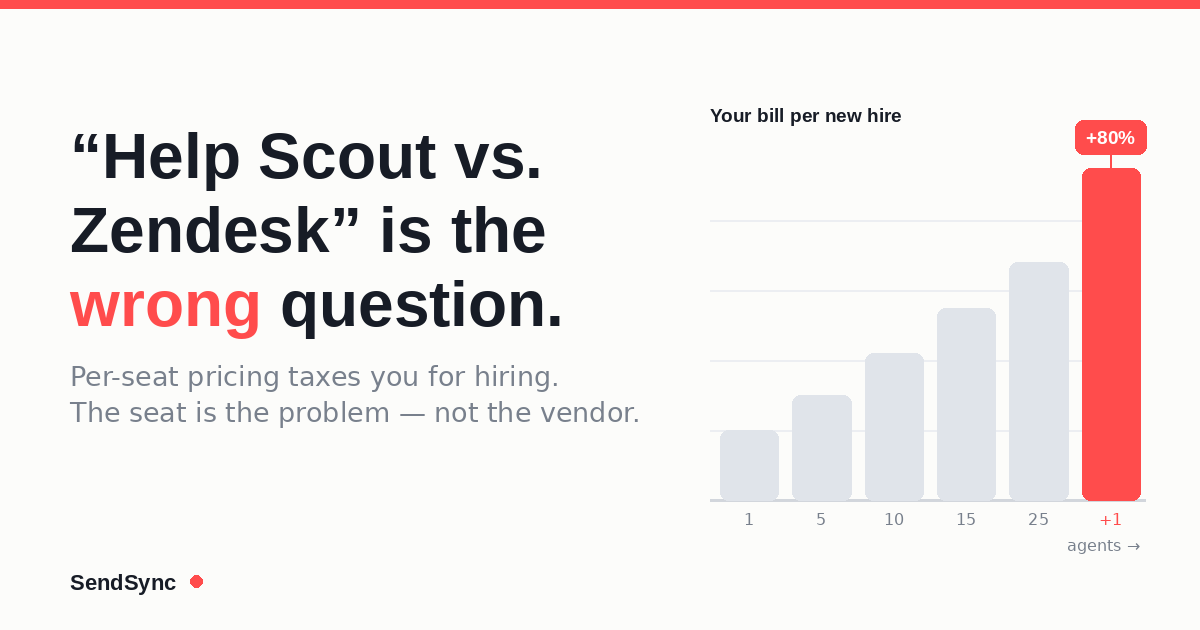
And here's the part that should make you angry. On Help Scout, adding your 26th agent forces you off Standard and onto Plus, and your per-seat cost jumps from $25 to $45. That's an 80% increase per seat, triggered not by using more software, but by hiring one more human. A 25-person team pays $625/month. Add one person, and you're at $1,170. You didn't get any new value. You just crossed a line someone drew on a pricing page to catch you.
Zendesk plays the same game with bigger numbers. Entry is around $19/agent on the bare Support tier, but the plan most people actually need, Suite, starts at $55/agent/month, runs $115 at Professional, and $169 at Enterprise. The AI that everyone's selling you on in 2026? That's an Advanced AI add-on at roughly $50/agent/month, applied across every seat, whether that agent touches AI or not. Verified contract data pegs the median Zendesk buyer at nearly $48,000 a year.
Freshdesk is the cheap one in every comparison, $15/agent on Growth, a real free tier for tiny teams, and it's genuinely a better deal. But notice what "better deal" means here: it means the same per-seat model, just with smaller numbers and the AI copilot ($29/agent) and advanced modules still bolted on separately.
Why this model exists (and who it punishes)
Per-seat pricing made sense in 1999. Software was a thing you installed on a desktop, and a "seat" was a real, scarce resource. Charging per person was a rough proxy for how much value you got.
That logic is dead. The marginal cost to these companies of adding your 11th agent to a cloud app is essentially zero. The price goes up anyway, because per-seat pricing isn't about cost, it's about capturing more of your budget as you grow. It's a tax on your success. The better your company does, the more people you hire, and the more you pay for software whose actual cost to operate doesn't move an inch.
It punishes exactly the wrong behavior, too. Per-seat pricing makes you ration access. You think twice before giving a part-time weekend person a login. You keep your ops manager out of the tool because "she only needs to peek in occasionally." You end up with fewer people able to help your customers, because the pricing model made it expensive to let them. That's insane. The whole point of a shared inbox is that the whole team can pitch in.
The question to actually ask
So no, the question isn't "Help Scout vs. Zendesk." Both of those answers lead to the same trap, just with different wallpaper.
The question is: why am I paying per person to run my own customer conversations?
When you look at it that way, the comparison grid falls apart. You stop asking which vendor has a slightly nicer reporting tab and start asking why a shared inbox, a tool whose entire premise is that your team works together, charges you more every time your team gets bigger. You start noticing that the "AI" everyone's racing to upsell is priced as a separate meter precisely so it never shows up in the number you compare on the landing page.
That's the conversation we're trying to start with SendSync. Not "we're a cheaper Help Scout." Cheaper-per-seat is still per-seat. We think the seat is the problem.
What we're building toward
I'll be honest that we're early, and I'd rather tell you what we believe than oversell what's shipped. SendSync is a shared inbox built on a simple bet: your team should be able to grow without your software bill growing in lockstep, and the basics, routing, collaboration, the features that make a shared inbox a shared inbox, shouldn't be tier-gated to push you into an upgrade.
If you've ever opened your help desk invoice, seen a number you didn't expect, and traced it back to "oh, we hired two people," this is for you.
Stop comparing the wallpaper. Start asking why you're renting the room by the head.
We're building SendSync in the open and we want the feedback. If per-seat pricing has burned you, tell us the story, the worst invoice surprise we hear gets written up (anonymously, if you want).